

ETHICS

Shifting the Balance of Power
from the Interpreter to the Deaf Consumer
By Joshua Pennise
The Registry of Interpreters for the Deaf (RID) and the National Association of the Deaf (NAD) recently announced new rules for how the Ethical Practices System will handle reported violations of the NAD-RID Code of Professional Conduct. These changes are the most substantive introduced in my 24 years of membership in the association and swing the balance of power away from the interpreter and toward the Deaf community. With such a large transfer of power, members need to understand and think carefully about the profession’s past and future.
A Brief History
According to Lou Fant’s seminal Silver Threads, the notion of an ethical code was on the mind of our association’s founders in 1964. It was during that celebrated June meeting at Ball State University in Indiana that our present code got its start. In the official minutes of that meeting, right after deciding the purpose of RID (to increase the number and quality of interpreters), it was decided:
“A code of ethics is to be developed by the organization.”
It wasn’t until the second meeting of RID (then called the National Registry of Professional Interpreters and Translators for the Deaf) in 1965 that the board assigned a committee to work out what the new code would be. The chair, and sole member, was Dr. Lottie Riekehof.
The code of ethics evolved further over the years and eventually got rid of tenets such as requiring “emotional maturity” and being “willing to provide services in situations where funds are not available.”
Eventually, RID joined with its long-time partner, the NAD, to set forth the current iteration, the NAD-RID Code of Professional Conduct (CPC), that sought to better reflect behaviors expected by both colleagues and Deaf consumers.
Ethical practice system changes
The judicial mechanism for holding interpreters accountable to the code of professional conduct (CPC) in its current form was established in 2006 (T. Bateson, personal communications, April 8, 2023). The system, which persisted until 2023, encouraged arbitration and resolution of conflicts, not necessarily to offer discipline or punishment for gross violations.
On April 19, the RID announced a new EPS handbook that included many fundamental changes to the system, including:
- Anyone can file a grievance: In the old system, only a person directly impacted by the behavior could file. This usually meant only the Deaf consumer could grieve. With the significant imbalance of power that exists between the two parties, this inadvertently meant that harmful behavior often went without consequence.
- Behavior off the clock counts: If an interpreter scammed the local association of the Deaf out of money, previously, this wouldn’t count as a grievable offense as it was outside of an interpreting event. Now, all actions related to the profession are fair game.
- Criminal convictions will be reviewed: Presently, unless someone was convicted for doing something while interpreting, criminal activity bore no impact on certification status. Now, RID has a review process to determine if the actions impact the interpreter’s ability to be trusted.
- Members must report violations: Members are now required to report unethical behavior by other members or risk sanctioning themselves. This may be the biggest shift for the profession, and it will require a lot of testing and monitoring to see how it applies in practice, given the somewhat subjective notion of ethical behavior.
- Discrimination is a violation: RID is taking a stand against behaviors that are racist, sexist, homophobic, transphobic, audist, and ableist. It’s worth noting that an interpreter can still turn down assignments based on lack of fit, meaning no one will be grieved against for not accepting an assignment incompatible with their personal beliefs.
- Time limits are abolished. Complaints previously had to be filed very quickly. The new handbook does not indicate a time limit, meaning individuals can have time to process offending events and decide whether or not to grieve before the clock ran out on them.
Perhaps most fundamentally, the system changes from a mediation and arbitration framework to one that is more judicial in nature. Instead of bringing disputing parties to the table to work things out, the EPS will now act to hold individuals accountable for their actions.
Why changes are needed
The data published by RID on their EPS website leads to some startling conclusions. Only 23 individuals are reported as having been sanctioned in the last 18 years. That’s .13 per 1,000 (based on about 10,000 certified members), compared to an average of 3.76 per 1,000 for doctors in the United States, as an example. That means that your doctor is 28 times more likely to be sanctioned than your interpreter.
The comparison holds with another trust-based profession: certified financial analysts (CFAs). American CFA charter holders (similar to RID’s certified members) suffered revocation of their charter at an average rate of 0.2 per 1,000 over the last five years. Interpreters lost their certifications just three times since 2005, or a rate of 0.016 per 1,000 certified members. That means the CFA giving you investment advice is 12 times more likely to face the most severe sanctions than an interpreter.
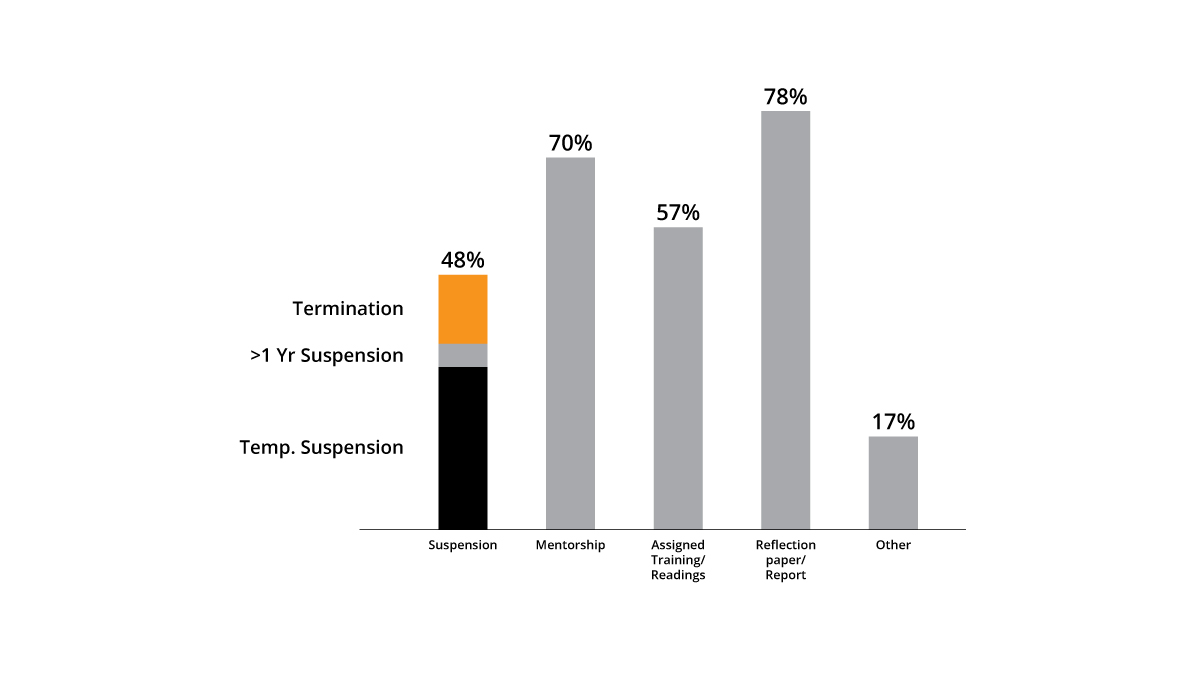
By far, the most frequent sanction for interpreters was to write an essay (78%), followed by mentorship (70%), and training or reading (57%)
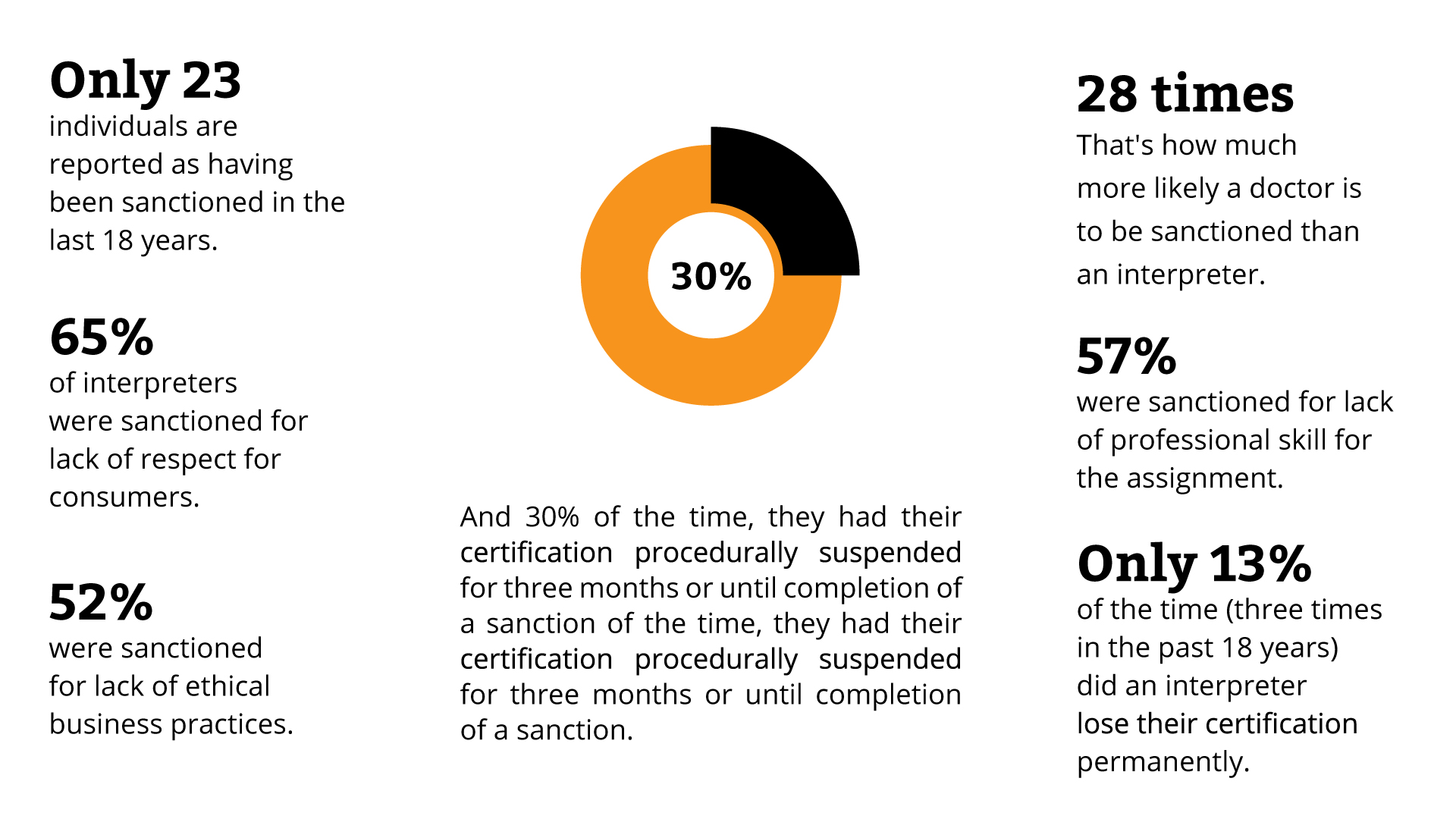
What’s also troubling is the lack of severity of consequence for an RID-sanctioned interpreter. Only 13% of the time (three times in the past 18 years) did an interpreter lose their certification permanently. And 30% of the time, they had their certification procedurally suspended for three months or until completion of a sanction, such as writing an essay or taking an eight-hour workshop, whichever came later.
These mild sanctions were true regardless of how many of the tenets of the Code of Professional Conduct were violated. On average, interpreters violated 3.5 tenets per case. In all but one case, the interpreter was sanctioned for the broad “professional conduct” tenet. A majority of cases also sanctioned interpreters for lack of respect for consumers (65%), lack of professional skill for the assignment (57%), and lack of ethical business practices (52%).
In one case, an interpreter was found guilty of violating six of the seven tenets but still did not receive a permanent revocation. The most common outcome amongst all cases was some combination of required mentorship, training or reading, and writing a reflective essay.
This points to an inescapable conclusion that the system was broken. Requirements for speedy filing, restrictions on who could complain, and lack of meaningful relief all likely caused legitimate concerns to go unheard, further marginalizing our Deaf communities in the process. The recent reforms adopted by RID will hopefully start to build faith in the system, increase accountability within the profession, and better safeguard the consumers we serve.
Is it enough?
Since speaking publicly about the EPS changes, I have heard from colleagues who have lamented that these changes don’t matter since, in many states, an interpreter can just resign their membership in RID and continue working. Others have pointed to the lack of meaningful action in the past as a reason to shrug off these changes. “Why bother?” is a common refrain.
It is true that RID does not (and should not) have sole authority over who can and cannot practice in the interpreting field. There are ways around RID’s authority in most places, especially since there are competing credentialing systems and entities that hire without any credentials anyway.
However, there are real impacts of official sanctions ranging from social to monetary. Lack of certification and revocation action can restrict employment options and reduce pay with entities that have a graduated scale based on credentials. More importantly, the EPS system, at its core, is about professional accountability and the integrity of the certification system. We must hold ourselves accountable to each other and to our consumers; we must ensure that when someone boasts RID certification, we as a community have at least ensured that the person is not actively harming people in their practice.
The system has long had an imbalance of power that strongly favored the interpreter and left the Deaf consumer with little meaningful recourse. Failure to address this imbalance, to essentially do nothing, is an action for which we will have to answer as well. As the 17th-century playwright Molière put it, “It is not only what we do, but also what we do not do, for which we are accountable.”
Congratulations and gratitude are due to the Ethics Committee, the RID Board, and the headquarters staff, who all had the courage to take decisive action.
Joshua Pennise has been certified for 23 years and has spent 22 of those years in the affiliate chapter board, national board, and national committee leadership. He is chair of the RID Audit Committee and on the board of the Association of Language Companies. Find him on LinkedIn.
RELATED ARTICLES
WEEKLY DIGEST
Subscribe to stay updated between magazine issues.


