

REVIEW

12 Translation Management Systems
A year in review
By Jourik Ciesielski
The translation management systems (TMS) market stands out prominently within the language services industry as one of the most bespoke technology spaces. With its rich history, TMS ranks among the oldest language technologies, witnessing the emergence of STAR Transit and Trados in the 1980s and the systematic transformation of CAT tools into extensive translation management platforms that allow both buy-side and supply-side localization stakeholders to manage the translation process of multiple content streams effectively. In 2020, the acquisition of SDL by RWS set the tone for a strong M&A and investment wave that would last until mid-2021 and affect many companies, including Across, Lingotek, Memsource, and XTM. Today, TMS remains the cornerstone of translation technology, serving as the glue that holds together various components such as translation memory, terminology, machine translation, quality assurance, and different project management assets.
While the appetite for acquisitions and venture capital has cooled, the market continues to experience substantial growth, resulting in an estimated market size of $0.3 billion. Even though the competitive landscape is dominated by the industry’s super agencies — TransPerfect (GlobalLink) and RWS (the Trados ecosystem) — it is more diversified than ever. Established players offering generic TMS like memoQ, Phrase, and XTM Cloud are steadily growing and increasing their footprint. TMS focused on continuous localization of software strings are gaining market share, confirming that developers have become prominent translation buyers. An array of new niche products has emerged, including Weglot, a user-friendly website localization solution for marketeers and website owners, and Cleverso by Tarjama, catering to the MENA region. Finally, there are TMS with LSP grassroots like Bureau Works and open-source systems such as translate5.
The race for generative AI adoption
TMS companies rushed to add LLM-based features to their product portfolio. Crowdin, Lokalise, and Trados integrated AI assistants; Bureau Works, memoQ, and Smartling announced LLM-driven machine translation engines, whereas LILT released a self-service model-building and training studio. One of the most observable trends is that pure translation technology providers such as Smartcat, DeepL, Writer (formerly Qordoba), and LILT have embarked on introducing AI copywriting tools, a strong endorsement of leveraging LLMs for multilingual content creation.
Despite the plethora of initiatives, we haven’t determined a significant business impact yet. Furthermore, the top TMS players are cautious as almost every AI-powered feature released across the different players is based on OpenAI, which is relatively easy to replicate and increases the risk of rapid obsolescence. For now, buy-side localization stakeholders are teased with demos, trials, and webinars. For tomorrow, the industry expects integrations with different models and impactful use cases that positively affect how translation memories, terminology, quality assurance, and automated translation are leveraged.
The revival of the translation memory
The big neural machine translation push of 2017 enticed MT advocates to primarily look at translation memories as data tanks used to train NMT models. Despite the systematic adoption of machine translation across many corporate localization departments and LSPs, MT has not succeeded in displacing translation memories from their position as the primary linguistic resource in translation workflows. The advent of LLMs could imply that translation memories are once again in danger of being relegated to the background.
Surprisingly or not, we’re observing the opposite effect. The rise of GenAI has spurred general interest in using LLMs as the broom to clean old translation memories. While translation memories are often exposed to linguistic pollution, especially when used over a long period of time, LLMs can identify obsolete and low-quality units following a set of company-specific, domain-specific, or product-specific instructions, eliminating the need to spend hours of manual work on tedious cleanup operations. Another use case where TMs and LLMs are mashed is fuzzy match augmentation — a noteworthy one since fuzzy matches are essentially translations with a fixed error rate.
Paradoxically, no matter the use case, the ultimate goal is to continue using translation memories as the main translation helper in localization projects. The greater the impact of AI, the stronger our interest in traditional linguistic resources becomes.
Orchestration: the new buzzword
The TMS connector, an important revenue-driving asset in the product portfolio of many TMS providers, is under siege as it is criticized for its limited point-to-point use cases and lack of customization. The new buzzword in the realm of automation is orchestration, whereas the focus is shifting towards end-to-end integrations of the different applications in the localization tech stack. Third-party middleware providers like BeLazy and Blackbird.io have recognized this need and provided refreshing alternatives to the bulkier products in TMS connector pools. Phrase follows suit with the launch of Phrase Orchestrator.
While our industry has seen many attempts to solve the connectivity problem for the non-technical localization professional, it remains a very hard nut to crack. With the new year and the increased competition in the connector space on the horizon, the challenge can be addressed with a fresh perspective.
Data-driven localization
Given the current economic climate, data-driven localization is becoming imperative to measure ROI, monitor KPIs, and make informed strategy decisions. Phrase and memoQ have released customized reporting features with Analytics and Business Analytics, respectively, thereby reviving earlier initiatives observed in other TMS such as GlobalLink and Lingotek. We anticipate that other TMS providers will follow the trend and announce similar reporting functionalities.
At the same time, 2023 has been the year of the breakthrough of machine translation quality estimation (MTQE). MTQE is intended to predict how much post-editing a specific machine translation requires, thus identifying potential risks associated with the translation. Apart from being cost-effective and fast, it is also scalable since the data used to train MT models can be repurposed to train MTQE models. It’s a great opportunity for localization managers with lots of MT-ready content, such as ecommerce product owners. Leading providers include Unbabel, TAUS, and ModelFront. In the TMS space, Smartling pioneered forward-looking quality scores in 2017 through quality confidence scores (QCS), but had to pass the torch when Phrase’s proprietary MTQE mechanism went live. memoQ facilitates MTQE by integrating ModelFront and TAUS.
Failure to adapt to multimedia localization needs
Many TMS providers, from memoQ and Trados to Lingotek, Smartcat, and XTM, ventured into subtitling by enabling live video previews in their workbenches. Meanwhile, the interest in AI dubbing is increasing at an incredible pace for several obvious reasons: It’s fast, customizable, relatively inexpensive, baseline quality is excellent, and there are good use cases for it. Think about elearning. We saw a similar discipline, machine translation, gaining a critical mass for the exact same reasons.
While we can no longer count the number of tools with dub and .ai in the name (deepdub.ai, dubdub.ai, dubformer.ai, dubverse.ai — the list goes on), the top TMS players are seemingly losing their grip on audiovisual localization in favor of specialized localization suites and AI-powered dubbing services. Given the demand for synthetic voices is skyrocketing, the first TMS provider to move into text-to-speech (and, optionally, speech-to-text) will have a considerable head start.
2024 outlook
The year 2024 promises key GenAI and LLM breakthroughs in the TMS market. It is undeniable that the introduction of LLMs allows the language services industry to rethink and perhaps redesign some of its most traditional disciplines. Think about QA; running QA checks is a time-consuming practice that generates many more false positives than real errors, while the underlying rule-based algorithm cannot learn from ignored false positives or transfer them from one project to another. It’s a perfect fit for LLMs.
Nonetheless, 12 months after the big introduction of ChatGPT, many localization stakeholders are still in the exploratory phase. It’s not unlikely that many people will ever get past this phase or even operate an LLM outside ChatGPT. Ultimately, the localization industry is a community of language professionals, and translation is its core activity. Research and development are reserved for tech companies and academics.
With the market’s sustained growth and diversification, TMS is firmly established in the heart of language technology and a significant part of the industry. Buyers as well as service providers will wait for the TMS companies to facilitate access to AI-driven applications, integrate models from providers beyond OpenAI, and develop use cases. If all the weight is put on the shoulders of the TMS market, GenAI and LLMs will become nothing but new tools for existing processes, like translation and localization.
Text by Jourik Cielsielski is the cofounder of C-Jay International, chief technology officer at Yamagata Europe, and a Nimdzi consultant and researcher.
Data review by Yulia Akhulkova is a software engineer and has worked in professional localization since 2010. For the last five years, she works as a technology researcher at Nimdzi Insights.
ACROSS LANGUAGE SERVER
YEAR FOUNDED: 2005
HISTORY:
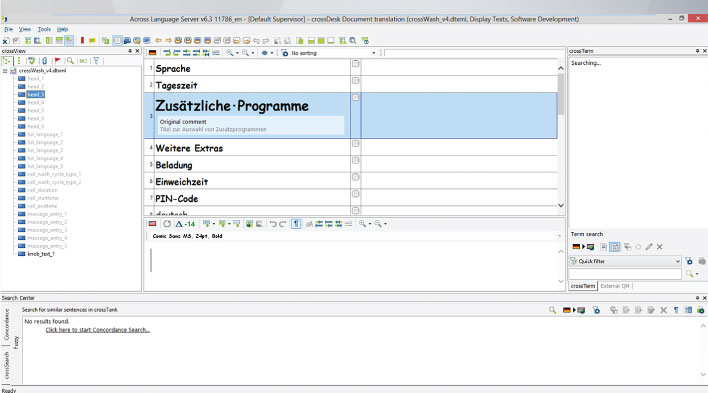
Across Systems GmbH was founded quite early in 2005 as a spin-off from Nero. At the time, the localization tools choice was limited to Trados and Transit. Across has always grown organically and without outside funding. It developed initially in the German-speaking world, selling to security-conscious German manufacturers, and eventually started expansion into the United States. At the beginning of 2018, around 80 people worked at Across Systems, and revenue estimates exceeded €5 million, making it one of the larger language technology companies.
SUPPORTED FILE FORMATS: 47/86
PRICING:
LANGUAGE SERVER
Custom
LANGUAGE SERVER LIGHT
Custom
BEST SUITED FOR:
-
Enterprises needing advanced localization workflows and reporting in a server scenario
-
Technical writing teams using document CMS
-
LSPs with security and automation requirements
DEPLOYMENT MODEL(S):
-
Private Cloud
-
Public Cloud
-
Server/On-premise
API:
REST
SOAP
Click Here
CLEVER SO
CLEVER SO
YEAR FOUNDED:2019
HISTORY:
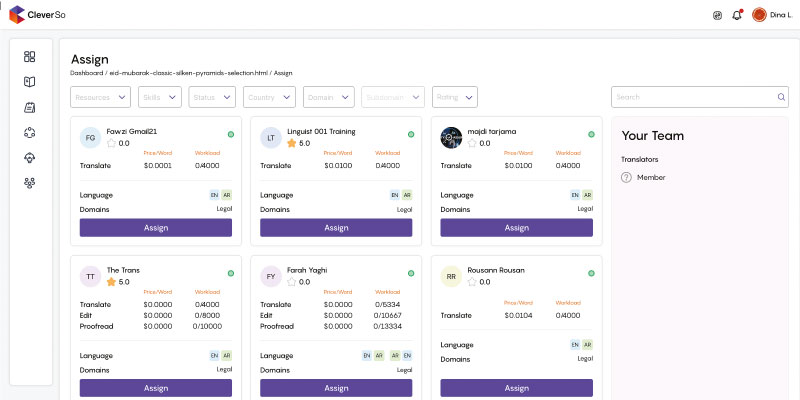
CleverSo was launched in 2019 by Tarjama, an AI- enabled LSP in the MENA region. Tarjama is a female-led business founded in 2008 in Jordan as a translation provider and transformed into a language technology company. Tarjama specializes in Arabic language technology and a proprietary AI-powered language service platform.
The company boasts over 180 employees and maintains offices in the UAE, Jordan, Lebanon, Saudi Arabia, and even France. Tarjama acquired the MENA region´s biggest subtitling provider, Screens, in 2022.
SUPPORTED FILE FORMATS: 38/86
PRICING:
ESSENTIAL
From $125/month
ELEVATE
From $1,500/month
ELITE
From $15,000/month
BEST SUITED FOR:
-
Large ecommerce projects with clever batch distribution, batch progress and auto-mated tracking of repetition
-
Arabic-centric projects
DEPLOYMENT MODEL(S):
-
Private Cloud
-
Public Cloud
-
Server/On-premise
API:
REST
Click Here
CROWDIN
YEAR FOUNDED: 2008
HISTORY:
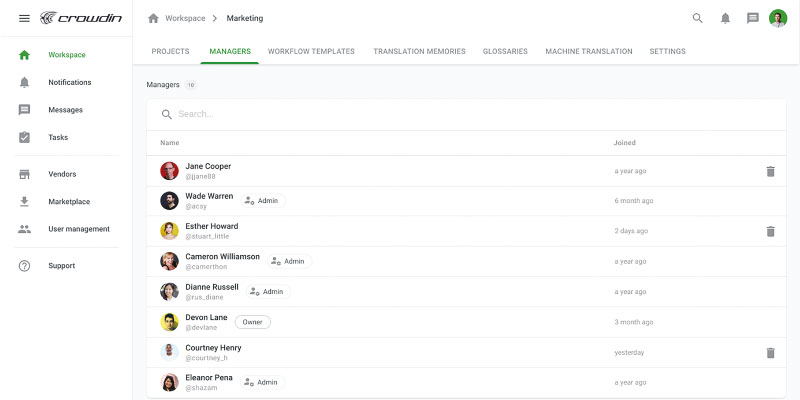
Crowdin was launched in 2008 and now is a company with 1.6 million registered users and 100,000 localization projects all over the world. Its software helps companies of any shape and size grow by reaching people who speak different languages. Crowdin Enterprise, a localization management platform for teams and businesses, is a web app, so you can access it from your preferred device with internet access.
SUPPORTED FILE FORMATS: 26
PRICING:
PRO
From $0/month
TEAM
From $150/month
TEAM +
From $450/month
BUSINESS
Custom
All plans come with a free 30-day trial
BEST SUITED FOR:
-
Companies and organizations that frequently improve their multilingual products
-
Localization managers, developers, and other teams working with content can manage and automate the localization process
DEPLOYMENT MODEL(S):
-
Private Cloud
API:
REST
Click Here
GLOBAL LINK

YEAR FOUNDED: 1999
HISTORY:
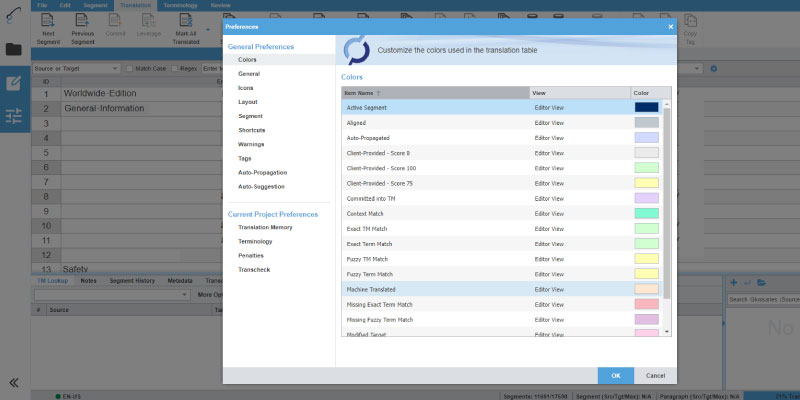
Initially developed as a support tool at eTranslate in 1999, GlobalLink saw large investment after the parent company was acquired by TransPerfect in 2003. The editor TranslatorStudio is an adaptation of WordFast under a special non-exclusive deal with WordFast’s creator Yves Champollion. More than 300 people work in GlobalLink, about 200 in the development team in Serbia and 100 more in the US. Support is 24/7, and it is based in Singapore, Barcelona, India, and Colorado in the US.
SUPPORTED FILE FORMATS: 19/86
PRICING:
CUSTOM PRICING ONLY
Typical models are monthly SaaS for smaller customers and enterprise clients can buy a perpetual license with a support contract.
BEST SUITED FOR:
-
Enterprise localization teams with volumes in millions of words and advanced multi-step workflows
DEPLOYMENT MODEL(S):
-
Private Cloud
-
Public Cloud
-
Server/On-premise
API:
REST
Click Here
LOKALISE
YEAR FOUNDED: 2016
HISTORY:
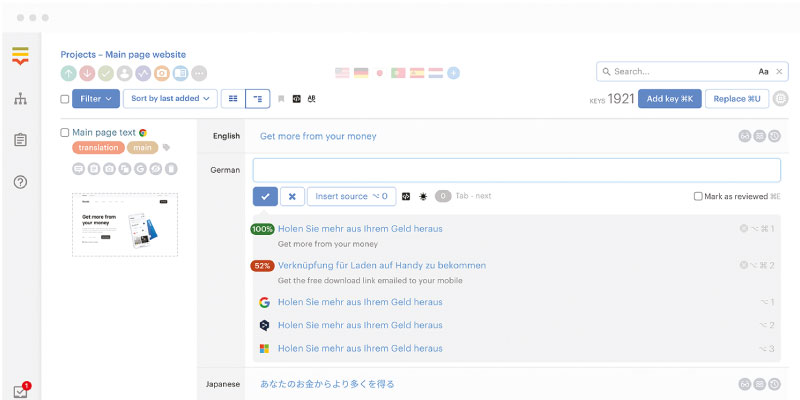
Founded in 2017 in Riga, Latvia by tech entrepreneurs Petr Antropov and Nick Ustinov, the product-led SaaS business since attracted over 2,000 customers in 80 countries, including Notion, Lemonade, Bayer, Revolut, HP, Tidal, Delivery Hero, BASF, Yelp, Virgin Mobile, Johnson & Johnson, and KPMG. Bootstrapped since its launch, the team decided to raise external capital to hire top SaaS talent globally in order to accelerate its growth as the company goes fully remote. The team of 100+ members includes 15 nationalities from three continents.
SUPPORTED FILE FORMATS: 11/86
PRICING:
BASIC
From $120/month
ESSENTIAL
$230/month
PRO
$825/month
ENTERPRICE
Custom
BEST SUITED FOR:
-
Mobile app developers
-
Growth-oriented companies with tech-savvy teams
DEPLOYMENT MODEL(S):
-
Public Cloud
API:
REST
Click Here
MEMOQ
YEAR FOUNDED: 2004
HISTORY:
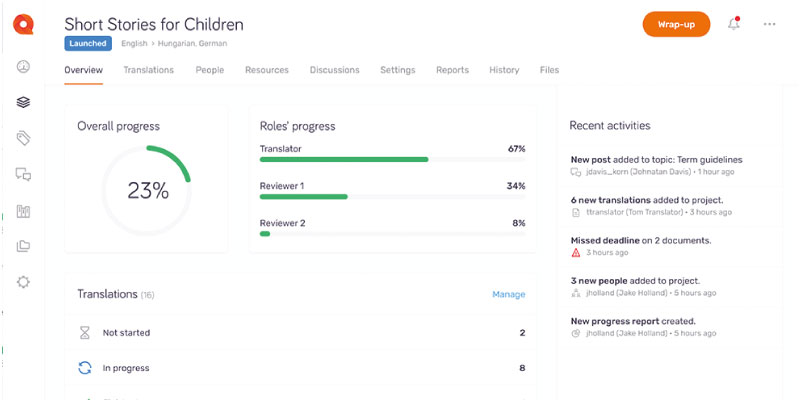
It all started in Hungary in 2004, when three passionate language technologists worked on machine translation and spellchecking-related projects at a publishing company that issued Microsoft Press Books. They imagined a new translation technology environment that places collaboration in the center of the scope. Since then, memoQ has grown to become one of the world’s leading translation management systems and has added hundreds of features. Today, with more than 100 employees, the team is working hard to continuously improve the software. In 2019, memoQ opened an office in Toronto, Canada, and launched the Gaming Unit to dedicate expert resources for its growing clientele in games localization.
SUPPORTED FILE FORMATS: 33/86
PRICING:
TMS CLOUD
From €185/ month
TMS CLOUD PLUS
From €415/month
TMS PRIVATE CLOUD
From €505/month
BEST SUITED FOR:
-
Organizations interested in high translator satisfaction and productivity
-
LSPs that receive localization packages from multiple buyers in different formats and want to process them in a single interoperable system
-
Buyers with proprietary systems that require custom integrations
DEPLOYMENT MODEL(S)
-
Private Cloud
-
Public Cloud
-
Server/On-premise
API:
REST
SOAP
Click Here
PHRASE
YEAR FOUNDED: 2012
HISTORY:
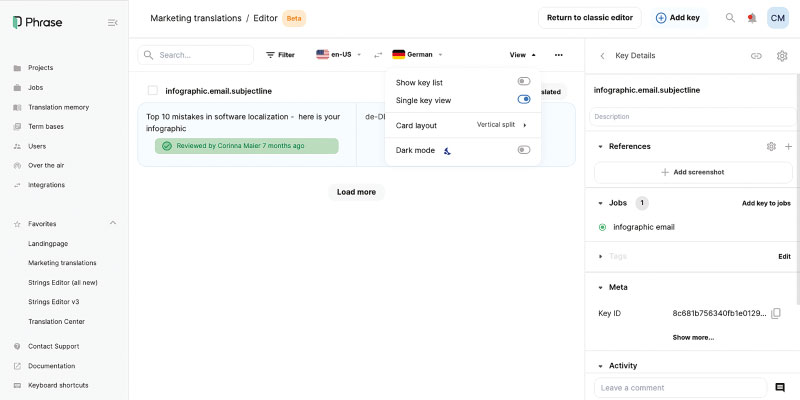
Memsource was founded in Prague in 2010 and Phrase was founded in Hamburg in 2012, with the two joining forces in 2021. In 2022, the brands unified as the Phrase Localization Suite. With 50+ integrations, 50+ supported file formats, and 30+ supported machine translation engines, it covers a broad spectrum of supported translation workflows in the industry.
SUPPORTED FILE FORMATS: 48/86
PRICING:
TEAM START
$29/Project Manager/month
TEAM
$209/Project Manager/month
ULTIMATE
$369/Project Manager/month
ENTERPRISE
Custom
BEST SUITED FOR:
-
Financial companies
-
Legal localization
-
Global marketing Public Cloud
DEPLOYMENT MODEL(S)
-
Public Cloud
-
Server/On-premise
API:
REST
Click Here
SMARTCAT
YEAR FOUNDED: 2012
HISTORY:
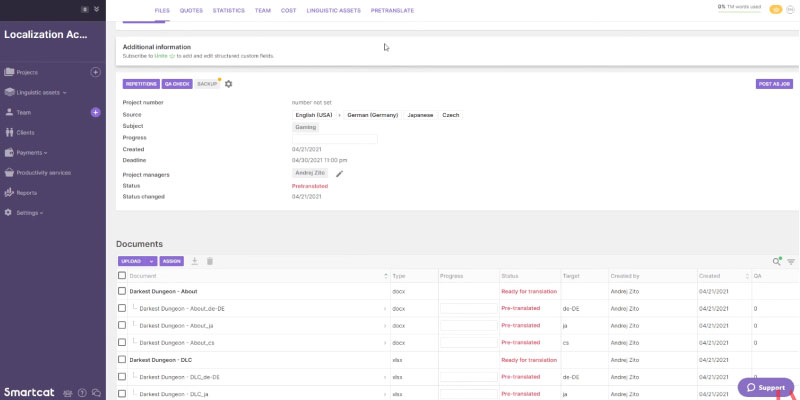
Smartcat was developed in 2012–15 as a CAT tool for in-house use by ABBYY Language Solutions. The parent company became a resident of the Skolkovo accelerator in 2011. The SaaS service was launched in 2014 in beta. In 2016, Smartcat spun out of ABBYY LS to become a separate company and attracted $2.8 million in investments. In 2018, Smartcat raised 7 million in Series A funding. As of May 2020, the platform has more than 300,000 freelance and corporate suppliers on its marketplace and provides an app store, allowing users to integrate their Smartcat account with third-party solutions.
SUPPORTED FILE FORMATS: 26/86
PRICING:
FOREVER FREE
$0. Everything you’ll find in other platforms, plus some things you don’t
STARTER
From $249/month
ENTERPRISE (for business)
Custom
SUMMIT (for LSPs)
Custom
BEST SUITED FOR:
-
LSPs
-
Translation customers looking for linguists/LSPs to streamline processes
-
Freelance and in-house linguists, as well as related professionals
DEPLOYMENT MODEL(S):
-
Private Cloud
-
Public Cloud
API:
REST
Click Here
SMARTLING
YEAR FOUNDED: 2009
HISTORY:
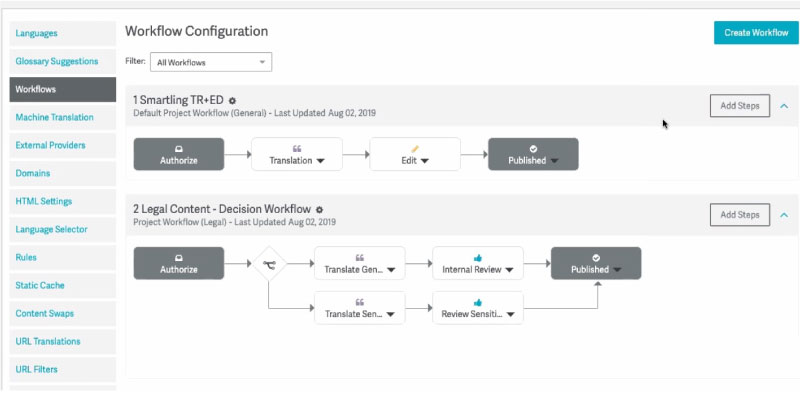
Initiated as a technology-only company, Smartling is both a BMS and a translation environment. Among other features, it includes APIs, content connectors, web proxy, and content distribution network. They have recently redesigned translation management platform to include features such as Dynamic Workflows, Smartling Draft, and an automatic MT engine selection based on the source and target languages. Smartling also offers reporting on team productivity and a widget for WordPress that aims to simplify website localization.
SUPPORTED FILE FORMATS: 25/86
PRICING:
CUSTOM
PRICING
ONLY
BEST SUITED FOR
-
Enterprise and midsize companies with new or established localization programs, seeking automation, quality, and cost-optimization in their translation process.
-
Companies seeking expert translation services, machine translation, and AI-powered translation options.
DEPLOYMENT MODEL(S):
-
Private Cloud
-
Public Cloud
API:
REST
Click Here
TRADOS

YEAR FOUNDED: 2019
HISTORY:
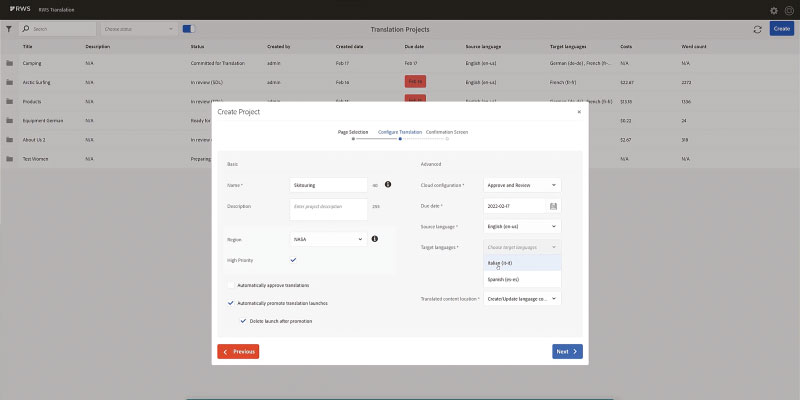
Created in 2019 and unifying RWS’s extensive TMS offerings and industry expertise, Trados Enterprise and Trados Accelerate offer robust cutting-edge translation management capabilities, automating all the parts of the translation supply chain. While Trados Enterprise and Trados Accelerate are RWS’s go-forward TMS options, RWS remain committed to maintaining all our additional translation solutions, which include WorldServer, MultiTrans, Managed Translation, and TMS.
SUPPORTED FILE FORMATS: 26/86
PRICING:
CUSTOM
PRICING
ONLY
BEST SUITED FOR:
-
Translators
-
Project managers
-
Companies looking for a TMS that offers:
-
Cloud-based TMS
-
Agile processes
-
Customizable interfaces
DEPLOYMENT MODEL:
Public Cloud
API:
REST
Click Here
TRANSLATE 5
YEAR FOUNDED: 2012
HISTORY:
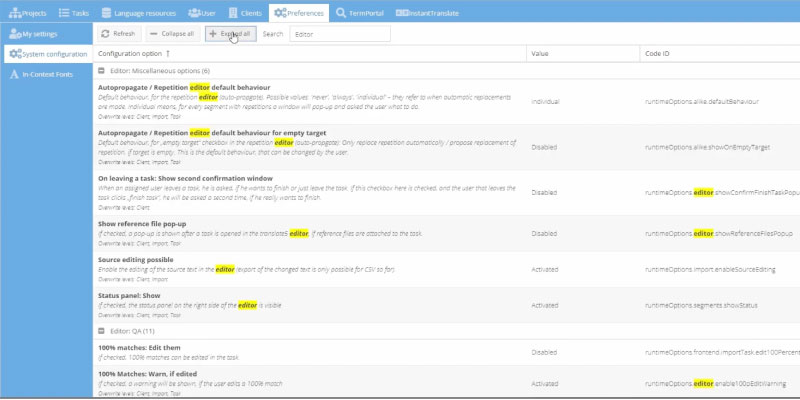
MittagQI has been providing quality informatics and process consultancy in translation software development since 2009. Marc Mittag, the founder and CEO of the company, leads the team of five software developers and one product marketing manager. Since 2021, the translate5 Consortium, comprised of 10 European LSPs, further accelerates translate5’s development with fresh ideas, professional input, and continuous support. The consortium focuses on comprehensive translation solutions.
SUPPORTED FILE FORMATS: 58/86
PRICING:
BASIC
From €100/month for one PM with access to basic features to 10 linguists. Includes free support from the translate5 portal and the one-hour personal support.
VISUAL
From €250/month includes everything in the Basic plan, plus Visual, Track Changes, and InstantTranslate.
BEST SUITED FOR:
-
LSPs
-
Industrial companies
-
State/government institutions
DEPLOYMENT MODEL:
-
Private Cloud
-
Public Cloud
-
Server/On-premise
API:
REST
Click Here
XTM CLOUD
XTM
YEAR FOUNDED: 2002
HISTORY:
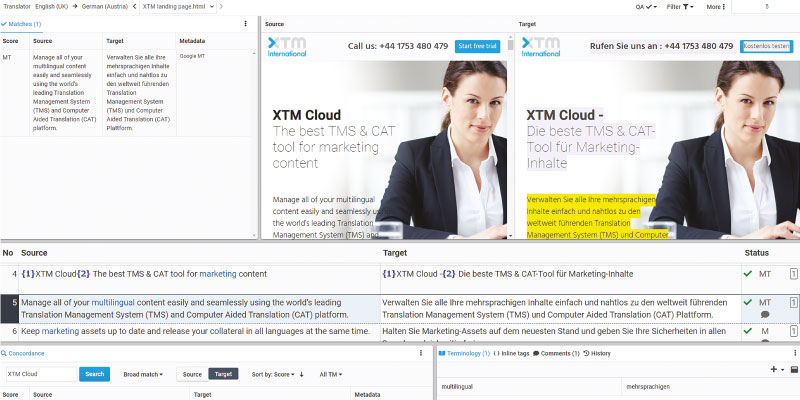
XTM was founded by Bob Willans and Andrzej Zydroń in 2002, and was ahead of the curve as the primary cloud-based TMS. As broadband internet became widespread, XTM grew its customer base considerably. As a vendor-independent technology company, XTM sells both to enterprises and LSPs. The parent company XTM International is headquartered in the UK, with additional offices in Poland, the US, Japan, Ireland, and Argentina. In 2023 Ian Evans became XTM’s new CEO.
SUPPORTED FILE FORMATS: 47/86
PRICING:
XTM CLOUD GROUP
From €17/user/month
GROUP ACCOUNT
From €32/user/month
PRIVATE CLOUD
>50 users: €20,000-50,000/year
BEST SUITED FOR:
-
Corporate translation and localization departments with complex needs in automation and reporting
-
Medium to large LSPs that want to keep their translation activity in a single TMS and CAT tool
DEPLOYMENT MODEL
-
Private Cloud
-
Public Cloud
-
Server/On-premise
API:
REST
SOAP
Click Here
RELATED ARTICLES

Georg Ell Phrase CEO
When it comes to the modern language technology business, keeping your eye on the ball is essential. It's a complicated, ever-changing world, which won't come…
→ Continue ReadingWEEKLY DIGEST
Subscribe to stay updated between magazine issues.


