

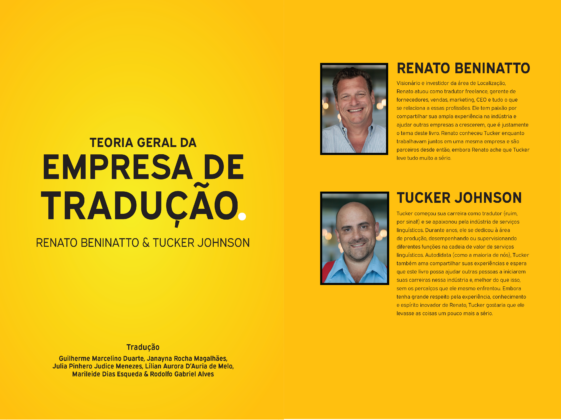
Renato Beninatto

Renato Beninatto co-founded Nimdzi Insights to provide research and analysis to investors, buyers, and suppliers of language services. He has written three books on global business.

Kathy Mok: Impact Beyond the Keystrokes
For Kathy Mok, head of internationalization and localization at OpenAI, the present challenge centers on not only what AI technology can accomplish, but also how humans will shepherd it into a tool that enables genuine communication and trust-building.

Brand Global, Adapt Local
For localization professionals, this book is a useful resource for helping cross-functional teams grasp the nuances that matter. For marketers, it is an invitation to look beyond headquarters-centric playbooks and listen more closely to what the world is saying.

Native Experience Marketing
Mark Saba’s Native Experience Marketing offers a refreshing approach to global marketing — one centered around the idea of authenticity. Saba’s framework provides a roadmap for marketers who are ready to leave behind outdated models and embrace a more inclusive way of communicating with the world.

Renato Beninatto
"MultiLingual's comprehensive coverage of pivotal topics in the language industry has been invaluable and continues to enrich my understanding to this day."


Handling Executive Pressure: A Practical Guide for Localization Professionals
A trend has emerged where executives contemplate bypassing traditional translation processes and cutting budgets, swayed by the potential of Generative AI (GenAI).

Take Your Company Global
I first crossed paths with Nataly Kelly when she was just making a name for herself with her debut book Telephone Interpreting. At the time, I was working at a market research firm exploring the interpretation services industry in the US. Curious to pick Nataly’s brain, I suggested we meet for lunch. She was initially hesitant, but I convinced her by promising we’d dine at the finest organic eatery in Massachusetts: the Life Alive Café.


Lack of interpreters hampers western efforts to train Ukrainian military
Germany and its allies are struggling to train Ukrainian soldiers on donated military hardware due to a severe shortage of qualified interpreters, according to...

10 Translation Blogs to Follow
The digital landscape is constantly changing, but the need for insightful content remains ever-present. As social media platforms have overshadowed the once-thriving world of translation blogs, Renato Beninatto explores the evolution of the blogging realm and spotlights 10 stand-out blogs that continue to offer invaluable insights for language professionals today. Discover the gems that continue to enlighten language professionals in a digital age.

Unpacking Writing with Style
In a world where we often joke that Americans can barely manage their own language, Lane Greene stands as a beacon of multilingualism. This American journalist and language columnist for The Economist is a delightful exception in a country often painted with a monolingual brush.

Accidental Encounters
Many members of the language industry community describe their career flow as a result of coincidence or chance. Olga Beregovaya and Anna Schlegel both have a more intentional path, working in localization specifically since the mid-'90s.

Remote Work and Global Dispersion
The COVID-19 pandemic has disrupted how wework and live in countless ways, but perhaps nonemore so than in remote work. With the pandemicforcing people to work from home en masse, companiesworldwide grappled with the need to adaptto a new way of working.
Scott Schwalbach
Scott SchwalbachThinking globallyINTERVIEW BY CAMERON RASMUSSONBORN INLos Angeles, CaliforniaUNIVERSITYUniversity of California DavisFAVORITE PLACEThere are too many to choose from and too many places I’ve...

Madhu Sundaramurthy
According to Zippia, 60.6% of translators are women, and 39.4% of translators are men. At the same time, press releases and public debate in our industry are often led by — and conducted around — men. There’s nothing wrong with highlighting influential and good men, of course, but we feel it’s not only sensible but even necessary to create a space to put some amazing women in the spotlight, supported by the greater language industry community. In total, 236 women agreed to be included in the vote, every nominee received at least four votes, and the final results were not far apart. All who were nominated and did not make the cut will be included in the 2024 vote.

Afaf Steiert
According to Zippia, 60.6% of translators are women, and 39.4% of translators are men. At the same time, press releases and public debate in our industry are often led by — and conducted around — men. There’s nothing wrong with highlighting influential and good men, of course, but we feel it’s not only sensible but even necessary to create a space to put some amazing women in the spotlight, supported by the greater language industry community. In total, 236 women agreed to be included in the vote, every nominee received at least four votes, and the final results were not far apart. All who were nominated and did not make the cut will be included in the 2024 vote.

Lorena Ortiz Schneider
According to Zippia, 60.6% of translators are women, and 39.4% of translators are men. At the same time, press releases and public debate in our industry are often led by — and conducted around — men. There’s nothing wrong with highlighting influential and good men, of course, but we feel it’s not only sensible but even necessary to create a space to put some amazing women in the spotlight, supported by the greater language industry community. In total, 236 women agreed to be included in the vote, every nominee received at least four votes, and the final results were not far apart. All who were nominated and did not make the cut will be included in the 2024 vote.