TINA and AASL Announce Strategic Merger to Strengthen Argentina’s Translation and Localization Industry

0
Buenos Aires cityscape overview

The Argentine Association of Linguistic Services (AASL) and Translated in Argentina (TINA) announced that the two organizations will merge, uniting their missions and resources to reinforce Argentina’s position as one of the world’s key hubs for translation and localization services.

Both associations have grown alongside an industry undergoing rapid transformation driven by globalization, AI, and the rise of multilingual digital content. The merger is a direct response to the shared belief that the moment demands stronger collaboration and a unified voice to support companies across the local ecosystem.

A Unified Association

The merged organization will operate under a new name: ALIA – Argentine Language Industry Association.

The acronym ALIA was chosen not only for its clarity in English but also because it resonates strongly in Spanish: it evokes “aliarse” (to join forces) and “alianza” (alliance), both concepts that reflect the spirit behind this merger and the collaborative future the new organization wants to build.

A Strategic Move at a Defining Time for the Industry

Argentina has consistently ranked as a leading global destination for language services, attracting international companies that establish operations, hire local talent, and leverage the country’s strong linguistic expertise.

 Argentina also stands out as:

  • The second country with the highest number of member companies per country in several international associations.
  • A top adopter of major translation and localization technologies, including CAT tools, TMS platforms, and AI-enabled workflows.
  • A regional powerhouse for multilingual operations, with thousands of professionals specializing in high-demand language pairs and verticals.

This merger aims to consolidate that leadership by offering a stronger institutional structure capable of advocating for the sector, supporting technological advancement, and generating greater visibility for Argentine companies on the global stage.

Why the Merger Matters

  • A unified response to shared challenges. Both associations represent companies facing similar opportunities and pressures, from automation to global competition.
  • Greater impact for the entire ecosystem. Combining resources enables broader training programs, stronger advocacy efforts, deeper research, and enhanced networking opportunities.
  • A streamlined path to serve the industry better. With one organization instead of two, members will benefit from clearer priorities, more efficient initiatives, and increased representation at national and international levels.

Leadership Statements

Juan Baquero, President of TINA, highlighted the natural alignment between the organizations:

“AASL and TINA were always walking similar paths. We shared the same challenges, the same goals, and the same commitment to elevating our industry. This merger isn’t just strategic, it’s the logical next step to empower Argentine companies and solidify our country’s leadership in the global translation market.”

Cristian Modesto, President of AASL, emphasized the transformative potential of the merger:

“Argentina has long been a global reference in linguistic services, but today more than ever our companies need a united platform that can truly champion their interests. By joining forces with TINA, we’re creating a stronger, smarter and more forward-looking association, one that is capable of supporting innovation and driving the growth of our entire industry.”

ALIA will officially begin operations in February 2026, marking the start of a new chapter for the country’s language-services community. A new website and the announcement of the new authorities will be released during December 2025 and January 2026, offering full details on its governance, mission, and upcoming initiatives.

How Linguists Can Become the Architects of Global AI

0
Four team members actively collaborating on a projet

Localization is at an inflection point. For decades, it’s been measured by cost, speed and quality in translating content. But as AI becomes central to global business strategy, the real opportunity isn’t restricted to adapting text. It’s in teaching machines to understand it.

Traditional localization budgets may be flattening, but multilingual AI investments are accelerating. This isn’t the end of localization; it is its evolution.

The shift: language is now infrastructure

Over the past decade, localization has evolved from human translation to machine-assisted workflows and AI-driven automation. Yet a bigger change is underway: language is no longer just content – it’s becoming an infrastructure for intelligence.

CSA Research calls this the “Post-Localization Era,” where language work must be embedded upstream in content and AI strategy. Gartner echoes that shift, naming “AI-ready data” a top enterprise priority. The message is clear: AI systems can’t scale globally without multilingual, culturally aware data – the kind localization teams already manage every day.

The opportunity: localization teams as AI enablers

Localization professionals already handle the same challenges AI teams face: complex quality frameworks, global coordination and nuanced communication.

They know how to:

  • Define and measure quality – set standards for accuracy and tone across languages.
  • Manage linguistic assets – maintain glossaries, memories and corpora for consistent output.
  • Protect nuance – capture intent and cultural context that machines often miss.

These same capabilities can drive AI excellence through data labeling, annotation, response validation, and human-in-the-loop (HITL) review. When localization leads in these areas, it transitions from a service provider to a strategic partner – helping shape how AI learns and performs worldwide.

The gap: AI needs language, not just translation

Most large language models (LLMs) are still trained primarily on English data. That bias limits performance and safety in other languages.

TrainAI’s recent LLM synthetic data generation study highlights this challenge clearly. Across leading models, English outputs consistently scored higher for accuracy and contextual fluency, while results in lower-resource languages showed more variability. 

AI doesn’t just need more data; it needs more linguistically intelligent data. Localization teams can close this gap by designing multilingual AI data strategies, defining annotation guidelines, and curating domain-specific datasets that teach AI to think globally, not just translate locally.

The pivot and the payoff

Dell’s recent AI reinvention offers a lesson for everyone. As Fast Company reports, Dell is rethinking its entire business around “AI-first” principles by embedding intelligence into every product, process and decision. That same mindset can inspire localization teams to redefine their own role in the AI era.

Instead of focusing only on translation output, a future-ready localization team becomes a language intelligence partner by aligning with data science, benchmarking multilingual model performance and embedding linguistic quality into AI development.

This kind of pivot doesn’t require new DNA, just a new perspective. The skills localization already owns, like managing linguistic data, ensuring quality, and understanding nuance, are exactly what AI needs to perform globally and responsibly.

Industry leaders, including RWS, continue to show how linguistic expertise strengthens the reliability and ethical use of AI. Their work suggests a future where linguists aren’t simply reacting to machine outputs but are actively guiding how multilingual AI understands, adapts and communicates with the world.

Because in the end, multilingual AI can only succeed with localization expertise. And only if localization teams evolve from translators to trainers, and from providers to partners.

Phrase Opens the Ecosystem, Accelerates Orchestration, and Deepens Connectivity Across the Platform

0
Phrase new product launch campaign slogan

Phrase, a global leader in AI-powered language technology, announced a platform-wide release that expands the Phrase ecosystem and scales the Phrase Platform for enterprise customers and partners. The December launch introduces new capabilities that help enterprises deliver consistent, high-quality global experiences at scale. These updates increase ecosystem flexibility, accelerate automation performance, and unify workflows across content types and teams, giving organizations a scalable system for running localization in support of the entire business.

Phrase’s latest release delivers four flagship innovations that strengthen the platform’s position as the enterprise standard for managing global content operations. 

Opening the Ecosystem with “Bring Your Own Engine”

Bring Your Own Engine (BYOE) marks a strategic step toward opening the Phrase ecosystem to customer and partner innovation. Organizations can now integrate their own MT or AI engines directly into Phrase workflows, preserving internal data governance and protecting ROI on existing AI investments while benefiting from Phrase automation, language assets, and quality features.

  • Integrates customer or partner-owned MT and AI engines directly into the Phrase workflow, so teams can use their preferred models without changing tools.
  • Keeps sensitive content compliant by preserving internal data governance and security policies.
  • Improves output for specialized content by supporting domain-trained MT, custom LLMs, and proprietary engines.
  • Protects and extends existing AI investment by combining customer engines with Phrase automation, translation memories, glossaries, QA, and analytics at scale.

All-new Phrase Orchestrator delivers up to 50x faster automation

The release also introduces a significant enhancement to Phrase Orchestrator, a rebuilt workflow engine designed for fast execution at enterprise scale. Workflows that once took minutes or hours now run in seconds, removing bottlenecks in complex, high-volume automation pipelines. The new Phrase Orchestrator engine features:

  • Up to 50x faster execution, enabling teams to process significantly more content in the same time. 
  • Real-time triggers and actions for always-on automation, keeping projects aligned with product and content releases.
  • Greater reliability for complex, multi-step automations.
  • Advanced enterprise controls, including retries, notifications, and custom integrations, to automate recovery at scale.

One governed workflow across content types

This release also brings video, text, and requester-submitted content into a single governed workflow within the Phrase Platform. With users of Phrase Studio and Phrase Portal now able to create jobs directly in the Phrase Platform’s TMS capability, teams can reuse the same linguistic assets, trusted vendors, and analytics across every content type. This is a clear example of the combined power of the Phrase Platform, driving increased efficiency, greater quality, and enhanced transparency across the business.

  • Reduce turnaround time by creating Phrase TMS jobs directly from Phrase Studio and Phrase Portal, reducing manual setup and handoffs.
  • Empower end-users across your business by making it easy for them to get the results they need, with the quality, consistency, and compliance that the business requires. 
  • Improve consistency and quality across every content type by reusing the same linguistic assets, trusted vendors, and QA standards.
  • Gain end-to-end visibility and consistent governance for every content type, improving quality and auditability.

Next-generation branching for complex products

Phrase is launching next-generation branching in Phrase Strings to deliver Git-like version control at enterprise scale. Teams can create, merge, and sync branches faster than ever across multi-million-key projects, keeping multi-version releases aligned without rework.

  • Create, merge, and sync branches faster than ever to keep development and translation aligned.
  • Stack branches for parallel versions with less coordination and rework.
  • Stay fast and stable at multi-million-key scale, even under heavy use.

“Enterprises want flexibility without fragmentation,” said Georg Ell, CEO of Phrase. “This release further opens the Phrase ecosystem so customers and partners can bring their own AI and MT technologies into the platform, automate at greater speed, and operate unified workflows across every content type. We’re supporting customer and partner innovation while giving them a scalable, connected infrastructure to run intelligent localization that supports the entire business.”

Additional enhancements across multimedia, marketing tools, and web content

Alongside the flagship innovations, the release adds enhancements that help teams scale multimodal content across key channels. Phrase Studio now delivers more natural AI dubbing with improved pronunciation and emotion controls, plus automated multimedia workflows through a new Studio API and native Google Drive integration. Marketing and web teams gain smoother global delivery through integrations with Figma Buzz in Phrase Strings and Storyblok, helping them scale campaign and web content faster while staying on brand and in control.

About Phrase

Phrase is a world leader in AI-led language technology, helping organizations open the door to global business by reaching more people, making deeper connections and driving faster growth across languages and cultures. 

The cloud-based Phrase Platform comes equipped with all the key capabilities a business needs to drive a multilingual content strategy, from AI-driven machine translation and world-leading translation management, to software and multimedia localization, best-in-class workflow automation, quality evaluation, and analytics. The Phrase Platform is designed to connect, streamline, and manage every possible translation task across the enterprise.

Connect with Phrase: LinkedIn | YouTube 

Coca-Cola Europacific Partners & Bureau Works Launch Groundbreaking AI Portal

0
Coca-Cola Europacific Partners Company Numbers

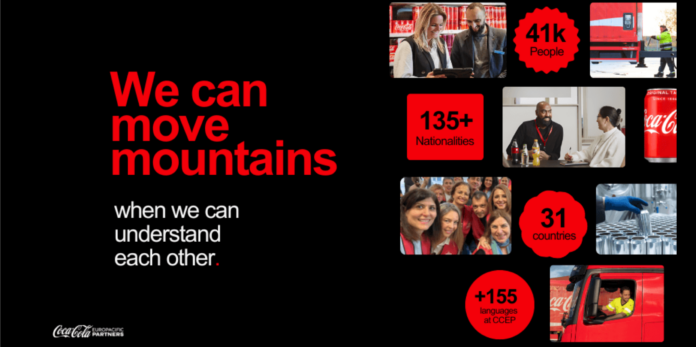
Coca-Cola Europacific Partners (CCEP) has partnered with Bureau Works to launch a new Language Portal that is transforming how one of the world’s largest consumer goods companies communicates across its global footprint. The initiative establishes a new model for enterprise translation: a system that combines AI efficiency with the structure, governance, and continuous improvement required for long-term sustainability.

As generative AI tools became more broadly available, many CCEP teams began using them to solve everyday language challenges. These tools offered remarkable flexibility, but translation at CCEP’s scale involves specialized content, complex file structures, and a constant need for consistent knowledge management. It became clear that the company needed a solution designed specifically for high-volume, high-context multilingual work.

The Language Portal was created to meet that need. The interface is intentionally simple, enabling any employee to upload a file and receive a translated version that preserves intricate formatting and structural fidelity. Slides retain their logic and flow. Documents hold their hierarchy. Videos maintain timing and alignment. Employees receive a clear, working first draft without the burden of rebuilding or reformatting.

Below the surface, the system is built around the realities of enterprise communication. The portal generates a strong draft and then invites refinement from the people who understand the message best. Those adjustments don’t get lost in personal workflows. They feed back into a growing knowledge base that becomes more precise and more aligned with CCEP’s voice over time, creating a sustainable loop of collective improvement.

“Beyond the accessibility and the simplicity of the experience, which are essential for adoption today, what I value most is how the platform understands that language isn’t just about accuracy. It’s about sounding like ourselves, wherever we operate. We needed a tool that would not only give our people a voice but empower them to shape it and make it their own,” said Elitza Dublewa-Servatius, Manager Digital EX & Change at CCEP.

For CCEP, the portal provides a unified way to manage translation across regions without adding complexity or fragmenting institutional knowledge. Teams can work with AI in a structured, governed environment that respects brand identity and supports collaboration. Improvements accumulate across the company instead of disappearing into individual tools or isolated workflows.

“The innovation isn’t speed; it’s coherence,” said Gabriel Fairman, CEO of Bureau Works. “Every interaction strengthens the system. Human insight and AI capability reinforce each other, and the result is communication that becomes more consistent and more culturally aligned across 31 countries.”

The engineering behind the portal was built to stay invisible. Bureau Works designed the system so that all the complexity—formatting intelligence, linguistic orchestration, versioning, knowledge management, and model routing—runs quietly in the background. Employees experience a tool that feels natural and intuitive, while the underlying architecture handles the demands of scale, consistency, and security.

“The challenge was to keep the experience simple while ensuring the system was powerful enough for how CCEP actually works,” said Henrique Cabral, CTO of Bureau Works. “True accessibility comes from removing friction, not adding features.”

Since launch, the portal has already transformed communication across HR, Supply Chain, Safety, Finance, Marketing, and other parts of the organization. Training materials, safety briefings, and operational updates that once required multiple systems and long lead times can now move through translation, refinement, and deployment in a fraction of the time. The portal has become a central point of alignment in a company that spans 31 countries and dozens of languages.

The partnership between CCEP and Bureau Works demonstrates the next stage of enterprise AI: not experimentation, but infrastructure. It shows how organizations can combine intelligent automation with human expertise to build communication systems that are both scalable and deeply aligned with their culture.

For enterprises navigating the rapid evolution of AI, the CCEP Language Portal offers a clear model for what a mature, sustainable, human-centered approach to multilingual communication can look like at scale.

DeepL Research Shows 69% of Global Executives Predict AI Agents Will Reshape Business in 2026

0
DeepL Research Visual Chart

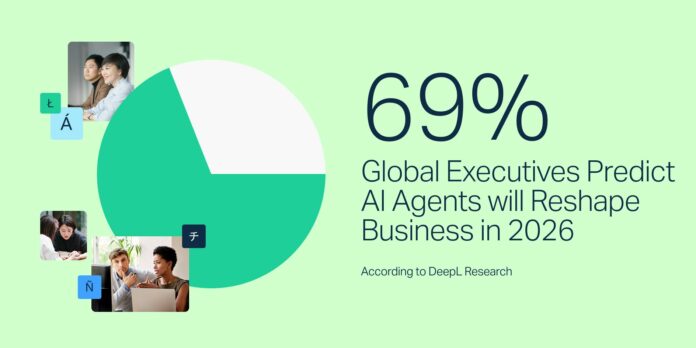
The age of the AI agent has arrived. New research from DeepL, a global AI product and research company, reveals that 2026 will mark a decisive shift from AI experimentation to agentic automation with a majority (69%) of global business leaders expecting agentic AI to transform their operations in the year ahead. 

Surveying 5,000 executives across the United States, United Kingdom, France, Germany, and Japan, DeepL’s research finds that companies are preparing to deploy autonomous AI agents at scale to handle knowledge work, boost productivity, and reshape workforce structures – signaling what could be the most significant operational shift in business since the cloud.

“AI agents are no longer experimental, they are inevitable,” said Jarek Kutylowski, CEO and Founder of DeepL. “The next phase is embedding them deeply into how we work. In 2026, AI agents will end the grind of context-switching and repetitive tasks, letting people focus on what actually moves businesses forward.”

AI agents become the next enterprise disruptor

After early pilots and narrow use cases, AI agents are moving into enterprise production. 

  • Nearly half (44%) of global business leaders expect major transformation from agentic AI in 2026, with another quarter (25%) saying it’s already underway. Only 7% believe AI agents will not change their operations, underscoring the speed of adoption.
  • Respondents reported that the top three drivers of confidence in AI agents include proven ROI and efficiency (22%), workforce adaptability (18%), and growing enterprise readiness (18%). 
  • On the flip side, respondents cited the primary challenges with AI agent deployment as cost (16%), workforce preparedness (13%), and technology maturity (12%). 

AI is the top growth driver for global business

Beyond AI agents, AI as a whole is now viewed as the primary engine of business growth for 2026.

  • Over two-thirds (67%) of respondents report rising ROI from their AI initiatives this year, and more than half (52%) expect AI to contribute more to company growth than any other technology next year.
  • The U.K. leads (80%) in measurable business performance from AI, followed by Germany (78%), the US (71%), and France (70%), while Japan lags at just 35%, suggesting slower adoption and readiness.
  • Interestingly, more than half (51%) of global business leaders believe AI will create more new roles next year than it replaces, and 52% say AI skills will be required for most new hires.

Language and voice AI evolve from tools to infrastructure

DeepL’s research also highlights how Language and Voice AI are becoming critical layers of enterprise infrastructure. 

  • Nearly two-thirds (64%) of global businesses plan to increase investment in language AI in 2026 – led by the U.K. (76%), and followed by Germany (74%), the U.S. (67%), and France (65%) – as multilingual communication and content generation become core to cross-border growth. In contrast, Japan (38%) remains comparatively conservative, signaling slower momentum but still reflecting growing interest among more than one in three business leaders. 

Voice AI, meanwhile, is shifting from “nice-to-have” to non-negotiable

  • Over half (54%) of global business leaders say real-time voice translation will be essential in 2026, up from just one-third (32%) today. 
  • The UK (48%) and France (33%) lead in early reliance on real-time voice translation tools, while Japan remains hesitant at just 11% relying on it today. 
  • Demand is being driven by advances in live voice technology (46%), customer expectations (40%), and cross-market expansion (38%). 

“Real-time voice translation is the next layer of global communication,” said Kutylowski. “When people can speak naturally and can be fully understood, collaboration accelerates.”

These insights can help arm global business leaders with critical insights into what’s coming next in AI, revealing how these shifts will reshape industries, redefine customer expectations, and ripple through the competitive landscape. To learn what DeepL’s executive team predicts for AI across technology, marketing, law, and more, please check out this blog post.

Methodology

This research was conducted by Censuswide on behalf of DeepL, surveying business leaders across the United States, United Kingdom, Germany, France, and Japan. The survey was conducted in September 2025. Censuswide abides by and employs members of the Market Research Society, which is based on the ESOMAR principles.

About DeepL

DeepL is a global AI product and research company focused on building secure, intelligent solutions to complex business problems. Over 200,000 business customers and millions of individuals across 228 global markets today trust DeepL’s Language AI platform for human-like translation, improved writing and real-time voice translation. Building on a history of innovation, quality and security, DeepL continues to expand its offerings beyond the field of Language, including DeepL Agent – an autonomous AI assistant designed to transform the way businesses and knowledge workers get work done. Founded in 2017 by CEO Jarek Kutylowski, DeepL now has over 1,000 passionate employees and is supported by world-renowned investors including Benchmark, IVP, and Index Ventures.

Welo Data Expands to Qatar, Advancing Data Integrity and Culturally Aligned AI in MENA

0
Welo Data Expands to Qatar

Welo Data Middle East LLC, doing business as Welo Data, a division of Welocalize and a leader in culturally aligned, human-centered AI data and evaluation solutions, announces its expansion to Qatar. The move marks an important step in the company’s commitment to building high-performing multilingual AI systems for the Middle East and North Africa (MENA) region.

Welo Data delivers high-quality datasets and evaluation frameworks that ensure AI models perform accurately across dialects, domains, and cultural contexts. The company’s presence in Qatar positions it to better collaborate with regional enterprises, advancing AI innovation and digital transformation across the Gulf.

“Our expansion into Qatar reinforces our long-standing belief that high performing AI begins with high data integrity and cultural fluency,” said Siobhan Hanna, General Manager of Welo Data. “The MENA region is rapidly shaping the global AI landscape — not just through innovation, but through its leadership in developing systems that reflect linguistic and cultural authenticity. We’re well-positioned to support that momentum by delivering data and evaluation solutions rooted in trust, accuracy, and respect for local values.”

As AI adoption accelerates across the Gulf, demand for high-quality Arabic-language data has surged. According to Grand View Research, the MENA artificial intelligence market is projected to grow from USD 11.92 billion in 2023 to USD 166.33 billion by 2030 — a compound annual growth rate of nearly 45%. Governments and enterprises across Qatar, Saudi Arabia, and the UAE are investing heavily in national AI programs, creating need for dialect-specific and culturally safe evaluation pipelines.

Welo Data’s presence in the region will support these initiatives through its expertise in workforce assurance, identity verification, and multilingual evaluation frameworks, helping organizations deploy secure, bias-resistant, and culturally responsible AI systems at scale.

“Reliable AI starts with reliable data — and that requires both technical precision and cultural depth,” adds Siobhan. “Our expansion into Qatar ensures that we can support organizations in building models that perform accurately across Arabic dialects and reflect the region’s cultural diversity.”

About Welo Data

Welo Data, a division of Welocalize, stands at the forefront of the AI training data industry, delivering exceptional data quality and security. Supported by a global network of over 500,000 AI training professionals and domain experts, along with cutting-edge technological infrastructure, Welo Data fulfills the growing demand for dependable training data across diverse AI applications. Welo Data’s technical expertise ensures that datasets are not only accurate but also culturally aligned, tackling significant AI development challenges like minimizing model bias and improving inclusivity. Its NIMO (Network Identity Management and Operations) framework guarantees the highest level of accuracy and quality in AI training data by leveraging advanced workforce assurance methods.

About Welocalize, Inc. 

Welocalize is a leading language service provider. Headquartered in New York, it bridges language and AI to power global success in complex and regulated environments. Welocalize’s expertise in translation, localization, and AI training data ensures precise, scalable, and compliant solutions for businesses worldwide, helping its clients communicate their businesses globally in over 300 languages. Its investment in AI innovation has produced patented, award-winning products that deliver multilingual content with unmatched efficiency, speed, scale, and accuracy. These solutions are delivered within a framework of data security, compliance, and safety, underpinned by its 7 ISO certifications.

TransPerfect Legal Strengthens Global Team with New Key Hires in Seattle and Dubai

0
TransPerfect Legal

TransPerfect Legal, the global leader in legal technology, AI, and advisory services, announced two strategic appointments that strengthen its consulting and investigations capabilities in high-growth markets: Angie Nolet as Vice President of Consulting & Information Governance in Seattle, and Haleh Hamzavian as Senior Director of Investigations in Dubai.

Nolet brings more than a decade of experience as a legal and eDiscovery leader in both corporate and law firm settings. Most recently, she served as Senior Corporate Counsel at Redfin, where she managed litigation and led the company’s eDiscovery program. Prior to that, she practiced at an Am Law 100 firm in the Seattle area. Nolet is also the founder and co-host of eDiscovery Chicks, a podcast dedicated to advancing thought leadership in the eDiscovery community.

In her new role, Nolet will advise clients and internal teams on complex consulting and governance projects, helping legal departments and law firms implement efficient, defensible data strategies across the litigation and investigation lifecycle.

“TransPerfect combines smart technology, talented people, and a deep commitment to clients, and that’s exactly the kind of team I want to be part of,” Nolet said. “I’m thrilled to contribute to the next chapter of growth and innovation.”

Hamzavian joins TransPerfect Legal as Senior Director of Investigations for the Middle East, based in Dubai. Qualified in both the UK and Australia, she brings more than a decade of experience spanning white-collar crime, fraud, and corporate investigations. She began her career with the Crown Prosecution Service, specializing in confiscating criminal assets, before moving to a London litigation boutique and later a prominent UK family office as a Senior Solicitor. Most recently, she held an in-house legal role at a Dubai-based fintech company overseeing regulatory and compliance matters.

At TransPerfect Legal, Hamzavian will lead the expansion of the firm’s investigations practice across the Middle East. She will advise clients on fraud, compliance, and enforcement matters, working closely with TransPerfect’s global forensics, consulting, and eDiscovery teams.

“The Middle East represents a dynamic and growing market for investigations and compliance services,” Hamzavian stated. “I’m excited to bring TransPerfect’s proven technology and global expertise to clients navigating increasingly complex regulatory environments in the region.”

TransPerfect President and Co-CEO Phil Shawe remarked, “We welcome these new strategic hires to the team and we believe our clients will immediately benefit from their expertise.”

About TransPerfect Legal

TransPerfect Legal is a global leader in legal technology, AI, and advisory services for Am Law 200 and Global 100 law firms as well as corporate legal departments. With offices in more than 140 cities worldwide, solutions include forensic technology and consultingeDiscovery and early data assessmentmanaged review and legal staffinglanguage servicesdeposition and trial support, and paper discovery, all offered alongside the Reef Technology ecosystem. TransPerfect Legal’s suite of proprietary applications address the needs of legal and regulatory practitioners around the world.

About TransPerfect

TransPerfect is the world’s largest provider of language services and AI solutions for global business. From offices in over 140 cities on six continents, TransPerfect offers a full range of services in 200+ languages to clients worldwide. More than 6,000 global organizations employ TransPerfect’s GlobalLink® technology to simplify the management of multilingual content. With an unparalleled commitment to quality and client service, TransPerfect is fully ISO 9001 and ISO 17100 certified. TransPerfect has global headquarters in New York, with regional headquarters in London and Hong Kong.

“Spanish With Vicky” Releases First Book

0
Spanish with Vicky Book Cover

In a world overflowing with Spanish-learning channels, only a few are truly qualified to teach the authentic language spoken in Spain, and Spanish With Vicky is one of them. With a total of 1 million followers on its social media platforms, @spanish.with.vicky has become the biggest social media community for Spanish learners.

Now, Victoria Chauvell — also known as Vicky — is taking the next step in her mission to spread natural, real-world Spanish to learners everywhere with her first book, Spanish With Vicky – Stop Being a Guiri and Finally Learn Español. First published by Penguin Random House exclusively in Spain in June, 2025, the book has now been released and made available for purchase worldwide.

Vicky’s Method

Textbooks teach the rules. Vicky teaches the real language that native speakers use every day. In her debut book, she unlocks the key to sounding authentic, helping readers overcome their hesitation in real conversations, stop defaulting to English, and finally get Spanish speakers to respond in Spanish.

This practical, entertaining guide takes learners far beyond memorizing verbs and grammar charts. With humor, cultural context, and the expressions locals actually use in Spain and Latin America, Vicky breaks down everyday situations step-by-step: from greeting people naturally, ordering food politely and confidently, to asking for help at the gym, supermarket, and at home. Designed for English-speaking learners of all levels, the book makes Spanish simple, relatable, and unforgettable.

The book complements her rapidly growing learning ecosystem, which includes viral Instagram and TikTok content, online webinars, and her comprehensive Spanish MasterCourse program, ranging from Beginner to Advanced. Whether learning from a smartphone or diving into structured lessons, students everywhere now have a fun and effective way to level up their Spanish and start sounding like locals.

As Vicky says, “…most students have learned some Spanish in a very formal way, and they don’t understand the real Spanish, so I teach them how to speak like a native speaker on the street”.

About Vicky

Vicky is a Spanish teacher from Barcelona with 12 years of experience and a master’s degree in applied Linguistics. After teaching at universities and the Instituto Cervantes in Casablanca, she found traditional methods too rigid and outdated. For this reason, she turned to social media to bring conversational Spanish to anyone and anywhere. Today, her online community Spanish With Vicky has 1 million students all over the world, from the US and UK to Spain and Germany, all united by the desire to speak Spanish confidently and naturally.

The Oxford Word of the Year 2025 Is “Rage Bait”

0
Oxford University Press

Oxford University Press (OUP) has named rage bait” as the Oxford Word of the Year 2025following a public vote that saw more than 30,000 people worldwide have their say over three days. OUP’s language experts shortlisted three contenders — rage baitaura farming, and biohack — to reflect some of the moods and conversations that have shaped the past year. The winning word was chosen by a combination of votes, sentiment of public commentary, and analysis of OUP’s lexical data.

With the 2025 news cycle dominated by societal unrest, debates about the regulation of online content, and concerns over digital wellbeing, the use of rage bait has evolved this year to signal a deeper shift in how we talk about attention — both how it is given and how it is sought after — engagement, and ethics online. Defined as ‘online content deliberately designed to elicit anger or outrage by being frustrating, provocative, or offensive, typically posted in order to increase traffic to or engagement with a particular web page or social media account’, usage of rage bait increased threefold in the last 12 months.

Rage bait is a compound of the words “rage” (violent outburst of anger) and “bait” (an attractive morsel of food) —both well-established terms in English dating back to Middle English times. Although a close parallel to the etymologically related clickbait — with a shared objective of encouraging online engagement and the potential to elicit annoyance — rage bait has a more specific focus on evoking anger, discord, and polarization. The emergence of rage bait as a standalone term highlights both the flexibility of English language, where two established words can be combined to give a more specific meaning in a particular context — in this case, online — and come together to create a term that speaks to the world today.

First used online in a posting on Usenet in 2002 as a way to designate a particular type of driver reaction to being flashed by another driver requesting to pass them, it introduced the idea of deliberate agitation. Rage bait then evolved into internet slang used to describe viral tweets — often to critique entire networks of content that determine what is posted online, like platforms, creators, and trends.

Since then, it has become shorthand for content designed to elicit anger by being frustrating, offensive, or deliberately divisive in nature, and a mainstream term referenced in newsrooms across the world and discourse amongst content creators. It’s also a proven tactic to drive engagement commonly seen in performative politics, and has developed into practices like rage-farming a more consistently applied attempt to manipulate reactions and to build anger and engagement over time by seeding content with rage bait, particularly in the form of deliberate misinformation of conspiracy theory-based material — as social media algorithms began to reward provocative content.

Speaking about Oxford Word of the Year 2025, Casper Grathwohl, President of Oxford Languages, said “As technology and artificial intelligence become ever more embedded into our daily lives — from deepfake celebrities and AI-generated influencers to virtual companions and dating platforms — there’s no denying that 2025 has been a year defined by questions around who we truly are; both online and offline.

 “The fact that the word rage bait exists and has seen such a dramatic surge in usage means we’re increasingly aware of the manipulation tactics we can be drawn into online. Before, the internet was focused on grabbing our attention by sparking curiosity in exchange for clicks, but now we’ve seen a dramatic shift to it hijacking and influencing our emotions, and how we respond. It feels like the natural progression in an ongoing conversation about what it means to be human in a tech-driven world — and the extremes of online culture.

 “Where last year’s choice, brain rot, captured the mental drain of endless scrolling, rage bait shines a light on the content purposefully engineered to spark outrage and drive clicks. And together, they form a powerful cycle where outrage sparks engagement, algorithms amplify it, and constant exposure leaves us mentally exhausted. These words don’t just define trends; they reveal how digital platforms are reshaping our thinking and behaviour.

 “Year after year, it’s incredible to see the campaign spark curiosity, conversation, and — most importantly —participation. The Oxford Word of the Year invites us to pause and reflect on the forces shaping our collective language. I can’t wait to see what the next year brings.”

About the Oxford Word of the Year campaign

In the fourth consecutive year language enthusiasts were invited to have their say and the shortlisted words were brought to life as official candidates in an election-style campaign. The three contenders — rage baitaura farming, and biohack — canvassed for votes across individual social profiles and manifesto videos, telling their own stories about the impact they had on the year. Once the voting closed, language experts at OUP conducted a final detailed analysis, considering data via a 30-billion-word corpus, votes, and public commentary on the finalists before naming the definitive Word of the Year for 2025.

The Oxford Word of the Year is a word or expression that reflects a defining theme from the past twelve months, either having potential as a term of lasting cultural significance or providing a snapshot of society at a certain time. For over two decades, it has highlighted the language that has shaped conversations and reflected the cultural shifts, patterns, and preoccupations of a particular year.

Shortlisted Words – Definitions

  • Aura farming (n.): The cultivation of an impressive, attractive, or charismatic persona or public image by behaving or presenting oneself in a way intended subtly to convey an air of confidence, coolness, or mystique.
  • Biohack (v.): To attempt to improve or optimize one’s physical or mental performance, health, longevity, or wellbeing by altering one’s diet, exercise routine, or lifestyle, or by using other means such as drugs, supplements, or technological devices.
  • Rage bait (n.): Online content deliberately designed to elicit anger or outrage by being frustrating, provocative, or offensive, typically posted in order to increase traffic to or engagement with a particular web page or social media account.

About Oxford University Press 

Oxford University Press (OUP) is a department of the University of Oxford. It furthers the University’s objective of excellence in research, scholarship, and education by publishing worldwide. OUP is one of the world’s largest university presses with a large global presence. It currently publishes thousands of new publications each year that includes scholarly works in all academic disciplines, holds offices in around fifty countries, and employs approximately 5,000 people worldwide.

About Oxford Languages

Oxford Languages, part of Oxford University Press, is committed to unlocking the power of language for learning and for life. Its world-class language research programme builds on over 150 years of experience and technological innovation to deliver authoritative, evidence-based content in over 50 languages.

All Oxford Languages content is uniquely curated and delivered by our expert team of lexicographers, linguists, and language technologists to the highest of standards. It brings unparalleled expertise to partnerships across the globe as it works with like-minded innovators to advance learning and communication for future generations. Trusted by big tech, academic institutions, and local community initiatives alike, its language data is at the forefront of global communication, powering the products, research, and projects that are making language knowledge available to all.