


For decades, the localization industry operated on a linear model. A file was extracted, sent to a translator, reviewed, approved, and pushed to production. Once published, that string was considered done. Unless the source text changed, the translation remained untouched – frozen in time as a permanent asset in a translation memory.
This “publish and forget” mindset was perfectly rational in a human-centric workflow where changing existing translations cost too much time and money. In the era of AI localization, however, this approach is outdated. Treating AI-generated translations as static assets limits the quality of content.
Today, we can say that there is no such thing as a finished translation.
Why Yesterday’s AI Translation is Today’s Legacy Content
If you deployed an automated AI translation pipeline a year ago to localize fast-changing content (such as documentation, release notes, support articles), that content is already underperforming.
The original output might have been completely fine at the time. However, AI translation quality is dynamic, and the gap between yesterday’s baseline and today’s potential is widening rapidly.
This evolution goes far beyond simply upgrading to a newer large language model (LLM) generation. The true differentiator in localization quality is that your own localization workflows have evolved. Over the past year, you have likely updated your system parameters, refined your rules, and added better context.
Today, localization managers do more than manage text – they configure the entire translation environment. Quality improves continuously as these system parameters evolve:
- Terminology databases and glossaries are constantly updated, expanded, and corrected.
- Brand voice requirements change, requiring new systemic enforcements.
- Workflows are becoming more sophisticated, incorporating automated quality checks, context-retrieval steps, and multi-model coherence validation.
When any of these variables change, the output changes. A pipeline configured today with an updated glossary and sharper rules will give you much better AI translations than the exact same model running on last year’s setup. Leaving older AI content unrefreshed means giving your audience an outdated experience.
Technical Challenges of Content Refreshes
We all know previous AI translations could be better, but updating them manually is incredibly slow and complex. Attempting to build an in-house continuous-refresh mechanism using standard APIs or basic translation scripts usually creates unexpected technical issues.
Without a proper localization platform, teams face major technical issues such as:
- Broken IDs and missing context: In most development ecosystems, string keys change, files get refactored, and content blocks are shifted. If you try to run an automated script to re-translate older strings, matching the exact original source string to its active production counterpart is incredibly unreliable. Without proper context tracking, scripts can pull text out of context, leading to broken variables, malformed placeholders, or completely broken UI text.
- Overwriting human edits: Localization is rarely 100% automated. High-priority pages often get manual polishes from professional linguists. A basic automation script running a bulk update can easily wipe out those pristine human edits. Building custom code to track the exact origin of every single string is a big task for engineering teams.
- Calculating the delta: Pushing entire files back into production just to update 15% of your strings triggers unnecessary CI/CD builds and strains APIs. Instead of refreshing everything, teams struggle to find the “delta” – identifying exactly which strings need an update, tracking when they were last translated, and deploying only those specific segments.
How Crowdin Solves the Refresh Loop
To unlock the true ROI of artificial intelligence, localization platforms must treat translations as a living, continuous loop rather than a final destination.
This requires a system that maintains a persistent connection to your content source — whether it is a code repository, a CMS, or a marketing automation platform. Because Crowdin natively tracks your project state, it eliminates the administrative and development work of content iteration.
Introducing the Re-Translation Feature in Crowdin
This paradigm shift is why we introduced Re-Translation. It fundamentally changes how enterprises maintain multilingual content and allows teams to safely refresh previously translated AI content, preventing the classic pitfalls of automated updates:
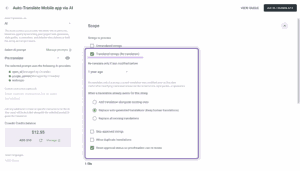
- Crowdin tracks the exact metadata of every string. In the updated workspace UI, you can target text dynamically by its operational “age” (for example, Re-translate only if last modified before 1 year ago).
- To protect human workflows, Crowdin includes built-in translation logic filters. You can explicitly instruct the system to Replace auto-generated translations (Keep human translations). The platform safely isolates machine-generated data and protects your human-curated edits from being touched.
- Because Crowdin maintains a persistent mapping layer between your content repo and your localization workspace, it doesn’t need to re-import files or recreate tasks. The system calculates the precise delta, runs the current, optimized AI pipeline against the selected scope, and pushes the updated assets directly back to your connected repository or CMS without breaking deployment pipelines.
The Future of the Localization Role
Because AI translations are never truly finished and are continually improving, the role of the localization professional undergoes a profound transformation and the focus shifts away from micro-managing individual strings. Instead, tomorrow’s localization managers will act as localization architects. They will manage quality at scale by continuously refining system guardrails, optimizing context-retrieval mechanisms, and adjusting pipeline steps.
When the localization stack becomes automated, continuous, and architecturally secure, multilingual content is never truly finished – it is simply continuously optimized.
Re-Translation capabilities are now fully live and available across both Crowdin and Crowdin Enterprise platforms.


