

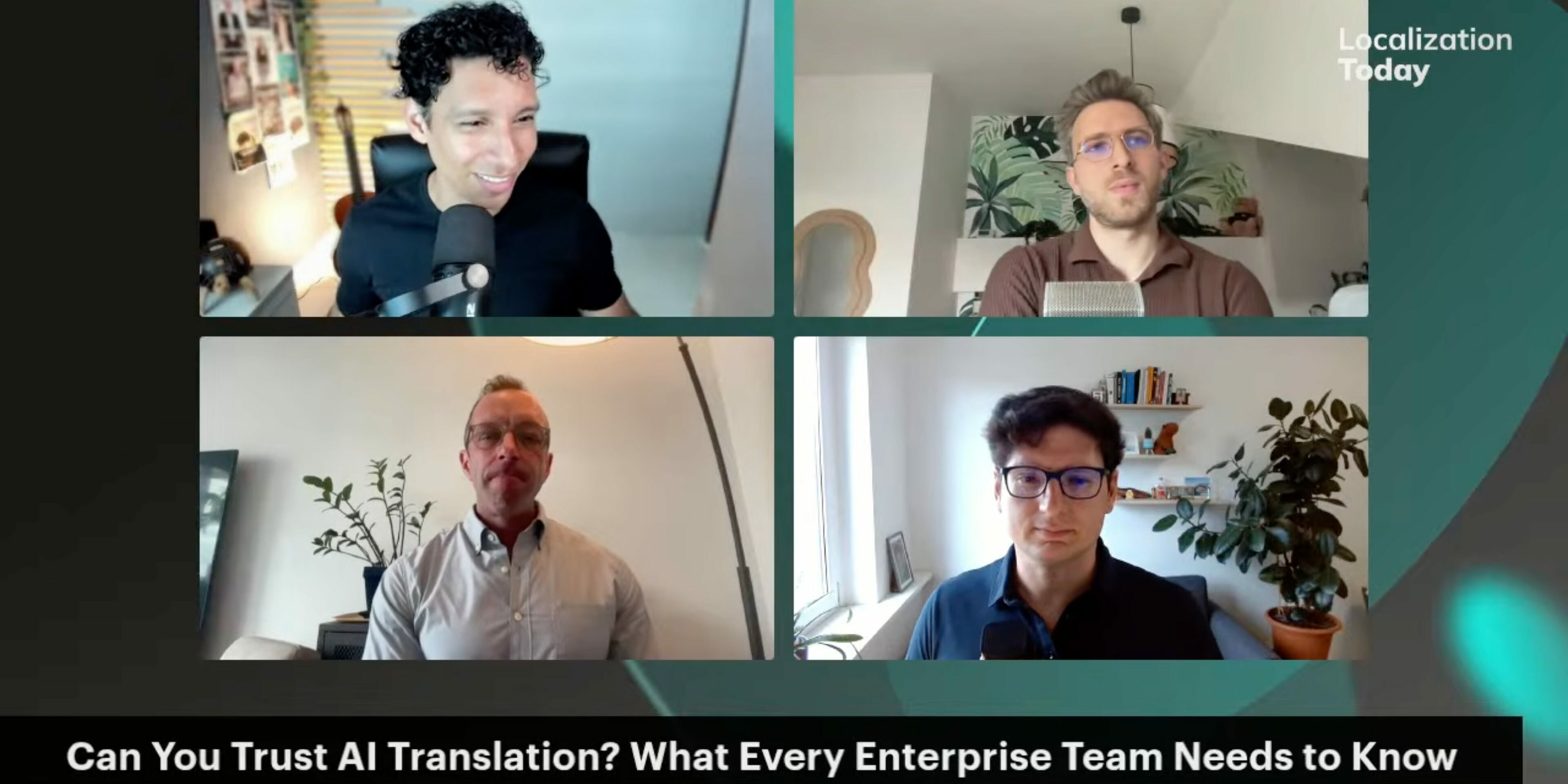
On July 16, Localization Today Live convened a panel of industry leaders to examine whether enterprises can reliably trust AI‑generated translation at scale. Supported by Smartling, the session brought together Konstantin Dranch (Custom.MT), Marcin Pajak (Miro), and Andrew Saxe (Smartling), moderated by Multilingual’s very own Eddie Arrieta.
Eddie opened by noting that the challenge is now “understanding when AI output is accurate” and how organizations can build systems stakeholders trust.
Konstantin traced the evolution of quality evaluation, explaining that MQM “has not been very practical for an enterprise” and that modern pipelines rely on simpler guardrails such as language correctness, terminology, and units of measure. With these in place, he argued that AI can be trusted “if you’re not looking for human voice.”
From the engineering perspective, Marcin described Miro’s shift to an AI‑first pipeline. His core belief is that “trust comes from the system that you build around it.” Miro’s “optimistic localization” approach delivers AI translations instantly, with human review happening asynchronously. Incorrect strings may briefly appear in production, but “fix goes out of the next series,” making errors short‑lived. Linguists now shape model behavior, as “language managers… own the behavioral rules of the AI.”
Andrew emphasized that trust depends on frameworks combining style rules, terminology, assessment, and routing. At large scale, organizations need “some good indication that something is good enough quality to ship and publish,” especially when translating tens of millions of words. He noted that quality is inseparable from business impact, whether content appears on a homepage, a help center, or a legal disclaimer.
The panel also explored high‑stakes content, where errors carry regulatory or cultural consequences. Konstantin pointed to legal, political, and creative material as areas requiring heightened scrutiny, noting that audiences can be “allergic to AI content” in entertainment. He also highlighted emerging regulations requiring AI‑generated text to be labeled.
Audience questions focused on hallucinations, compliance checks, and hybrid workflows. Konstantin was direct: hallucinations cannot be eliminated, but teams can build “multiple levels of checks” and “multiple AI judges.” Marcin added that hybrid systems often outperform either humans or AI alone.
As the session concluded, Andrew reflected on the pace of change, noting that the conversation will be completely different in six months, while Konstantin offered a final takeaway: “Trust but check.”
Supported by Smartling, the event underscored that AI translation is no longer just a technology question — it is a governance question. Trust must be built through measurement, oversight, and a clear understanding of risk.


, Marcin Pajak (Miro), and Andrew Saxe (Smartling) regarding AI.)