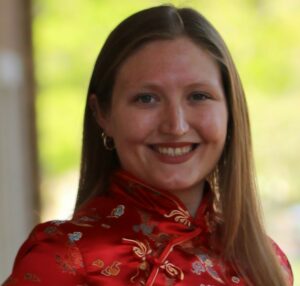
A highly skilled linguist active during the Cold War era, Kató Lomb’s methodical approach to interpreting in an emerging language industry led to her fame as one of the first globally recognized simultaneous interpreters. She is credited with changing not only culturally accepted gender norms in the field of interpreting, but also what it meant to be a professional linguist by bypassing institutional validation in favor of lived fluency.
Lomb was born in 1909 in Pécs, Hungary, in a post-war political landscape layered with cultural and ethnic diversity — as Hungarians, Croatians, and Swabians all called the city home. Hungarian by blood and a native speaker of Hungarian, she mastered 27 other languages on her own through environmental circumstances and linguistic resources that allowed her to reach self-directed multilingualism.
Despite only being certified in Chinese interpretation through a state-level exam, throughout her career, Lomb was a professional interpreter for 16 languages. She eventually interpreted for United Nations Educational, Scientific, and Cultural Organization (UNESCO) meetings, government bodies, and scientific delegations all around the world — validating cognitive flexibility over formalism in the profession.
Lomb worked in a time when formal linguistic studies outside of clinical or academic settings was quite rare and language work was mostly state-controlled. The concept of a global language services market didn’t exist — rather than climbing the corporate ladder, she built her career without guiding parameters from agencies, certification bodies, or standardized pricing models that linguists use today to gain verification and credibility.
Lomb published multiple books, including the influential Polyglot: How I Learn Languages, in which she describes her formula for language acquisition as (Motivation × Time) / Inhibition. She continued to acquire new languages well into her 90s through contextual learning and emotional engagement.
Legacy in the Modern Language Industry
Lomb’s techniques were way ahead of their time, with many of them later formalized in interpreter training programs that are still used today. Her methods foreshadowed currently accepted cognitive theories about working memory, semantic mapping, and working under pressure.
Lomb influenced and encouraged the practice of distinctive strategies that have shaped current interpreting pedagogy for freelancers and autodidacts. Concepts of autolexia (self-reading), autographia (self-writing), and autologia (self-speaking) were strongly implemented throughout her career and therefore heavily studied from a neurological perspective to language acquisition post-mortem.
Lomb wasn’t just one of the world’s first simultaneous interpreters; she was also the first to prove that mastery of a language could be self-taught outside of institutions, geopolitical privilege, and cultural norms. She serves as an inspiration to many people today who aspire to achieve multilingualism and successful language careers through non-traditional avenues.