Phrase Launches Verified Solutions Program to Strengthen Its Ecosystem of Trusted Integrations

0
Decorative Phrase logo

Phrase, a global leader in language intelligence technology, has announced the launch of its Verified Solutions program. This new initiative is designed to help customers build and scale their language technology stack using validated, best of breed solutions from across the Phrase ecosystem.

As enterprises manage an expanding mix of content systems, AI models, and service providers, ensuring these technologies work together reliably is a growing challenge. The Verified Solutions program addresses this by recognizing partner technologies and services offerings built on top of its language intelligence platform that meet Phrase standards for quality, compatibility, and customer value.

“Enterprise teams are under pressure to move faster without increasing risk,” said Edmund Ovington, Vice President, Global Partnerships and Ecosystem. “The challenge is not access to technology; it’s knowing what will work reliably at scale. With a growing ecosystem of partners and integrations, our Verified Solutions give customers the confidence to buy or build the capabilities they need, with technology and service offerings validated to perform within Phrase.”

The program is part of Phrase’s broader ecosystem strategy, enabling customers and partners to build, connect, and grow on a shared infrastructure. 

Phrase already supports a growing ecosystem of 100+ partners and 50+ integrations, including providers such as Figma, Contentful and Storyblok as well as Acclaro, Argos Multilingual and more recently Welocalize Opal. The Verified Solutions Program builds on this foundation by identifying those solutions that meet Phrase standards for quality, compatibility, and customer value.

By validating partner-built capabilities, Phrase supports customers in assembling a solution stack tailored to their needs, without the cost and disruption of switching platforms or being tied to a single vendor.

For partners, achieving Verified status with Phrase unlocks a range of benefits designed to accelerate innovation and growth. These include access to development resources such as sandbox environments and training, opportunities for joint product innovation, and expanded go to market support. Verified partners can publish their solutions directly within the Phrase Platform, making them discoverable to organizations looking to extend their capabilities.

The Verified Solutions program reinforces Phrase’s commitment to an open, extensible platform, where customers can combine Phrase native capabilities with partner technologies to create a scalable, future ready infrastructure.

To explore the Phrase Verified Solutions program and partner ecosystem, please visit: phrase.com/ecosystem/

Connect with Phrase: LinkedIn | YouTube 

About Phrase

Phrase is a leading language intelligence platform, helping global organizations move faster, reach more markets, and deliver content that feels local, relevant, and authentic. Its Phrase Platform combines AI, agentic orchestration, and a headless, API-first architecture in one unified system. It applies the context that makes content perform in every market, including brand voice, quality standards, glossaries, prior translations, and cultural nuance. This means every team, in every region, can ship content that’s on-brand, on-point, and ready for any audience. 
WE ARE VERY Launches Multilingual Editor: Where Freestyle Content Creation Meets Brand-Aware AI

0
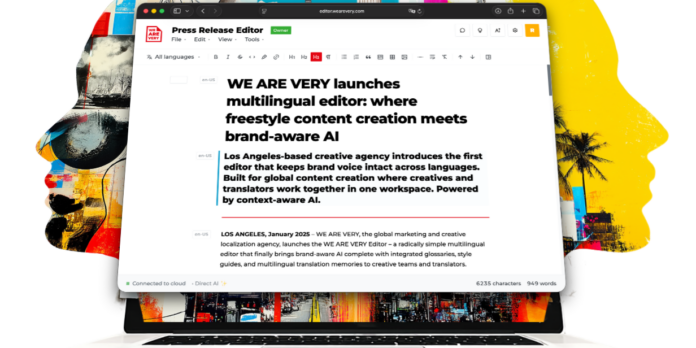
WE ARE VERY's multilingual editor announcement shown on a computer screen

WE ARE VERY, a global marketing and creative localization agency, has announced the launch of the WE ARE VERY Multilingual Editor – a radically simple editor that finally brings brand-aware AI to creative and localization teams complete with integrated glossaries, style guides, and multilingual translation memories.

The global brand voice problem

For decades, creative teams and localization teams have operated in separate worlds with separate tools. Copywriters worked in Word or Google Docs. Translators worked in CAT tools. The handoff between them was where brand voice went to die.

And the problem runs deeper than just disconnected workflows:

  • Generic AI models produce generic content. Every marketing team has the same workflow: write in Google Docs, copy to ChatGPT, prompt, copy back, paste, repeat. It’s tedious. It’s error-prone. And worst of all, these generic models doesn’t know the brand. They don’t know specific terminology. They ignore style guides. They’ve never seen past campaigns. Training custom models is expensive and can’t keep pace with new AI updates.
  • Traditional copywriting is inconsistent and inefficient. Brand voice has relied on individual copywriters internalizing style guides with no systematic way to leverage past content or maintain terminology consistency across campaigns.
  • Translation sacrifices creativity for efficiency. Traditional translation management systems were built for translators processing volume, not crafting stories. Tools like Smartling, Phrase, and Trados force content into rigid segment boxes, prioritizing consistency overflow and diminishing the creative nuance that makes great copy work.
  • Teams work in silos. Copywriters never see how their work translates. Translators lack creative context. The result: off-brand content, endless revision cycles, and frustrated teams on both sides.
  • Creativity, Context, Collaboration

The WE ARE VERY Editor finally bridges this gap. It’s built for creative talent and translators to work together in one place – for the first time, both sides speak the same language.

Context beats training

The AI landscape changes every two weeks. A new model drops, and suddenly last month’s fine-tuned system is obsolete. Training models is wasted time.

What actually works is context. The WE ARE VERY Editor uses a sophisticated RAG pipeline (Retrieval-Augmented Generation) that feeds glossaries, style guides, and translation memory to whatever model is newest and best. Every piece of content, whether created by AI or translated by AI, automatically follows brand rules. No prompting. No copy-paste. Just on-brand content, every time.

And when better AI arrives, the context travels with it. “We’re not betting on any single model,” explains Rinaldo Dieziger. “We’re betting on your brand knowledge. That’s the asset that compounds over time.”

One document, every language

In localization, managing content across languages has always meant managing separate files, one document per language, multiplied by chaos. Ten languages means ten documents, ten versions, ten opportunities for things to drift apart.

The WE ARE VERY Editor introduces multilingual documents: a single document containing all language versions, aligned and synchronized. Edit the source, see the impact across translations. Review everything in one place. It’s a genuinely new concept, and it changes everything about how multilingual content gets made.

Freestyle, not boxed-in

The WE ARE VERY Editor takes a different approach to traditional CAT tools : freestyle editing. It looks and feels like the editors creatives already know, with the real-time collaboration features of Google Docs and the power of professional translation tools running underneath.

Unlike CAT tools, the free-flow editor enables AI to considers entire paragraphs, not isolated sentences. This produces more contextually appropriate translations that maintain the original’s flow and intent.

Similarly, translators can see the full copy, understand context, and produce translations that feel natural. Because here’s the truth: translation as we knew it is increasingly becoming an editing job. And editing is much easier in a freestyle environment than in a segmented TMS.

Made for humans

ChatGPT and similar tools have a fundamental problem: every revision produces a new version. Want to change just one paragraph? Here’s a whole new document. The AI isn’t integrated into editing workflows, it replaces it.

The WE ARE VERY Editor is built for creative talent, translators and basically everyone to work alongside AI, not be replaced by it. AI suggestions appear inline. Accept what works, reject what doesn’t, refine as you go. The AI handles the heavy lifting. Human talent handles the creative decisions.

A visionary workspace

The editor represents a fundamental shift in how teams approach content creation — whether they’re writing in one language or fifty.

“This isn’t just for localization teams,” says Rinaldo Dieziger, Founder of WE ARE VERY. “This is for every marketing team, every creative department, everyone in a company who creates content and wants it to sound like the brand.”

Kristy Sakai, CEO of WE ARE VERY, adds: “The best multilingual content happens when creative and linguistic talent work as one team. There is so much that the copywriting process can learn from localization and vice versa. Now we’ve built the platform that makes it possible.”

Pricing for Teams of Any Size:

  • Free — 5 documents, 1,000 AI requests
  • Starter — $99/month for growing teams
  • Pro — $299/month for agencies and content operations
  • Very Pro — $899/month for enterprise-scale production
  • Custom — Tailored solutions for large organizations

All plans include unlimited collaborators and real-time collaboration.

Available Now

The WE ARE VERY Editor is available and can be accessed at wearevery.com/editor.

Start free, upgrade when you’re ready.

About WE ARE VERY

WE ARE VERY is a creative agency specializing in brand strategy, content creation, and multilingual experiences. Founded in Los Angeles by industry veterans with two decades of localization expertise, the agency has built its reputation on transcreation and creative translation—helping global brands speak authentically in every language.

MachineTranslation.com Expands Its AI Consensus Pool

0
MachineTranslation.com

MachineTranslation.com has announced it has expanded the AI model pool that powers its SMART consensus mechanism. With the addition of Aya Expanse 32B by Cohere and MiniMax M2.7, the platform now compares the outputs of up to 24 leading AI models, including ChatGPT, Claude, Gemini, DeepL, and Google. SMART surfaces the translation the majority of them agree on as the result every user receives.

The expansion is more than a feature update. Every model added to the pool means another independent voice cross-checking every translation before it reaches a user. Internal benchmarking shows this consensus approach reduces critical translation errors and hallucinations by up to 90% compared to any single-model baseline.

What each new model brings

Aya Expanse 32B (Cohere) is a multilingual model built for 23+ languages, with particular strength in low-resource and non-English language pairs where single-model tools are most likely to fail silently.

MiniMax M2.7 is a high-performance model recognized for reasoning depth across Asian languages, including Chinese, Japanese, and Korean. These are language pairs that demand more than surface-level fluency.

“Every time we add a new model to MachineTranslation.com, we’re not just expanding a list. We’re increasing the quality of the translation,” said Ofer Tirosh, CEO of Tomedes.

“Aya Expanse 32B fills a gap we’ve been tracking carefully: underserved multilingual markets where a single model’s cultural and linguistic blind spots go unchecked. MiniMax M2.7 brings serious reasoning depth to Asian language pairs. Together, they don’t just add coverage. They make the translation that the majority agrees on even harder to get wrong.”

Rachelle Garcia, AI Lead at Tomedes, added: “The more linguistically diverse the model pool, the harder it is for any one model’s bias to go unchallenged. Aya Expanse 32B was built to close the quality gap in language pairs where single-model tools fail most. When it joins the SMART pool, it actively protects the translations where protection is needed most. Our data shows that 82% of translation errors on professional content occur in exactly these underserved language corridors.”

How SMART works

Unlike every other AI translation tool, MachineTranslation.com does not ask users to trust one model’s answer. Through SMART, the platform makes its full pool of leading AI models produce independent translations of the same text simultaneously. The translation the majority agrees on, is the one users receive. Every output is AI-verified before delivery.

Frequently Asked Questions

  • Can users see how different AI models translated their text? Yes. MachineTranslation.com displays each model’s output individually alongside the agreed-on result, so users can see exactly where the AI systems aligned and where they didn’t.
  • Why does MachineTranslation.com use multiple AI models instead of just one? A single AI model has no way to check if it is wrong. MachineTranslation.com was built on the principle that the translation dozens of independent AI systems agree on is fundamentally more reliable than the translation any one of them produces alone.
  • Why Aya Expanse 32B and MiniMax M2.7? Both were selected for demonstrated strength in the language pairs where single-model tools are statistically most likely to fail: low-resource multilingual languages and Asian language pairs respectively.
  • Is Human Verification still available? Yes. For any translation requiring 100% guaranteed accuracy, Human Verification is available as an add-on within the same platform, with no external agency required.

About MachineTranslation.com

Developed by Tomedes, MachineTranslation.com is a leading AI translation tool. By using SMART to compare up to 24 AI models and select the translation the majority agrees on, the tool provides secure, transparent, and highly accurate translations for over 1.5 million users worldwide.

Lionbridge Recognized with 2025 Cigna Healthy Workforce Designation

0
Lionbridge Cigna Healthy Workforce Designation award

Cigna Healthcare® has selected Lionbridge as a recipient of their 2025 gold level Healthy Workforce Designation for demonstrating a strong commitment to improving the health and vitality of its employees through a workplace well-being program.

Lionbridge drives employee vitality through dynamic well-being initiatives designed to address the unique challenges of the modern workplace. These programs, ranging from global fitness challenges to mental health resources, provide the tools necessary for Lions to build sustainable, healthy habits. By prioritizing these comprehensive resources, Lionbridge ensures that a culture of health is integrated into the daily experience of its worldwide workforce.

“Achieving the Gold-level Healthy Workforce Designation for the second consecutive year is a powerful testament to our culture of care at Lionbridge,” said Ann Lazarus-Barnes, Chief People Officer at Lionbridge. “Our journey from Silver-level in 2023 to back-to-back Gold-level honors reflects a sustained, global commitment to the holistic well-being of our people. We believe that when our team members feel supported, healthy, and empowered, they are better positioned to innovate and deliver world-class solutions for our customers.”

Vitality is defined as the ability to pursue life with health, strength and energy. It is both a driver and an outcome of health and work/life engagement, and Cigna Healthcare believes it is not only essential to individuals, but also a catalyst for business and community growth.

Research conducted as part of the Evernorth Vitality Index confirms that those with higher vitality experience better mental and physical health along with higher levels of job satisfaction, performance and stronger manager relationships. With only one in five U.S. adults reporting high levels of vitality, employers have an opportunity to improve workplace well-being programs and support. A workplace well-being program that takes a comprehensive approach to employee health can be critical in boosting vitality and building a workforce that experiences better overall health and job productivity.

“Employers that prioritize workforce vitality — by addressing workplace stress, promoting healthy behaviors, and fostering a sense of competence, autonomy, and connection — are supporting employee well-being and driving organizational success,” said Bryan Holgerson, president of Cigna Healthcare U.S. “As a company committed to creating better health care experiences and outcomes, we’re proud to recognize and celebrate employers who are building cultures of well-being across all dimensions of vitality.”

The Cigna Healthy Workforce Designation evaluates organizations based on the core components of their well-being program, including workforce insights, strategy and culture, health equity and social determinants of health, dimensions of vitality, and engagement and experience. Organizations recognized with this designation set the standard of excellence for organizational health and vitality. Cigna Healthcare’s selection of Lionbridge with the gold level designation reinforces the company’s efforts and progress in 2025 toward nurturing a healthy work culture.

About Lionbridge

Lionbridge, based in Massachusetts with offices in 24 countries, partners with brands to break barriers and build bridges all over the world. Since its founding, it has helped companies connect with their global customers and employees by delivering translation and localization solutions in over 350 languages. Through its world-class platform, it orchestrates a network of experts across the globe who partner with brands to create culturally rich experiences.

The Week in Review: Language Industry News April 21-27

0
Week in Review April 21-27

This week’s news reflects a sector in motion, one where accessibility, automation, and operational modernization are reshaping how multilingual communication is delivered at scale. From hands‑free multilingual meetings to AI‑driven sign language translation and new insights into interpreting reliability, the industry continues to evolve toward more integrated, equitable, and technologically adaptive systems.

Product Expansion

Sorenson Communications has unveiled two AI Sign Language Translation (AST) proofs‑of‑concept (POC) designed to support everyday interactions where live interpreters are impractical or unavailable. Offering both an avatar‑based system that converts prerecorded video or text into ASL and a real‑time platform that translates ASL into English text for two‑way communication, the POCs aim to expand functional equivalency for Deaf employees and consumers by enabling quick, natural exchanges in settings like retail, hospitality, transportation, and customer service. Sorenson positions the technology as a cost‑effective way for enterprises to embed accessibility directly into employee and customer experiences, reducing wait times and improving service quality for Deaf, Deafblind, and Hard of Hearing users.

KUDO has launched Automatic Language Detection and Automatic Meeting Summaries, two AI‑powered features that automate both live multilingual meetings and post‑meeting documentation. The system identifies spoken languages in real time, allowing participants to switch languages seamlessly and generate structured, multilingual reports that include key points, decisions, action items, and attendee lists. Built with enterprise‑grade compliance and scalability, the release helps to better position KUDO as a fully end‑to‑end AI platform for multilingual collaboration, reducing manual setup and accelerating knowledge sharing across regions. 

Community

An article by Sydnee Cooper highlights Spanish Language Day, examining why it still carries weight for the global language industry. The piece situates Spanish’s expanding institutional footprint — from surpassing 600 million speakers to gaining official status at the Hague Conference — within a broader conversation about multilingual diplomacy and the rising demand for professional linguists across international governance. By framing the observance as both cultural and infrastructural, the article argues that Spanish Language Day remains a reminder of how global institutions shape language visibility, and why sustained investment in high‑quality language services is essential as Spanish continues to grow demographically and diplomatically. 

Boostlingo has released the State of Interpreting Technology 2026 report, finding that while organizations now offer more interpreting modalities than ever, half still report cases where limited English proficiency (LEP) individuals needed an interpreter and did not receive one. Based on responses from more than 370 stakeholders, the findings point to operational strain, including manual scheduling, inconsistent quality, and coordination challenges as a top barrier. The results suggest that the industry’s core issue is no longer access alone but the complexity of managing multi‑channel interpreting programs. With AI interpreting adoption still relatively low, it argues for AI‑driven orchestration layers that dynamically match use cases to the right modality, making hybrid operations the new standard for reliable language access.

_____________________________________________________________________________________________________________________________________________

Across these stories, a clear pattern emerges: technology is expanding what’s possible, but reliability, orchestration, and human‑centered design remain the industry’s defining challenges. Whether through automated multilingual meetings, AI‑enabled accessibility, or new insights into interpreting operations, this week’s news underscores a sector steadily building toward more seamless, equitable global communication.

For more stories like these, visit our News section.

PanSALB and IsiXhosa Bible Review Committee of the Bible Society of South Africa Handed Over the Completed Revised IsiXhosa Bible

0
Multiple IsiXhosa Bibles with sample pages in the background

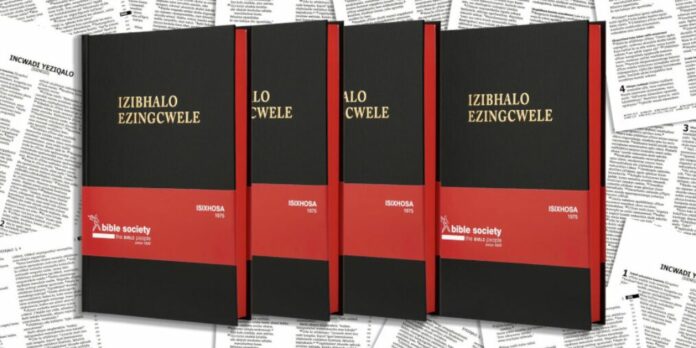
The Pan South African Language Board (PanSALB) and the IsiXhosa Bible Review Committee of the Bible Society of South Africa have handed over the revised IsiXhosa Bible to the printing department of the Bible Society of South Africa.

The Bible revision forms part of PanSALB’s continued commitment to preserve, protect and promote multilingualism and the development and use of official languages in the country.

Amongst other institutional initiatives, the verification and authentication of terminology is one of the programs aimed at ensuring that institutions comply to the principles and the regulation of the spelling and orthography rules of all official languages. It is a significant program in line with the institutional mandate to ensure that formal and standardized language is used accordingly to ensure the effective utilisation of the country’s language resources.

Key PanSALB structure members such as the IsiXhosa National Language Bodies (XNLB) who oversees the role of compliance and the use of correct official languages attended the hand-over. Other members in attendance includes the South African Council of Churches and executives of the Bible Society of South Africa. The IsiXhosa Bible Review Committee of the Bible Society of South Africa also honored PanSALB with a certificate to acknowledge the organization’s contribution in the development of the revised IsiXhosa Bible.

The hand over was a significant milestone to communicate the role of the spelling and orthography rules of IsiXhosa as the guiding official and standardized tool to official writing. Adhering to the revised IsiXhosa spelling and orthography rules in the Bible is very crucial for the development and standardized use of the language, as the Bible is the most read document in African languages literature in South Africa. This revision, therefore, will have an impact on the improvement and promotion of proper IsiXhosa language use, noting that the Bible is the same document that established the first IsiXhosa orthography and developed it throughout. It is therefore appreciated that this document (the Bible) continues to lead the promotion of IsiXhosa spelling and orthography rules.

PanSALB continues to support the use of spelling and orthography rules of all the official languages to guide the formal and standard writing of all official languages in the country to promote the furtherance of multilingualism.

About PanSALB

The Pan South African Language Board (PanSALB) is a constitutional body mandated to create conditions for the recognition, implementation and furtherance of multilingualism in the Republic of South Africa, and the development of previously marginalized languages. Its mission it to promote and protect South Africa’s linguistic diversity by advancing the use, development, and equal status of all official languages. It supports language rights, standardization, research, and public engagement, working with institutions and communities to strengthen multilingualism and ensure inclusive access to information nationwide.

Iyuno Recognized for Operational Excellence with 2026 NAB Show Project of the Year Award

0
Iyuno and SDVI with NAB show project of the year award

Iyuno has announced it has won the 2026 NAB Show Project of the Year award for Media Operations. The award recognizes the combined efforts of Iyuno and SDVI for their successful implementation of a sprawling, cloud-native supply chain designed to meet the rigorous demands of global media distribution.

Nominated by technology partner SDVI, the project utilized the Rally media supply chain management platform to modernize how content is ingested, processed, and delivered to international audiences.

The transition represents a significant shift from traditional, localized hardware setups to an elastic, cloud-based framework. By centralizing operations, Iyuno has gained the ability to scale its resources dynamically, a critical advantage when managing massive content volumes.

The NAB Show Project of the Year program celebrates organizations that push technical boundaries and demonstrate the practical application of next-generation workflows. For Iyuno, this project serves as a blueprint for the future of the industry, proving that cloud-native solutions can handle the most complex and high-stakes media environments.

The award was officially presented during a ceremony on the NAB Show Main Stage on Wednesday, April 22. This accolade underscores Iyuno’s role as a leader in the digital transformation of the media and entertainment sector, continuing its mission to connect content with audiences on a global scale.

About Iyuno

Iyuno is a leading provider of localization services for the media and entertainment industry. Trusted by top entertainment brands and creators worldwide, Iyuno offers comprehensive end-to-end localization services from 45 offices across 29 countries. Backed by a team of exceptional creative and technical talent, state-of-the-art facilities, and cutting-edge technologies, Iyuno proudly boasts the largest global footprint amplifying its dubbing, subtitling and media services offerings.

Spanish Language Day: Why a UN Observance Still Shapes the Global Language Industry

0
United Nations flag

Each year on April 23, the United Nations celebrates Spanish Language Day. Now a global cultural and institutional touchpoint that increasingly intersects with the language services industry, the day honors the legacy of Miguel de Cervantes, whose 1616 death marks the symbolic date for the observance. Cervantes’ Don Quixote is regarded among the greatest works in world literature by the UN and significantly helped shape modern Spanish. 

In 2024, the United Nations Office at Geneva (UNOG) highlighted that the number of Spanish speakers worldwide had surpassed 600 million for the first time. The same year, Spanish became the third official language of the Hague Conference on Private International Law. These developments underscore the Spanish language’s expanding global footprint and signal rising demand for professional linguists to bridge communication across diplomacy, law, and international cooperation.

Spanish as a Driver of Multilingual Diplomacy

As one of the UN’s six official languages, Spanish is described as a “key instrument for international dialogue and cooperation.” Spanish Language Day helps reinforce the UN’s multilingualism agenda, which emphasizes linguistic diversity as essential to mutual understanding, cultural exchange, and peace across global communities.

For the language services industry, this institutional framing has direct implications. Successful multilingual diplomacy depends on a robust ecosystem of translators, interpreters, revisers, terminologists, editorial specialists, and more. As of 2025, Spanish ranks as the second-most spoken mother tongue in the world by native speakers, and its presence across international organizations continues to grow. When the UN elevates the visibility of Spanish, it reinforces the need for professional language expertise — not only within the UN system but across NGOs, intergovernmental bodies, and global enterprises that follow UN communication standards.

The Group of Friends of Spanish, created in 2013, further promotes the use and dissemination of Spanish within UN activities, strengthening linguistic parity and supporting the infrastructure behind multilingual governance.

Cultural Presence and Community Practice

Spanish Language Day is not merely symbolic. The UNOG frames the observance as a celebration of the history and culture of the Spanish language to raise awareness, accompanied by cultural programming, exhibitions, quizzes, and interactive activities. One example is the UN Geneva photobooth available during the observance week, where staff and visitors can take photos showcasing the languages they speak. The initiative is designed to demonstrate the linguistic diversity of teams across the organization.

Spanish Language Day is also an opportunity to highlight the richness of the Spanish‑speaking world, from its literary heritage to its global cultural influence. These institutional celebrations confirm that the day carries genuine cultural resonance for Spanish‑speaking professionals and communities.

April 23 also marks English Language Day, traditionally associated with the death of William Shakespeare. The shared date creates a subtle literary symmetry: two global languages, two monumental writers, and two linguistic traditions that continue to shape international communication.

Why It Still Matters

Spanish Language Day remains relevant because it reflects language’s role as the foundation of global infrastructure. As Spanish expands demographically and institutionally, the demand for high‑quality language services grows with it. Observances like this one remind global institutions and the public alike that multilingualism requires investment, expertise, and visibility. For an industry built on connection, clarity, and cultural understanding, that reminder is more important than ever.

KUDO Launches Hands-Free Multilingual Meetings with Automatic Language Detection and AI Summaries

0
KUDO

KUDO, a leading platform for multilingual communication, has announced the launch of two new AI-powered capabilities: Automatic Language Detection and Automatic Meeting Summaries. Together, these innovations remove friction from both live meetings and post-meeting workflows, delivering a fully hands-free, end-to-end multilingual experience for global enterprise teams.

With these releases, KUDO continues to advance its AI-driven platform, helping global organizations simplify real-time communication while turning every meeting into a structured, actionable outcome.

From setup to follow-up, fully automated

Multilingual meetings have traditionally required manual configuration and time-consuming follow-up. KUDO’s latest innovations eliminate both challenges.

  • Before the meeting, Automatic Language Detection identifies spoken languages in real time, removing the need for manual set-up and allowing for speakers to change language during the meeting.
  • After the meeting, Automatic Meeting Summaries instantly generate structured, multilingual reports, ready to download and share.

Automatic Language Detection: smarter meetings with real-time language switching possible

KUDO’s Automatic Language Detection feature removes one of the biggest barriers to multilingual collaboration: configuring languages manually.

Key Benefits

  • Detects spoken languages automatically in real time
  • Allows for participants to change from one language to the next
  • Eliminates manual set-up and configuration errors
  • Supports up to 10 languages simultaneously
  • Creates a more natural, seamless meeting experience

By adapting dynamically to participants, KUDO ensures meetings run smoothly, without interruptions or technical friction.

Automatic meeting summaries: turn conversations into action

KUDO’s Automatic Meeting Summaries feature transforms meetings into structured, multilingual documentation, instantly available after each session.

What’s included

Each meeting generates downloadable reports (one per language), including:

  • Key discussion points
  • Action items
  • Decisions made
  • Attendee lists
  • Concise summaries

This enables teams to align faster, share knowledge more effectively, and maintain consistent documentation across languages and regions.

Built for enterprise-grade AI and compliance

Both features are designed with enterprise needs in mind:

  • Multilingual outputs at scale
  • Standardized, structured reporting
  • GDPR-compliant infrastructure
  • Optional EU-hosted deployment

These capabilities make KUDO particularly well-suited for global enterprises and regulated industries requiring accuracy, compliance, and efficiency.

Redefining multilingual collaboration

While many platforms offer limited automation, KUDO delivers a truly end-to-end AI-powered experience, automating both the live meeting and what comes after it.

From real-time language detection to instant multilingual summaries, KUDO enables organizations to focus on what matters most: communication, collaboration, and outcomes.

About KUDO

KUDO is a global leader in providing real-time multilingual solutions that enable people to communicate effortlessly in any language⁠, on any platform. Its network of 12,000 professional language interpreters, combined with their ground-breaking Speech Translator, empower organizations of all sizes to collaborate more efficiently, with greater inclusivity, and on an international scale. KUDO Inc. is a New-York based technology start-up founded and managed by language and conferencing industry insiders seeking to create a world in which everyone has the power to understand and be understood in their own language.