Introducing Managed AI: AI Language Solutions, Simplified and Scaled

0
Managed AI TOPPAN

The promise of AI in language services is undeniable. The industry is at a turning point. AI language technologies – (neural machine translation (MT), large language models (LLMs), and natural language processing (NLP) – are reshaping how businesses createtranslate, and adapt content. 

AI-powered language technologies can transform content creation with unmatched speed and precision. LLMs generate on-brand social media posts and marketing copy in moments, slashing creation time from hours to minutes. Neural machine translation processes massive text volumes instantly, while LLMs deliver human-like, context-sensitive translations. AI-driven proofreading and quality checks help ensure consistency, minimizing revisions.  

By automating repetitive and high-volume tasks, these tools accelerate workflows, freeing teams to prioritize strategy and creativity.  

However, harnessing the potential of AI in robust, scalable processes comes with significant challenges

Customers face a dizzying array of AI technology choices, each with its strengths, limitations, and risks. Evaluating these options requires expertise, time, and resources that many organizations simply don’t have.  

Furthermore, bias in AI outputs, such as skewed translations or culturally insensitive content, can damage brand reputation. Hallucinations (where models generate plausible but inaccurate information) pose risks, especially for high-stakes content. A mistranslation in a regulatory filing or a medical guideline is a huge liability. 

Security and compliance are non-negotiable, especially with regulations such as GDPR, the EU AI Act, and HIPAA, which demand robust governance to avoid legal and financial penalties.  

Then there’s cost management. AI can be expensive, with high computational costs, especially when scaling across languages and use cases. The wrap-around costs of AI management and governance can further undermine ROI.  

These challenges make strategic implementation critical to balance innovation with cost-effectiveness, reliability, and compliance. 

Introducing Managed AI

Managed AI from TOPPAN Digital Language is a comprehensive set of services designed to streamline the adoption and management of AI-driven language solutions, enabling you to progress successfully from idea to experimentation to implementation at scale. 

Managed AI includes:  

  • Consultancy and use-case analysis to understand each use-case’s objectives, business KPIs, and risk thresholds.  
  • Language Model selection and integration to evaluate models for best fit, and integrate them into workflows for maximum effectiveness.  
  • Linguistic Asset Management and model training to leverage linguistic knowledge bases alongside AI for continuity, consistency, and brand voice.  
  • Governance and compliance to help ensure that data protection and AI regulationssecurity, and process standards are adhered to.  
  • Audit and quality assurance to leverage automated checks alongside human review to maintain consistent, high-quality outputs.  
  • Ongoing optimization and cost management to continuously refine AI strategies to balance performance, compliance, and budget over time. 

As the field of AI is changing rapidly, Managed AI is technology agnostic. Our technology platform, STREAM AI, uses an open framework to integrate any AI model or AI microservices chosen together with our customers, enabling true flexibility and future-proofing. 

The Bottom Line

Managed AI from TOPPAN Digital Language redefines what is possible in language services, transforming complexity into a competitive edge. By combining our technology-agnostic STREAM AI platform with expert consultancy, robust compliance, and human-in-the-loop oversight, we deliver high-quality, scalable language solutions that drive real ROI. 

From seamless integration to ongoing optimization, Managed AI empowers businesses to harness AI’s full potential—faster, safer, and more cost-effectively. In a world where precision and compliance are non-negotiable, Managed AI isn’t just a service; it’s your partner in building a future-proof, AI-driven content strategy that engages global audiences with confidence. 
CITLoB Launches Samvād 2025: Call for Papers Now Open for India’s Leading Localization Event

0
Samvād 2025

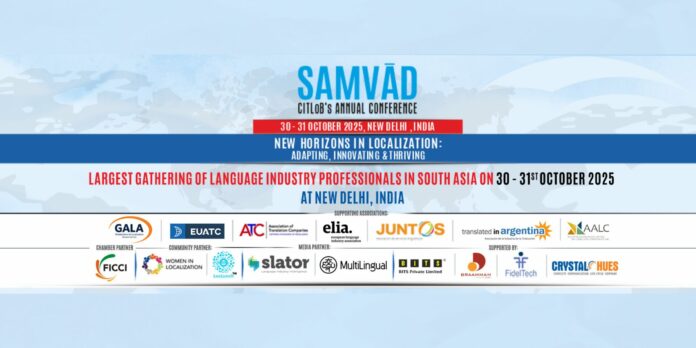
New Delhi, India, June 6, 2025: The Confederation of Interpreting, Translation and Localization Businesses (CITLoB) has officially announced the return of Samvād, its flagship annual conference, to be held in person on October 30–31, 2025, at the India Habitat Centre in New Delhi. This year’s theme, “New Horizons in Localization: Adapting, Innovating & Thriving,” will guide two days of in-depth discussions around the future of language services in India and beyond.

India, the world’s fastest-growing major economy, continues to rise as a strategic global market. With over 1.4 billion people—nearly a billion of whom are under 35—and a rapidly digitizing society processing almost 1 billion UPI transactions per day, the country is redefining how localization is approached. For global brands and language professionals alike, India offers more than scale—it offers transformation.

Samvād, meaning “dialogue” in Sanskrit, is a space for the localization industry to connect, learn, and collaborate. This year’s event will feature expert talks, interactive panels, and focused networking opportunities. It will also include a curated Expo with limited booths (10 total), giving companies and service providers direct access to partners and prospects in the region.

CITLoB is now accepting proposals for talks, panels, and moderator roles. The Call for Papers is open here: https://forms.office.com/r/DwFpLVx5Ty

Delegate fees and sponsorship packages are designed to be accessible for both domestic and international attendees. For full event details, visit: https://citlob.in/samvad-2025.html

Samvād 2025 is where the language industry meets India’s next chapter. Join the conversation—and help shape what’s next.

UK Court Interpreters Threaten Strike as Ministry Outlines Service Reforms

0
UK court interpreters

Response from the Ministry of Justice follows recommendations from the House of Lords Public Services Committee

The UK Ministry of Justice (MoJ) has issued a formal response to the House of Lords Public Services Committee (PSC), outlining upcoming changes to translation and interpreting services in the UK court system. The update follows a public inquiry into interpreter standards, pay, and working conditions.

According to MoJ Minister of State Sarah Sackman, 0.7% of trials in 2024 were delayed due to the lack of an interpreter. While noting that the percentage is low, the Ministry acknowledged areas for improvement and confirmed new contractual measures to be implemented in October 2026.

Measures Include Welfare Support and Quality Review

The MoJ plans to consolidate public data related to interpreting services and deepen engagement with stakeholders. New contracts will require language service suppliers to introduce welfare support for interpreters and improve the visibility of complaint processes.

The Ministry also intends to strengthen quality assessment procedures through a risk-based approach. This will involve the analysis of service data to prioritize assessments, particularly in high-sensitivity court settings.

Interpreter Qualifications to Remain Tiered

The PSC had recommended a Level 6 qualification requirement for all court interpreters. The MoJ stated it will maintain a tiered model: Level 6 qualifications will apply to “Professional” assignments, while Level 3 will remain valid for “Community” assignments such as telephone interpretation and non-evidential hearings.

The Ministry cited the need for flexibility in interpreter qualifications to meet the varying needs of the justice system.

MoJ Declines Recommendation on Minimum Pay Rates

While the PSC called for improved remuneration, including the introduction of a minimum pay rate, the MoJ stated that it does not plan to implement such a change. According to the Ministry, interpreter rates were benchmarked against other public sector departments and found to be competitive.

The MoJ confirmed that interpreters continue to be paid a minimum of two hours per assignment and noted that travel time and expenses are factored into supplier pricing. It also reaffirmed that interpreters may claim travel-related costs as part of self-employed tax reporting.

However, changes to cancellation policies will take effect in October 2026. The cancellation cut-off time will move to midnight, allowing more cases to qualify for short-notice cancellation fees. Pay will also be adjusted annually in accordance with the Consumer Price Index.

Strike Action Announced by Interpreter Group

On the same day the MoJ response was published, the UK Court Interpreter Initiative, supported by the National Register of Public Service Interpreters (NRPSI), announced strike action for four days across June and July 2025.

The group issued a list of demands, including updated cancellation policies, revised travel compensation, and changes to quality assessment protocols. The MoJ has not issued further comments regarding the planned strike dates.

“AI Hasn’t Replaced Me:” One Translator’s Perspective on the Profession’s Future

0
Person and AI

When I started working in the translation and localization industry more than two decades ago, the idea of machine-generated language felt like science fiction. Automated translation existed, but it wasn’t any good. Back then, our work was unquestionably human. We were, as we continue to be, gatekeepers of tone and nuance. Where machine translation (MT) was available at all, it produced rigid, awkwardly mirrored sentences with no grasp of intent or tone. As a linguist, it wasn’t something you feared, it was merely something you fixed.

Fast forward to today, and AI has completely transformed the translation landscape. Tools that once butchered meaning are now producing eerily fluent copy. Large language models (LLMs) are capable of translating long, complex chunks of text with extraordinary accuracy. Computer-assisted translation (CAT) tools now come with integrated neural engines. The pace of change is overwhelming, and understandably, many colleagues and players in the industry are wondering where this leaves us humans.

Believe me, I understand the concern. But from personal experience, I’ve also learned this: AI hasn’t made me obsolete — it’s made me more valuable, especially when I embrace it on my own terms.

I’ve lived through every stage of this evolution. I started working in the subtitling industry circa 2000, then became a Sworn Translator, and ended up founding a boutique translation agency. Over the years, I’ve seen firsthand how large organizations have shifted from purely human localization pipelines to hybrid models, driven by the growing promise of AI.

But let’s be clear: It hasn’t always worked smoothly.

Years ago, I was tasked with overseeing a large-scale localization project for a major tech giant. The project involved training a voice-enabled assistant using user-generated content pulled from high-traffic online forums. The source material was already difficult, fragmented, slang-heavy, and culturally specific. The MT output? Even worse. It delivered flat, literal renderings of content that made no sense out of context.

My team and I spent hours interpreting the intent behind these posts, researching cultural equivalents, and rewriting everything from scratch to make it relevant for Latin American audiences. In that scenario, MT wasn’t just unhelpful, it was a barrier we had to work around. And this was from a proprietary internal MT engine touted as being more powerful than the public tool that was available at the time.

What’s changed since then? A lot!!!

Around 2018, I started noticing a shift. As voice-enabled virtual assistants went mainstream, so did the research driving their language models. Translation tools began to pick up more context. Segmentation became smarter. Syntax improved. When LLMs like ChatGPT emerged, the pace of evolution skyrocketed. We moved from MT systems that handled sentences in fragments to models that could generate cohesive, human-sounding paragraphs.

At the same time, CAT tools evolved. Platforms like Phrase and Smartling, once limited to leveraging termbases and translation memories, began to integrate AI-powered MT. And when configured properly (which is absolutely essential), these tools started producing drafts that were genuinely useful. Today, with the right segmentation, prompts, and review workflows, AI can become a powerful asset to human localization teams. Not a replacement, but an amplifier.

That said, the risks haven’t vanished. AI still stumbles over idiomatic expressions, humor, emotion, and regional nuance. It still misses cultural cues that only a human translator can catch. It still struggles to replicate tone, irony, and subtext. And it certainly doesn’t understand a brand’s voice or mission unless someone properly trains it to — and that’s not an easy feat.

What all this means is that the role of the translator has evolved and continues to evolve, but it hasn’t and won’t disappear. We are becoming editors, strategists, cultural consultants, and, increasingly, the human voice guiding AI toward better output. The craft is still there, it’s just shifting upstream.

Translation is no longer just about words, but about intent, emotion, positioning, and connecting. AI can generate content, but it can’t yet interpret values. It can mimic language, but it can’t speak to people’s realities. That’s where we human translators, editors, and quality assurance specialists come in.

I’ve learned that translators who adapt and learn how to prompt, curate, post-edit, and quality-assure are not being pushed out of the profession. Instead, we’re rising to the top of it. That’s why I believe AI hasn’t replaced me — it’s made me better at what I do!

Welo Data Introduces Bilingual Benchmarking Framework for Evaluating Causal Reasoning in LLMs

0
Welo Data Launches Bilingual Evaluation of LLMs

June 2025 – Welo Data has published new research presenting a bilingual evaluation framework aimed at measuring how large language models (LLMs) perform in complex causal reasoning tasks across multiple languages. The study, titled “Diagnosing Performance Gaps in Causal Reasoning via Bilingual Prompting in LLMs,” highlights model behavior under more realistic multilingual conditions, using blended-language prompts that better reflect real-world applications.

The evaluation covered eight LLMs developed by four major companies, using over 70,700 prompts across six languages—English, Spanish, Japanese, Korean, Arabic, and Turkish—and four causal question types: causal discovery, confounder identification, language variation, and norm violation.

Expanding Beyond Monolingual Benchmarks

Welo Data researchers note that existing causal reasoning benchmarks often lack linguistic diversity and task complexity. To address this, they constructed a dataset of narrative-based prompts developed by professional analysts with advanced degrees and domain experience, aiming to create more representative testing conditions.

Key Observations

  • Bilingual prompts led to a consistent accuracy decrease, with performance dropping an average of 4.6% compared to monolingual prompts.

  • Models exhibited a recency bias, prioritizing the language of the question over that of the story, which affected both accuracy and reasoning language.

  • A negative response bias was noted in binary causal tasks, where models tended to reject causal claims, especially when the correct answer was “yes.”

  • Larger LLMs outperformed smaller ones in complex scenarios, particularly in identifying confounders and evaluating norm violations.

Implications for Real-World Use

“Multilingual evaluation typically relies on monolingual prompts translated into multiple languages,” said Dr. Abigail Thornton, Head of Research at Welo Data. “But actual use cases often involve bilingual or multilingual inputs. Our findings show that structure and language pairing can meaningfully influence model behavior.”

Dr. David Harper, lead author of the study, added: “This kind of evaluation goes beyond surface-level performance and reveals how LLMs respond to complexity—an important factor for global applications.”

According to the researchers, bilingual prompts may expose reasoning weaknesses that are less visible in standard benchmarks. These findings could help developers improve model consistency and generalization across multilingual deployments.

The research is part of Welo Data’s broader initiative to support transparent evaluation practices through its Model Assessment Suite, which tests LLMs using domain-specific scenarios in multiple languages.

The full study is available at welodata.ai.


About Welo Data

Welo Data, a division of Welocalize, specializes in AI training data solutions. With a global network of over 500,000 contributors and a focus on quality, cultural relevance, and bias reduction, the company supports AI development through services such as data annotation, model enhancement, and relevance assessment. Its proprietary NIMO framework helps ensure high-quality outputs through workforce assurance and data validation protocols.

Huawei Develops Smarter Hybrid AI Translation Systems

0
Huawei Hybrid AI Translation

A Selective Approach to Translation AI

Huawei is rethinking the use of large language models (LLMs) in translation workflows. In a paper published in May 2025, the company introduced a hybrid AI translation system that determines, before any translation occurs, whether to use a traditional neural machine translation (NMT) engine or a more powerful large language model (LLM).

Unlike earlier approaches that rely on post-translation quality estimation, Huawei’s system analyzes each source sentence in advance. Using a classifier trained on sentence complexity and domain, it predicts whether the LLM would meaningfully outperform NMT. This preemptive decision saves time, energy, and computational cost while preserving translation quality.

When to Call in the Big Models

According to the researchers, the hybrid AI translation system used LLMs for about 25% of sentences across various language pairs: Chinese–English, English–Chinese, Japanese–English, and German–English. This selective application still matched or exceeded full-LLM performance, proving that smarter deployment trumps brute-force usage.

The system defaulted to LLMs for literary or informal content and leaned on NMT for technical or structured language. This not only improves efficiency but also aligns with real-world needs in industries like localization, healthcare, and legal translation.

“If NMT performs equally to LLM,” the authors noted, “we see no improvement after integration.”
The method works best when both engines bring complementary strengths to the table.

Implications for the Translation Industry

This approach could significantly reshape how hybrid AI translation systems are integrated into enterprise and public-sector workflows. Instead of blindly trusting LLMs to handle everything, Huawei shows that strategic use improves both performance and resource allocation.

In a time when businesses seek to balance cost, speed, and quality, selective LLM use offers a scalable and practical path forward.

As generative AI continues to disrupt language technology, solutions that emphasize precision and efficiency over raw power may become the new standard. Huawei’s method sends a clear message: it’s not about using more AI—it’s about using the right AI, at the right time.

Interpreters Unlimited Launches Language Access Plan Services to Support LEP Compliance Nationwide

0
Language Access Plan services

SAN DIEGO, CA – June 5 2025 – In a country where more than 25 million people speak English less than very well, ensuring meaningful access to essential services is no longer just best practice—it’s a legal and moral obligation. Interpreters Unlimited (IU), a national leader in interpretation and translation services, proudly announces the official launch of its Language Access Plan (LAP) development services. This new offering underscores IU’s mission to break down language barriers and help organizations serve Limited English Proficient (LEP) communities more effectively.

A Language Access Plan is a formal document outlining how an organization will provide equitable access to its programs, services, and activities for individuals with limited English proficiency. Often required by federal, state, or local laws—especially for entities receiving federal funding—LAPs serve as essential tools for compliance, community trust, and equity.

“Our clients have always relied on us for dependable language services—now we’re going one step further,” said Shamus Sayed, COO of Interpreters Unlimited. “We’re helping organizations not only communicate but also build infrastructure that ensures access is consistent, strategic, and fully inclusive.”

This expansion comes at a pivotal time. According to the U.S. Census Bureau, one in five U.S. households speaks a language other than English at home. In 2023, the foreign-born population reached a record 47.8 million—an increase of 1.6 million from the previous year. Net international migration accounted for 84% of the country’s population growth between 2023 and 2024, as reported by the Associated Press. With LEP communities on the rise, demand for structured language access frameworks is growing rapidly across healthcare, education, government, and corporate sectors.

Recent legislation—such as Colorado’s House Bill 25-1153 and California’s strengthened LEP compliance mandates—further highlight the shift toward language equity as a public service priority. Under Title VI of the Civil Rights Act, organizations that receive federal funds are legally required to provide meaningful access to LEP individuals. Non-compliance can lead to financial penalties, legal consequences, and erosion of public trust.

But IU sees LAPs as more than a compliance checkbox.

“Language Access Plans aren’t just forms to file—they’re tools for transformation,” added Sayed. “They signal that an organization values every member of its community, no matter what language they speak.”

IU’s LAP services begin with a detailed assessment of the LEP populations served by the organization. From there, IU designs a customized strategy that includes clear internal protocols, staff and leadership training, and a practical roadmap for implementation. Each plan also comes with long-term support—including regular updates, ongoing monitoring, and performance evaluation—to ensure sustainable impact.

With decades of experience developing LAPs in nearly every U.S. state across sectors like healthcare, government, legal, and education, IU offers deep expertise in navigating federal, state, and municipal requirements.

Dedicated LAP Advisors work directly with clients to understand operational realities, share best practices from successful implementations, and ensure every plan meets legal standards while aligning with the organization’s goals.

“This is about raising the national standard for language accessibility,” Sayed concluded. “Together, we can ensure no one is left behind because of a language barrier.”

For more information or to schedule a free Language Access Plan consultation, visit www.interpreters.com or call 800-726-9891.


About Interpreters Unlimited, Inc.

The IU Group of companies includes: Interpreters Unlimited, Accessible Communication for the Deaf, Albors & Alnet, Arkansas Spanish Interpreters and Translators, and IU GlobeLink, LLC. Headquartered in San Diego, California, IU is a certified minority-owned business committed to providing linguistic and cultural services nationwide. With over 70 years of combined experience, IU offers interpretation, document translation, and non-emergency medical transportation, serving clients across healthcare, legal, government, and education sectors.

Regulation and Innovation: Rethinking Endorsement in the Age of AI and Global Workflows

0
Interpreters and translators

As technology reshapes professional services, the role of government oversight is under renewed scrutiny. In Australia, the proposed Language Service Provider (LSP) Endorsement Model from the National Accreditation Authority for Translators and Interpreters (NAATI), supported by the Australian Institute of Interpreters and Translators (AUSIT), is part of this broader shift. It aims to formalize standards and improve accountability in a complex and evolving industry.

While the model addresses valid concerns, particularly within community interpreting, it may not align with how many language professionals now work. The key question is whether traditional regulatory models can keep up with technological change and global service delivery.

1. Translators and Interpreters Work Under Different Conditions

Interpreters often operate in public-facing roles, such as in courts or hospitals, where local compliance and contractual oversight are necessary. These contexts benefit from stronger regulation. Translators, however, are more likely to work remotely with international clients. Their workflows are often built on digital systems and rarely intersect with domestic procurement structures.

A uniform endorsement model may overlook these significant differences, as well as any future tech developments in the interpreter space.

2. Technology Already Offers Transparency

Processes that once relied on agency-led checks are now increasingly handled through digital tools. Platforms offer verified job tracking, audit-ready logs, real-time certification checks, and secure document workflows. These systems provide a level of consistency and traceability that manual oversight often struggles to match.

If endorsement is to remain meaningful, it should recognize the systems already in place across much of the industry.

3. Cross-Border Work Is Now the Default

Translators routinely serve clients outside their own country. Many certified professionals in Australia may never engage with a domestic LSP. If the model focuses solely on national compliance, it risks becoming disconnected from the reality of the profession. It may also disadvantage Australian operators who must meet higher standards than their global counterparts.

Any reform aimed at raising quality must also reflect how certification interacts with international workflows.

4. Endorsement Needs a Clear and Contemporary Purpose

Professional standards matter. So does accountability. But endorsement should not become an administrative burden that fails to offer real value. It should support fairness, encourage high standards, and improve the working environment for professionals, regardless of where or how they operate.

The discussion now is not whether oversight is needed, but what kind of oversight is effective. The model should serve the profession as it exists today and adapt as it continues to change.

Grammarly Secures $1B in Grammarly AI Platform Financing

0
Grammarly

Strategic investment fuels AI platform expansion

Grammarly has raised $1 billion in Grammarly AI platform financing from General Catalyst’s Customer Value Fund. Unlike a typical equity round, this funding operates more like a credit line or loan, with capped returns tied to Grammarly’s future revenue—allowing the company to grow without diluting ownership. The financing was announced on May 29, 2025, by CEO Shishir Mehrotra, following the company’s January merger with collaborative AI platform Coda.

From grammar tool to agent platform

According to Mehrotra, Grammarly is shifting from a single-use tool to a broader “agent platform” that can support more complex communication needs across contexts. “Grammarly is going through a huge transformation… from being what is mostly known as a single-purpose agent to being an agent platform,” he told Reuters.

This Grammarly AI platform financing will support that transition by accelerating product development, especially around AI-powered tools that enhance communication, tone, and intent. The funds will also fuel expansion through strategic acquisitions and increased investment in sales and marketing.

Profitability and investor confidence

Grammarly is currently a profitable SaaS company with over 40 million individual users and more than 50,000 Grammarly Business accounts. With annualized revenue now exceeding $700 million, the company is well-positioned to scale further. PitchBook last valued Grammarly at $13 billion in 2021.

General Catalyst previously invested $90 million in Grammarly in 2019 and is also a key backer of Coda. Their continued support via Grammarly AI platform financing underscores confidence in the company’s long-term revenue model and its growing relevance in the AI communication space.

IPO on the horizon?

Although Grammarly has not announced an initial public offering, Mehrotra indicated it’s a possibility: “I’m right now just focused on making sure we’re innovating with new products, growing as fast as we can. But when we feel ready, we’ll go public,” he said.

The structure of this financing reflects a growing trend in SaaS—performance-tied capital that aligns investor returns with business growth. For Grammarly, this approach enables bold expansion while maintaining control, advancing its mission to power effective communication through AI.