Grammarly Secures $1B in Grammarly AI Platform Financing

0
Grammarly

Strategic investment fuels AI platform expansion

Grammarly has raised $1 billion in Grammarly AI platform financing from General Catalyst’s Customer Value Fund. Unlike a typical equity round, this funding operates more like a credit line or loan, with capped returns tied to Grammarly’s future revenue—allowing the company to grow without diluting ownership. The financing was announced on May 29, 2025, by CEO Shishir Mehrotra, following the company’s January merger with collaborative AI platform Coda.

From grammar tool to agent platform

According to Mehrotra, Grammarly is shifting from a single-use tool to a broader “agent platform” that can support more complex communication needs across contexts. “Grammarly is going through a huge transformation… from being what is mostly known as a single-purpose agent to being an agent platform,” he told Reuters.

This Grammarly AI platform financing will support that transition by accelerating product development, especially around AI-powered tools that enhance communication, tone, and intent. The funds will also fuel expansion through strategic acquisitions and increased investment in sales and marketing.

Profitability and investor confidence

Grammarly is currently a profitable SaaS company with over 40 million individual users and more than 50,000 Grammarly Business accounts. With annualized revenue now exceeding $700 million, the company is well-positioned to scale further. PitchBook last valued Grammarly at $13 billion in 2021.

General Catalyst previously invested $90 million in Grammarly in 2019 and is also a key backer of Coda. Their continued support via Grammarly AI platform financing underscores confidence in the company’s long-term revenue model and its growing relevance in the AI communication space.

IPO on the horizon?

Although Grammarly has not announced an initial public offering, Mehrotra indicated it’s a possibility: “I’m right now just focused on making sure we’re innovating with new products, growing as fast as we can. But when we feel ready, we’ll go public,” he said.

The structure of this financing reflects a growing trend in SaaS—performance-tied capital that aligns investor returns with business growth. For Grammarly, this approach enables bold expansion while maintaining control, advancing its mission to power effective communication through AI.

KUDO Celebrates Fourth Consecutive Year of SOC 2 Type 2 Attestation and Successful Transition to ISO/IEC 27001:2022 Certification

0
KUDO security certification

(Tuesday, June 3, 2025, New York City, NY) – KUDO, a leading provider of multilingual meetings solutions powered by professional interpreters and AI, is proud to announce its fourth consecutive year of achieving SOC 2 Type 2 attestation, alongside a successful transition to the latest ISO/IEC 27001:2022 certification. This dual achievement reflects the company’s unwavering dedication to maintaining best-in-class information security practices and ensuring the highest levels of trust and protection for its customers.

The SOC 2 Type 2 attestation, conducted in accordance with the standards established by the American Institute of Certified Public Accountants (AICPA), confirms the consistent effectiveness of KUDO’s security controls over an extended period. Simultaneously, the company’s transition to the ISO/IEC 27001:2022 standard, the most current version of the globally recognized information security management framework, demonstrates its proactive approach to staying ahead of evolving risks, compliance demands, and international best practices.

“Sustaining SOC 2 Type 2 compliance for four straight years, while also successfully transitioning to ISO/IEC 27001:2022, reflects our deeply ingrained culture of security and continuous improvement,” said Frank Shirmo, Chief Information Security Officer at KUDO. “These milestones are more than checkboxes, they represent our ongoing commitment to safeguarding our customers’ data, adapting to emerging threats, and upholding the highest standards of operational integrity.”

The certifications were awarded following independent third-party audits, validating that KUDO has effectively implemented and continuously enhanced its security, governance, and risk management practices.

Since its inception in 2017, KUDO has been propelled by a vision to empower individuals to understand and be understood in their own language. This vision drove the company to pioneer the only platform-agnostic interpreter marketplace in the world, connecting users with a curated network of over 12,000 on-demand interpreters.

Subsequently, it led to the in-house development of KUDO AI, an AI-driven speech-to-speech translator. By 2024, KUDO AI was awarded four patents from the United States Patent Office (USPO) for its innovative methodology and components, with client usage growing month-on-month.

KUDO’s language accessibility solutions are continuously evolving, incorporating feedback from real-world implementations to enhance accuracy, reduce latency, and expand language options. This commitment has cemented KUDO’s position as the leader in language accessibility technology across multiple sectors, including the events industry, government and international institutions, and houses of worship.

About KUDO

KUDO is the world leader in providing real-time multilingual solutions that enable people to communicate effortlessly in any language⁠—on any platform. Their network of 12,000 professional language interpreters, combined with their ground-breaking AI-powered Speech Translator, empowers organizations of all sizes to collaborate more efficiently, with greater inclusivity, and on an international scale, giving everyone the power to understand and be understood in their own language.

Media Contact:

Chloë Wlaford-Delahaye
marketing@kudo.ai

Translated’s Newest Lara Model Improves Translation Quality by up to 46% across 50 Languages and Locales

0
Lara V2 translation AI interface with glossary and memory tools

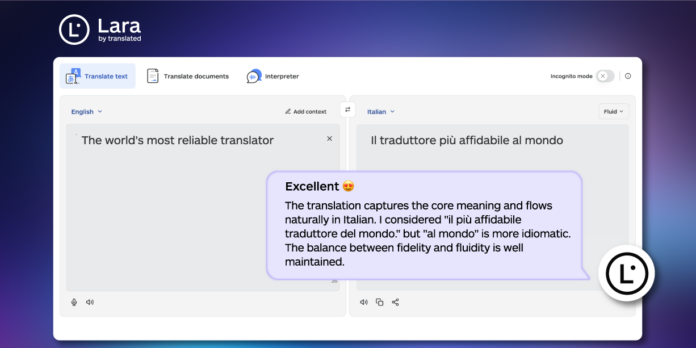
With a redesigned architecture and new features, Lara V2 delivers greater accuracy and responsiveness, enabling deeper integration of human translation into the localization process and enhancing the translation experience for every user on the Lara Translate platform.

Rome, June 4, 2025 — Translated, a leading provider of AI-powered language solutions, today unveiled Lara V2, the latest evolution of its translation AI. Building on Lara’s acclaimed debut in November 2024, which professional translators consistently preferred over leading machine-translation systems in a double-blind evaluation, Lara V2 moves Translated closer to its mission of allowing everyone to understand and be understood in their language. Human A/B testing by three expert linguists, using majority voting, showed that Lara V2’s output was preferred up to 46% more often than that of the previous model.

Now supporting 50 languages and locales, Lara V2 delivers increased accuracy, improved responsiveness, and is better equipped to meet the evolving needs of global businesses. These results confirm Lara’s ability to provide strong, consistent performance, even for companies with limited linguistic data.

The most notable improvements include:

  • Glossary Integration: Lara now allows users to upload custom glossaries and translation memories to ensure more consistent terminology across all content types.
  • Improved Context Handling: Lara more reliably follows user instructions for tone, style, and formatting, enabling more nuanced and accurate outputs.
  • Expanded Locale Support: Lara now supports 18 additional locales, including British and American English, Canadian French, and Hong Kong Chinese, extending its reach and precision across regional language variants.
  • Document translation via API: Supports Lara’s styles (faithful, fluid, and creative) and translation memories.

Lara V2 is powered by a redesigned architecture featuring a new tokenizer that addresses the issues traditional large language models face when dealing with multilingual data. It was trained on a larger, more diverse, and meticulously cleaned dataset using Trust-Attention V2, Translated’s proprietary methodology that weights high-quality data more heavily during training to produce more accurate and reliable translations. Thanks to this architecture and the newly added features, Lara V2 enables deeper integration of human translation into the localization process, achieving a level of human–AI symbiosis never seen before

The new model is immediately available on Lara Translate’s platform and via API, with new features and language support rolling out in the coming weeks. Users of the Lara Team and Enterprise Plans, which enable localization managers to share their company’s custom-trained model with colleagues, will also have immediate access.

The Lara Translate platform has also received an upgrade. Users can now edit translations directly, either manually or using a new alternative suggestion feature, which will be available soon. Immediate feedback is provided through Lara’s pop-up, a distinctive feature that serves as a quality assurance tool.

Commenting on the launch, CEO Marco Trombetti said: “This release broadens the solutions offered by Translated, enabling Lara users to operate more independently while reaching outstanding efficiency and quality when working alongside our professional translators.

These improvements will help individual translators, teams, and enterprises to scale their translation workflows with greater quality, consistency, and speed, making it easier for everyone to communicate clearly and effectively in their language at any scale.

About Translated

Translated is a leading language services provider and a pioneer in using artificial intelligence (AI) to assist professional translators. The company was founded in 1999 by linguist Isabelle Andrieu and computer scientist Marco Trombetti with the mission to allow everyone to understand and be understood in their language. In pursuit of its mission, Translated invented context-adaptive machine translation (MT) in 2012. Translated’s work is trusted by the largest translation buyers in the world and has been recognized as leading in AI-powered translation technology by IDC Marketscape, CSA Research, and Gartner.

In 2024, Translated launched Lara, a breakthrough translation AI that outperforms leading machine translation and approaches the quality of top-tier professional translators. With Lara, Translated combines the sensitivity of over 500,000 native-speaking professional translators with the speed and capability of machines, making it possible to tackle once-unimaginable localization projects. Today, Translated delivers fast, consistent, high-quality translations to over 300,000 customers in 200 languages and over 40 subject areas.

ASL Interpretation Lawsuit Targets Trump Administration Over White House Briefings

0
White House

A community left out of the conversation

A group of Deaf Americans has filed a federal lawsuit against former President Donald Trump and senior White House officials, alleging that the current administration violated their civil rights by discontinuing the use of American Sign Language (ASL) interpretation during official press briefings. The suit—filed in the U.S. District Court for the District of Columbia—names not only Trump but also White House Press Secretary Karoline Leavitt and Chief of Staff Susie Wiles.

According to the plaintiffs and the National Association of the Deaf (NAD), this rollback of accessibility measures has left Deaf and hard-of-hearing Americans without real-time access to critical national information. They point to a pattern that began after Trump reassumed office in January 2025, contrasting sharply with the previous Biden administration’s practice of providing live ASL interpretation for all briefings and hiring a full-time White House interpreter.

For plaintiffs Derrick Ford and Matthew Bonn—both Deaf individuals who rely primarily on ASL—this omission goes far beyond inconvenience. It has meant missing essential updates on executive orders, healthcare policy, economic changes, and national security. Closed captioning alone, they argue, is not an effective substitute for ASL, especially when many Deaf individuals consider English a second language.

Legal grounds for inclusion

At the heart of the lawsuit is the claim that the Trump administration’s failure to provide ASL interpretation violates Section 504 of the Rehabilitation Act of 1973 and Title II of the Americans with Disabilities Act (ADA). The plaintiffs also invoke the First and Fifth Amendments, asserting that the administration has effectively silenced their right to equal participation in public discourse.

Supporters of the lawsuit emphasize that both Republican and Democratic administrations in recent years have embraced inclusive communication. The NAD previously won a similar case in 2020, compelling Trump’s first-term White House to include ASL interpreters in COVID-19 briefings. That precedent, they argue, makes the decision to withdraw interpreters in 2025 even more egregious.

“This is not about politics,” said a NAD representative. “It’s about access. About ensuring no American is shut out of essential government communication.”

A call for systemic change

The lawsuit does not seek monetary compensation. Instead, the plaintiffs demand a court mandate requiring future presidential administrations to provide qualified ASL interpretation during all official briefings and press conferences. They also ask the court to formally recognize the exclusion that occurred and to implement measures to prevent similar violations moving forward.

Such structural reform would not only benefit the Deaf and hard-of-hearing community, but also reinforce a broader commitment to accessible governance. “We’re not asking for special treatment,” said plaintiff Derrick Ford. “We’re asking for equal footing.”

Implications for government communication

Legal experts say this case could have wide-reaching implications for how accessibility is embedded into public communication strategies. If the plaintiffs succeed, the ruling could solidify ASL interpretation as a non-negotiable standard for real-time government messaging—on par with captioning, translation, and digital accessibility.

Recent developments in on-device ASL translation, such as Google’s SignGemma, show that both public and private sectors are moving toward more inclusive communication—but lawsuits like this one highlight how much institutional effort is still required at the federal level.

“Access to information is a civil right, not a courtesy,” one legal analyst noted. “This case could shape not only how this administration communicates, but how all future administrations are held accountable.”

As the legal battle unfolds, it signals a broader reckoning with what inclusive democracy truly looks like—and who gets to participate in it without barriers.

Pacific AI Joins Forces with the Coalition of Health AI as Newest Partner in Assurance Provider Certification Process

0
Pacific AI

LEWES, Del., June 4, 2025Pacific AI, the AI governance company, today announced its intent to pursue operational deployment certification under the Coalition for Health AI (CHAI)‘s Assurance Service Provider certification process. This milestone sets a precedent for how AI models can be responsibly governed in healthcare and reinforces Pacific AI’s commitment to the safe, effective, and trustworthy deployment of AI technologies.

CHAI’s Assurance Services are designed to accelerate the adoption of AI in healthcare by offering tools and frameworks that promote compliance with industry best practices. The certification framework is built on consensus-driven standards that prioritize transparency, trustworthiness, and accountability in real-world AI applications.

As part of this initiative, Pacific AI will collaborate with CHAI to establish a governance framework and pursue designation as a CHAI Certified Assurance Service Provider once the framework is finalized later this year. Upon certification, Pacific AI will offer:

AI Governance Policies

Aligned with CHAI guidelines and current laws, regulations, and industry standards. These policies are continuously reviewed and updated to reflect the fast-evolving regulatory landscape in healthcare AI.

AI Governance Tools and Software

Designed to streamline compliance with governance requirements and help healthcare organizations accelerate the responsible adoption of AI technologies.

Assurance Service Providers play a critical role in building trust by offering transparency into how AI models perform in real-world settings. While these services are not part of formal government regulatory processes, they help fill vital gaps in the AI evaluation pipeline—enabling users and stakeholders to better understand the reliability and context-specific performance of AI systems.

“As we advance our mission to enable responsible, trustworthy AI, this is one of the first of many collaborations in which CHAI-certified service providers and health institutions will work together to ensure AI serves all patients,” said Dr. Brian Anderson, CEO of CHAI. “We’re proud to see Pacific AI lead the way in simplifying product evaluation and enabling easier comparisons during AI procurement in healthcare.”

“Partnering with CHAI to build governance processes and pursue formal certification reflects our shared mission to advance the responsible deployment and oversight of AI in healthcare,” said David Talby, CEO of Pacific AI. “We’re proud to contribute to a trusted ecosystem that ensures AI fulfills its promise responsibly.”

Pacific AI upholds the highest standards for ethical and secure AI validation. The company is committed to co-developing CHAI’s governance framework, which addresses key areas such as privacy, security, data quality, intellectual property protection, conflict of interest management, and adherence to CHAI standards like the CHAI Model Card.

For more information about Pacific AI, visit www.pacific.ai. To learn more about CHAI and its Assurance Service Providers, visit www.chai.org.


About Pacific AI

Pacific AI helps organizations deploy AI systems that comply with the rapidly evolving U.S. regulatory landscape. Whether you’re getting started with AI governance or need to implement tools, controls, or audits for existing systems, Pacific AI delivers practical, future-ready solutions. Learn more at www.pacific.ai.

About CHAI

The Coalition for Health AI (CHAI) is committed to establishing trusted guidelines for responsible AI in healthcare. Its mission is to ensure high-quality care, promote public trust, and meet growing health needs. CHAI convenes experts from health systems, startups, government, and patient advocacy to advance standards in privacy, fairness, transparency, usefulness, and safety of healthcare algorithms.


Press Contacts

Gina Devine
Head of Communications
Pacific AI Corp.
gina@pacific.ai

Media Contact for CHAI

chai@12080group.com

John Snow Labs Acquires WiseCube to Refine and Safeguard Medical AI Models with Knowledge Graphs

0
John Snow Labs

LEWES, Del., June 4, 2025 — John Snow Labs, the AI for healthcare company, announced the acquisition of WiseCube, a pioneer in biomedical knowledge graphs and AI-powered literature analysis. This acquisition reinforces the company’s mission to deliver responsible, accurate, and explainable healthcare AI solutions, now enhanced by WiseCube’s billion-scale knowledge platform.

WiseCube integrates and analyzes disparate biomedical datasets to provide fast, literature-backed answers to complex medical questions. Its use of cutting-edge biomedical ontologies and documents ensures access to the most current and comprehensive medical knowledge. This capability has proven indispensable, revealing new use cases and solutions John Snow Labs can now support — including drug discovery and precision medicine within its Medical Chatbot Platform.

Through the acquisition, John Snow Labs will:

Enhance Biomedical Literature Review:

Leverage proprietary algorithms to perform holistic analysis of unstructured data and medical ontologies, generating new scientific hypotheses.

Accelerate Drug Discovery:

Uncover hidden relationships among drugs, genes, and diseases, reducing the time from discovery to clinical trials.

Improve Hallucination Detection for Medical LLMs:

WiseCube’s Pythia service includes a hallucination detection tool that monitors AI-generated responses for alignment with verified medical knowledge, improving the safety and regulatory compliance of medical AI applications.

“With John Snow Labs’ leadership in healthcare AI, our combined teams can now bring safe and effective AI solutions to the market at scale,” said Vishnu Vettrivel, CEO of WiseCube. “We look forward to improving research productivity, clinical decision-making, and patient outcomes together.”

“The integration of WiseCube’s knowledge graph technology into our healthcare AI solutions enables a new level of accuracy and reliability for our customers,” said David Talby, CEO of John Snow Labs. “We’re excited to accelerate our ability to deliver real-world, production-ready solutions that clinicians and researchers can trust.”


About John Snow Labs

John Snow Labs, the AI for healthcare company, provides state-of-the-art software, models, and data to help healthcare and life sciences organizations harness the power of AI. Developer of Medical LLMs, Healthcare NLP, Spark NLP, the Generative AI Lab No-Code Platform, and the Medical Chatbot, John Snow Labs’ award-winning medical AI software powers the world’s leading pharmaceutical companies, academic medical centers, and health technology firms. As the creator and host of The NLP Summit, the company is committed to advancing and educating the global AI community.

Contact:

Gina Devine
Head of Communications
John Snow Labs
gina@johnsnowlabs.com

UConn’s Translation Program Gains Ground in Global Literary Circles

0
Peter Constantine: UConn literary translation

Poetry translations from the university’s journal make the longlist for a leading anthology

Recognition on an international stage

The University of Connecticut (UConn) is earning recognition for its contributions to literary translation. Four works published in its World Poetry Review journal recently made the 2026 longlist for Best Literary Translations, an annual anthology from Deep Vellum.

Moreover, one of these translations secured a spot for publication: Kate Deimling translated six poems by French poet Gabriel Zimmerman into English. This milestone highlights both the program’s quality and World Poetry Review’s role as a platform for student-led multilingual translation.

A program built on practice

Since 2016, UConn’s literary translation program has given students hands-on experience translating poetry, prose, and dramatic texts into English. The curriculum emphasizes linguistic accuracy, cultural nuance, and stylistic fidelity.

Under the direction of translator and editor Peter Constantine, the program features collaborative workshops, courses in translation theory, and publication opportunities. Students translate from a wide range of source languages, including French, Bulgarian, Spanish, Chinese, and Arabic. Additionally, they receive direct mentorship from faculty and industry professionals.

Constantine, who edits World Poetry Review, noted that this recognition reflects the high level of work produced by students in the program.

Momentum in the field

Last year, Jonathan Dunne’s translation of Bulgarian poet Yordan Eftimov appeared in the 2025 edition of Best Literary Translations. Now, this marks the second consecutive year that World Poetry Review has contributed to the anthology. As a result, UConn’s program continues to gain visibility within the international translation community.

Furthermore, recent grants and awards from organizations such as the National Endowment for the Arts and PEN/Heim have supported UConn students. These honors reinforce the university’s reputation as a strong foundation for emerging literary translators.

As UConn prepares for its next academic cycle, faculty, and students look ahead to further advancing the university’s impact on global literary translation.

The Need to Better Serve Tibeto-Burman Languages

0
Letters in Tibetan language

Speakers of Asia’s Sino-Tibetan languages account for a large portion of consumers in the language industry, as Asia-Pacific occupies the position of fastest-growing market area and North America (with its large Asian immigrant population) maintains its position as largest market area overall. While the focus of language services is often on common Sino-Tibetan languages such as Mandarin Chinese, smaller languages — specifically those in the Tibeto-Burman subgroup — are often left behind.

What Are Tibeto-Burman Languages?

Tibeto-Burman languages are part of the Sino-Tibetan language family, which is the world’s second-largest language group with approximately 400 languages and 1.4 billion speakers worldwide. Geographically covering Asia’s Eastern, Southeastern, and Southern countries, the language family is divided into two branches: Sinitic and Tibeto-Burman.

Sinitic languages are largely defined as those whose meaning is derived from pictographs and tones, including all Chinese languages (the Latin word Sinae refers to China). Mandarin, Cantonese, Hokkien, Taiwanese, and Shanghainese are all Sinitic languages.

Tibeto-Burman languages, on the other hand, share lexical roots with their surrounding neighbors in Asia, as seen in their similar vocabularies that collectively trace back to Proto-Tibeto-Burman. Tibeto-Burman languages include Burmese, Tibetan, Meitei (Manipuri), Karen, and Bodo.

Services in Tibeto-Burman Languages

While a large portion of language service providers (LSPs) within the United States (US) offer services for Sinitic languages, an overwhelming majority do not have the capability to support Tibeto-Burman languages. For example, Transperfect — the number one LSP based in the US — offers seven Sinitic languages but only three Tibeto-Burman languages. This proves that even the most financially equipped LSP with the greatest availability of resources is only able to provide a small number of languages within this vast language family.

Similarly, while there are a considerable number of certified linguists for more commonly used Sinitic languages, there is a shortage of those whose language pairs include a Tibeto-Burman language. To make matters worse, hundreds of lesser-known Tibeto-Burman languages come from remote mountain regions, which makes them incredibly difficult to properly document for public access.

To overcome these challenges, the language industry needs to invest in linguistic research supporting the documentation of lesser-known Sino-Tibetan languages, as well as create more linguistically diverse training programs for emerging professionals. This will allow LSPs to bridge the gap for one of the largest language families by population and better serve consumers across the globe.

What Are “Critical Languages” in the United States?

0
United Nations in New York City

Did you know that the United States (US) government officially designates certain languages as “critical” to maintaining national security, diplomacy, and economic competitiveness? Languages with “critical” status receive government-provided incentives for boosting proficiency levels among Americans for reasons of strategic necessity. 

The designation was established in 1991 with the passage of the David L. Boren National Security Education Act. While there is no required number of critical languages, historically, there have been between 12 and 15 active critical languages at any given time. As of 2025, eight out of the 12 active critical languages rank within the top 14 most-spoken languages in the world by population.

On an ongoing basis, the government identifies languages that are perceived as essential to US interests. Factors in the selection process include geopolitical tensions, trade and economic influence, and limited US proficiency. Instead of integrating more comprehensive foreign language education into the American curriculum on a permanent basis, education in certain languages is bolstered when these global factors demand it.

The Department of State (DOS) and the Department of Defense (DOD) are the two main governing bodies that oversee the creation and implementation of the list. These agencies work together to ensure that language education within the US aligns with current needs that constantly shift based on global events.

More specifically, the Secretary of Defense is responsible for determining which languages are included in the list, primarily through its Defense Language, Regional Expertise, and Culture Program (LREC). In addition, the Office of the Assistant Secretary of Defense serves as the custodian for the list. The DOS, meanwhile, is responsible for implementing government programs such as the Critical Language Scholarship Program (CLS), which are used as incentives for American students to quickly learn these languages in exchange for college credit and federal-level jobs.

There are many ways in which the establishment of critical languages affects the country’s presence on the global stage. Critical language education has undeniably contributed to international intelligence, diplomacy, and trade competitiveness — and will continue to do so in the future as long as foreign policy deems it necessary.