From Advocacy to Infrastructure: The Rise of the Linguistic Justice Foundation (LJF)

0
Linguistic Justice Foundation (LJF)

For years, linguistic justice has depended on isolated advocates pushing for change without the institutional backing they deserve. In a field currently defined by fragmentation, the Linguistic Justice Foundation (LJF) is quickly emerging as one of the first organizations capable of turning scattered advocacy and representation into coordinated infrastructure. 

Who is the Linguistic Justice Foundation?

Founded in 2024 by Irene Gotera, a bilingual expert in both law and conference interpreting, LJF is the world’s first and only independent 501(c)(3) nonprofit dedicated exclusively to linguistic justice. Based in Virginia, the foundation positions linguistic justice not as a niche concern but as a global equity issue. Its early work focuses on the Americas and Asia, with plans to expand worldwide as it builds the institutional scaffolding the field has historically and collectively lacked.

What sets LJF apart is its insistence on professional-grade interventions. Rather than treating linguistic justice as an aspirational ideal, the foundation approaches it as a structural problem. And it builds infrastructure equal to the task: research-informed tools, educational resources, and systematic support for linguists attempting to implement language rights in real-world contexts. While advocates often operate without institutional backing, on Capitol Hill for example, LJF is positioning itself to become that missing backbone for better implementation.

Multilingual Roots and a Global Equity Lens

LJF’s multilingual identity is foundational to its purpose. The organization communicates in both English and Spanish, reflecting the founder’s bilingualism and the demographic realities of the Americas, where Spanish is the second-most-spoken language. In addition to Spanish, the selected team of linguistic experts together represent a multitude of other languages, reinforcing the nonprofit’s commitment to accessibility and to building a justice framework that reflects the diversity of lived linguistic experience.

Its bilingual editorial work, including curated content and contributions to their developing publication Voiceful Magazine, deliberately channels linguistic justice as a lived practice. Through accessible blog posts and multilingual educational resources, LJF is actively shaping public understanding of what linguistic justice is, and what it is not by reaching beyond the English language. Most notably, to further demonstrate its commitment to global accessibility, the organization not only encourages those from within the industry to take action and partake in the initiative, but also encourages anyone who is passionate about ensuring linguistic justice in any and every language.

From Advocacy to Infrastructure

The clearest indicator of LJF’s early success is the Language Rights Pledge. Created in 2025, it functions as both a visibility tool and a constituency, giving LJF a level of network power unusual for such a young organization. Signed by more than 500 individuals, institutions, and organizations across healthcare, education, government, interpreting, and academia, the cross-sector network signals a field ready for coordination, legitimacy, and shared purpose of language justice across the board. The pledge’s implementation demonstrates that the foundation is not merely raising awareness, but actively building and pushing for a global movement.

As LJF expands, its influence is beginning to extend into sectors traditionally dominated by language access providers, public institutions, and commercial language services. The foundation is not a language service provider (LSP), however, nor does it aim to be. Instead, it is carving out a distinct role adjacent to the industry where it translates linguistic advocacy into applied infrastructure. With its bilingual educational resources, professional-grade interventions, and growing pledge network, LJF is positioning itself as a future reference point for standards, ethics, and rights-aligned practice.

In a landscape where linguistic equity has too often been reactive, fragmented, or underfunded, the Linguistic Justice Foundation represents something new. A coordinated, rights-based force with the potential to reshape how institutions understand and uphold language rights, its rise signals a shift from advocacy to architecture for the world to follow.

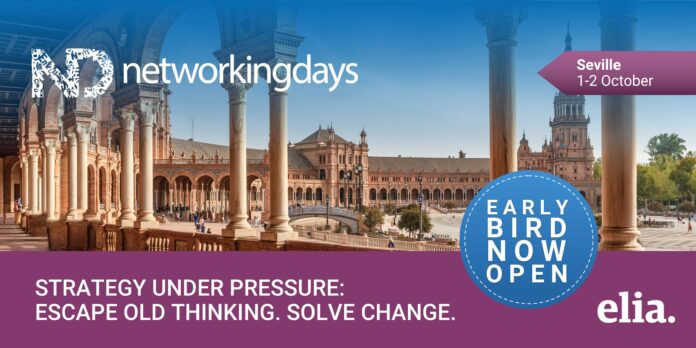
ELIA Networking Days 2026: Strategy Under Pressure: Escape old thinking. Solve change.

0
ELIA Networking days 2026 Early Bird Registration open announcement

ELIA is pleased to announce that registration is now open for ELIA Networking Days 2026, taking place on 1-2 October 2026 at the Meliá Lebreros Hotel in Seville, Spain.

Under the theme Strategy Under Pressure: Escape old thinking. Solve change, this year’s event comes at a defining moment for language service companies. Inspired by Escape Rooms, this year’s program turns business challenges into shared puzzles to solve. Across the event, participants will look for clues, test assumptions, unlock new perspectives and work together to find routes forward.

Networking Days 2026 is designed for owners, executives, operations and sales leaders, consultants, and decision-makers looking for practical ways to respond to change. In ELIA’s signature interactive format and inspired by the concept of an escape room, attendees will work with peers to move beyond business-as-usual thinking and explore the strategic choices needed to remain competitive today.

The program will open with keynote speaker Julio Leal, Head of Localization at Rover.com, who will present The Master Key. Bringing a buyer-side perspective, Julio will explore how client needs are evolving and what this means for language service providers (LSPs) seeking to build relevant, resilient offerings.

Day one will focus on escaping old assumptions about what clients buy, where growth comes from, and how companies can collaborate more effectively. Through facilitated group sessions and dedicated networking, attendees will examine how AI is changing purchasing behavior, how to identify opportunities beyond saturated markets, and how to build a stronger network of collaborators, partners, and problem-solvers.

Day two will turn attention to business transformation and strategic renewal. Participants will explore how consultants can support LSPs through change, how to rebuild offerings when demand shifts, and how peer coaching can help leaders work through real business dilemmas with fresh perspective and practical input.

Alongside the sessions, Networking Days 2026 also includes a welcome drinks evening, the famous Networking Dinner, and a city treasure hunt, creating valuable space for conversations and connections beyond the program.

The question is, will you uncover the clues that unlock your next business opportunities?

Early Bird is now open for a limited time. Secure your place to rethink strategy under pressure, exchange practical insight with peers, and build the clarity and connections needed to solve change together.

Interpreters Unlimited First to Add AI Interpretation and Translation to GSA SIN 541930

0
Interpreters Unlimited Group of associated companies

As artificial intelligence rapidly expands across government and public services, Interpreters Unlimited (IU) has announced it has become the first Language Service Provider to add AI powered interpretation and translation services to GSA SIN 541930 under the General Services Administration’s Multiple Award Schedule.

SIN 541930 covers interpretation, translation, ASL, localization, transcription, and multilingual accessibility services used across healthcare, courts, emergency response, education, defense, law enforcement, and other government operations. The addition allows federal, state, and local government agencies to procure AI supported language services directly through the GSA Schedule while maintaining the human oversight, quality control, confidentiality, and accountability increasingly being called for at the federal level.

The announcement comes at a time when artificial intelligence has become one of the most heavily debated topics in Washington, with growing national conversations surrounding AI adoption, workforce modernization, government efficiency, and safeguards against misuse in high stakes environments. It has been a major focus across Washington, including recent efforts by the current administration to expand AI development and AI services as part of broader government modernization initiatives included in the administration’s “Big Beautiful Bill.”

IU offers 100% human interpretation and translation, AI powered language services, and Hybrid AI + human supervised solutions. Every hybrid AI translation delivered through IU undergoes review, editing, and quality control by qualified human linguists with subject matter expertise in the specific field being translated.

“We are not replacing humans with AI. We are building responsible systems where technology and human expertise work together,” said Interpreters Unlimited CEO Shamus Sayed. “Government agencies want innovation, speed, and efficiency, but they also need accountability and accuracy, especially when communication affects healthcare, legal rights, public safety, or critical government services.”

The IU hybrid model can reduce turnaround times by up to 50% and costs by approximately 30% while still ensuring every final translation is reviewed and verified by experienced human translators. The company says the approach has become increasingly attractive to government agencies balancing modernization efforts with compliance, accessibility, and public trust concerns.

Recent federal attention surrounding AI oversight has intensified following the release of the U.S. Commission on Civil Rights’ landmark report on language access, formally delivered to the President of the United States and Congress after unanimous bipartisan approval. The 214 page report specifically warned about the risks associated with overreliance on artificial intelligence and machine translation without proper human oversight, particularly in situations involving healthcare, courts, emergency response, public benefits, and other essential services.

Interpreters Unlimited CEO Shamus Sayed directly contributed industry insight and guidance during the Commission’s yearlong investigation and discussions surrounding the report. “For years, we have said the future is not AI alone and it is not humans alone. The future is responsible human supervised AI,” said Sayed. “That is exactly where this industry is heading, and frankly, where it needs to head.”

The company believes adding AI supported services to GSA SIN 541930 represents an important shift in how government agencies may approach multilingual communication moving forward, particularly as federal agencies continue exploring practical uses of artificial intelligence under increased public and legislative scrutiny.

About Interpreters Unlimited, Inc.

The IU Group of companies include: Interpreters Unlimited, Accessible Communication for the Deaf, Albors & Alnet, Arkansas Spanish Interpreters and Translators, and IU GlobeLink, LLC, and are headquartered in San Diego, California as a minority-owned company.  IU Group is committed to providing equal opportunity in the work environment with its diverse team to aid in supplying linguistic and cultural interpretation services to clients. A combined 70 years in the industry has demonstrated a surplus of leadership and best practices, which has helped establish its respected role in the language services community. Its services include interpretation, document translation and non-emergency medical transportation.

Ravi Chandran Krishnadas Joins RWS as Senior Vice President & Country Lead, India

0
Ravi Chandran Krishnadas

RWS (AIM: RWS.L), a global AI solutions company, has announced that Ravi Chandran Krishnadas has joined as Senior Vice President & Country Lead, India, effective 1 June 2026. The appointment marks an important step in RWS’s strategy to strengthen India as a major operations and innovation hub as demand for enterprise AI solutions continues to grow worldwide.

In his new role, Ravi will unify RWS’s presence across India, bringing together technology, product, services and shared functions to help deliver faster, more integrated outcomes for global clients. Ravi brings two decades of leadership experience across technology, product development and management, transformation and global shared services. He has held senior roles at organizations including News Corp, Epsilon, ICF and Thomson Reuters. Most recently, he was Regional Vice President, Infrastructure Delivery at News Corp, based in Bangalore.

“India is central to how we deliver for our clients. Ravi’s appointment reflects our ambition to move faster, work smarter and unlock the full potential of our India teams. His combination of technology expertise, operational leadership and deep understanding of global businesses means he is exceptionally well-placed to drive growth, elevate our client delivery and strengthen RWS’s position as a world-class AI solutions company,” said Ben Faes, CEO of RWS.

Ravi will also lead RWS’s external engagement in India – building relationships and partnerships with government bodies, industry associations and strategic organizations to position RWS as a leading employer in one of the world’s fastest-growing technology markets.

“RWS has an impressive base of talent across Bangalore, Indore and Mumbai, and there is a clear opportunity to bring that capability together in a way that supports our colleagues, clients and long-term growth. I’m looking forward to working with teams across the business to build a strong, connected India presence that contributes to RWS’s global ambitions,” said Ravi Chandran Krishnadas.

About RWS

RWS, headquartered in the UK, is a global AI solutions company empowering one of the world’s most trusted enterprise AI. It’s proprietary Cultural Intelligence Layer, powered by 250,000 data specialists, cultural and language experts and deep domain professionals, backed by 45+ patents, makes enterprise AI culturally fluent, contextually accurate and secure, ensuring every interaction reflects a brand’s tone, context and customer values. Through its Generate, Transform and Protect segments, it delivers intelligent content, enterprise knowledge, large-scale localization and IP protection for global growth. RWS provides the confidence, governance and expertise organizations need to deploy AI safely, responsibly and at scale.

Federico Orchansky Joins LocReset and GTE Localize as First-Ever Global Community Manager

0
GTE Localize

LocReset and GTE Localize have announced that Federico Orchansky has joined the team as Global Community Manager, the first role of its kind across both brands.

Federico brings a strong mix of outbound energy, community-minded thinking, and a background in International Relations, along with hands-on experience supporting localization and language services companies. In his new role, he will help turn the LocReset audience into an engaged community, create stronger bridges between buyers, providers, and operators, and support the design of more meaningful experiences across LocReset initiatives.

“We’re thrilled to welcome Fede to the team,” said Matt Grotenstein, Host of LocReset and VP of North America at GTE Localize. “He brings the kind of curiosity, drive, and relationship-building mindset that fits exactly where we’re headed. This is a big step in building something community-first.”

As LocReset and GTE Localize continue expanding their thought leadership and community offerings, Federico will play a key role in helping shape conversations around localization, AI, and global business in a more connected and practical way.

About LocReset

LocReset is GTE Localize’s flagship thought‑leadership podcast exploring how AI is reshaping localization, content operations, and global growth. Hosted by VP of North America and industry veteran Matt Grotenstein, it features leaders across tech, media, and enterprise who share practical, no‑hype insights for modernizing multilingual workflows and scaling global content programs.

About GTE Localize

GTE Localize is a global translation agency delivering machine and human translation across 100+ languages. With ISO‑certified quality, industry‑expert linguists, and multi‑step QA, it supports marketing, technical, legal, and enterprise content. The company operates from the US, UK, Singapore, and Vietnam, serving clients worldwide.

As Enterprise AI Evolves, Alexa Translations Introduces Apertera

0
Alexa Translation's new brand identity Apertera

Apertera, formerly Alexa Translations, has announced the transition from a traditional language‑services model to an AI‑driven enterprise communication platform. The new brand reflects the company’s evolution beyond translation toward broader adaptive AI solutions for high-stakes communication. 

As enterprise AI rapidly transforms the way organizations operate, high-profile examples of hallucinated outputs and context failures are reshaping expectations around what enterprise AI must deliver. In response to these evolving demands, Alexa Translations is introducing Apertera, a new brand designed to support the next generation of high-stakes communication and AI-powered enterprise workflows.

As enterprise AI adoption has matured, what began with concerns around generic AI has shifted toward secure, approved systems, but for organizations operating in regulated environments, security alone is no longer enough. Increasingly, businesses require AI solutions that understand context, adapt over time, and deliver the precision that complex work demands.

Built on more than two decades of experience supporting legal, financial, and regulated organizations, Apertera combines advanced AI with deep domain and professional expertise to help teams operate with greater precision, consistency, and confidence. 

The shift in enterprise AI

From tools that generate outputs to systems that understand the work. And as context accumulates over time, Apertera becomes increasingly aligned with how organizations operate, continuously reinforcing terminology, standards, and organizational preferences.

Gary Kalaci, CEO of Apertera, believes the next phase of enterprise AI will be defined by systems built for regulated environments that continuously adapt to the organizations they support. “Organizations are looking for systems that evolve alongside their business, supported by teams that understand their standards, workflows, and what’s at stake. In high-stakes environments, the real advantage isn’t just speed. It’s long-term alignment, accumulated context, and the ability to deliver work that stands up under scrutiny,” he noted.

Beyond translation

Translation is where Apertera built its foundation. But as AI and enterprise communication continue to evolve, the need goes beyond translating content. Organizations increasingly require systems that can help manage, adapt, and scale complex enterprise communication with precision. Apertera reflects that broader vision, creating a foundation for expanded capabilities, deeper integration, and new ways to deliver value over time.

The future isn’t about replacing translation. It’s about building on it.

About Apertera

Apertera, Canadian-owned and ISO 17100 and SOC2 certified, is helping to lead the evolution of language solutions for high-stakes content. It partners with enterprises as an extension of their teams, combining professional expertise with Adaptive AI technology that is continuously refined by client context. For more than twenty years, Apertera has set the bar for legal, financial, and regulatory translation, serving the most rigorous buyers, including over 75% of major national Canadian law firms, all major banks, and leading securities regulators.

The Language Bias in AI Search Is Costing You Rankings

0
cityscape and superimposed digital map

There is a question localization programs rarely ask. Not because it’s difficult but because it sits just outside the scope of what localization professionals have traditionally been hired to do.

Will this content actually earn authority in the market it’s being translated for?

For the industry’s history, that question belonged to marketing and search engine optimization (SEO). Localization handled the language. Authority was someone else’s problem. That division made sense when search engines used geographic signals to give local content a fighting chance and when a translated page had a reasonable shot at ranking simply by existing in the right language.

Artificial intelligence (AI) search has changed the math in ways the industry hasn’t fully reckoned with yet.

Peec AI analyzed over 10 million ChatGPT prompts and found that 43% of the background queries the AI runs when answering a non-English question are performed in English. In nearly 78% of non-English sessions, AI supplements its research with at least one English-language search, regardless of what language the user typed in or where they’re asking from.

That’s the system working as designed, optimizing for sources it has been trained to treat as authoritative. On those topics, in those categories, those sources are in English. A local company asking why they’re invisible in AI search results for their own market is really asking why their content isn’t in the sources AI search trusts. Language alone doesn’t answer that question.

The Wrong Instinct

A German user asks ChatGPT about German software companies. In German. From Germany. Not one German company makes the list.

Run the same test tomorrow and you might get different results. That inconsistency is exactly the point.

The instinct when you hear “AI search has a language bias” is to think about translation. Make more content in German. Get better at localizing. There are two different things happening when someone searches in German, though. Getting an answer in German. And getting your company into that answer. AI search conflates them. Companies expanding into non-English markets need to stop conflating them too.

When someone uses traditional search, they see a list of links. Google spent 20 years building infrastructure around geographic signals, local domains, local backlinks, and local behavioral data to give local results a fighting chance. AI search generates one answer, assembled from whatever sources the model determines to be credible. If your company isn’t in those sources, there is no page two to scroll to.

The companies that appear in AI results for non-English queries are the companies with the strongest English-language authority signals. Backlinks. Citations. Content depth that English-language publications have indexed, referenced, and built on top of. A local company that dominates its home market, has excellent reviews, and a well-built local website can be completely invisible in AI search — not because the model is working against them but because the evidence of their authority exists in a language the model weights less heavily.

Going global used to mean fighting for visibility abroad. Now you have to fight for it at home too.

What the Standard Localization Playbook Produces

Localization programs are built around the same workflow. Write content in English, translate it into the target language, polish the output for local audiences, publish. The result reads correctly. The keywords are adapted. The register is close.

When the rankings don’t move, the advice is usually “give it time, authority builds gradually.” That’s a partial truth. Time does matter. But local authority requires more than a correctly localized page, and no amount of waiting fixes content built on the wrong foundation.

I run a localization agency. We recommend AI translation for blog content regularly. The economics make sense and the quality floor has risen significantly. What I’m describing isn’t a criticism of that approach. For many clients it’s exactly the right starting point. The honest observation is that translating existing content, however well, produces a correctly localized page. Earning authority in that market requires something the translation layer was never designed to deliver.

The gap sits upstream of translation entirely. It lives in the decisions about what gets written before anyone opens a translation tool.

Localization Has Always Been Research

Localization has never been pure execution. Everyone who has worked in it knows this, even if the industry’s billing structures have often pretended otherwise.

Good language work involves researching terminology, investigating how a concept lives in the target culture, making judgment calls about register and reference that require genuine knowledge of the market. The craft has always had an intelligence layer built into it. That’s what the industry has defended as its core value for decades, and rightly so.

That intelligence layer needs to move. Not disappear. Move.

AI is automating linguistic execution faster than the industry expected. The quality floor for translation has risen significantly and will keep rising. What AI cannot do is understand what a German B2B buyer is actually searching for versus what an English-language product brief assumed they were searching for. It cannot know that a Polish market is at a different stage of awareness about a problem category than the US market the content was originally written for. It cannot tell a client that the topic their English team identified as high-priority has already been covered to saturation in that language, or that the angle they’re missing is the one that would actually earn local backlinks.

That is research work. It is skilled work. It is exactly the kind of market intelligence that local language specialists are better positioned to provide than anyone else in a localization workflow, and in the vast majority of programs, they’re never asked to do it.

What Getting It Right Looks Like

The companies building real content authority in non-English markets are treating local market entry as a content intelligence decision first, with translation following from that rather than leading it.

Before any content gets written, the questions worth asking are different from the ones an English content brief typically covers. What is this market actually searching for? What stage of the conversation are local buyers at? Which angles exist in English that don’t land here? What are local audiences asking that the English content strategy never considered?

For a software-as-a-service company entering Germany, that might mean understanding that German enterprise buyers want GDPR compliance context built into product explanations before they’ll engage with feature comparisons. For a fintech company entering Poland, it might mean recognizing that the market maturity gap means educational content outperforms conversion-focused content at this stage. For any company with a blog, it means asking whether the topics that perform in English are the topics worth localizing at all, or whether the smarter investment is a multilingual content strategy built around what local audiences actually search for.

Translation delivers the language. The strategy behind what gets written requires something else entirely, and AI search has made the cost of skipping that step visible in a way traditional search never did. Authority in local markets now has direct consequences for AI search visibility, which means it has direct consequences for whether a company exists in AI-generated answers in their own home market. The businesses that understand this are involving local expertise earlier — before the brief, before the topic list, before the English version gets written.

What the Industry Does With That

The localization industry is at a genuinely interesting inflection point. AI is taking over a significant portion of what was once billable execution work, and the response in many agencies has been to compete on price and speed for a job that machines are going to keep getting better at.

The more interesting direction is upstream. Local language specialists who have spent careers developing market knowledge, terminology expertise, and cultural intuition are perfectly positioned to do something more valuable than post-editing. They can be the intelligence source that determines what content a company should be creating for a given market in the first place.

That is a different service. It requires a different conversation with clients. It means telling a company that the 10 blog posts they want localized are the wrong 10 blog posts for that market — and being able to explain why. It means treating local content strategy as a deliverable, not a side note.

Local language expertise is market knowledge. The localization industry has been selling it as a finishing layer when it belongs at the foundation.

The question AI search has forced into the open is whether companies building content for non-English markets are producing content that earns authority there or content that merely exists there. The localization industry is the right place to answer that question. Whether it does is still being decided.


Didzis Grauss is the founder of Native Localization, a localization agency helping software companies build content infrastructure for international markets.

The Week in Review: Language Industry News May 27 – June 1

0
Week in Review May 27 - June 1

This week’s stories reveal an industry doubling down on capacity‑building in diverse ways — from interpreter training and multimedia orchestration to privacy‑aligned AI translation and language revitalization. Across sectors, organizations are investing in the systems that make multilingual communication sustainable, ethical, and future‑ready. 

Expansion

Acclaro has introduced Acclaro Multimedia Orchestration, an AI‑powered solution designed to streamline end‑to‑end multimedia localization as global demand for multilingual content accelerates. The platform integrates AI with Acclaro’s human expertise into 100+ languages, supporting workflows that range from fully human to fully automated. Positioned as a unified alternative to fragmented tools, the solution enables organizations to localize and distribute multimedia content with greater speed, accuracy, and scale.

The Academy of Interpretation and the De La Mora Institute of Interpretation have formed a new partnership allowing both organizations to host and promote each other’s courses. An expansion of access to high‑quality interpreter training, the collaboration strengthens a growing interpreter‑education ecosystem by giving students from both communities a broader catalog of programs while supporting the rising demand for qualified interpreters nationwide. With AOI featuring five De La Mora courses to start and De La Mora hosting AOI’s full catalog, both institutions frame the partnership as a commitment to elevate training standards, accessibility, and professional development. 

SweetP Productions has released XLIFF Editor 4.0, a major macOS update that introduces AI‑powered translation, TMX import/export, and complete XLIFF 2.x specification compliance — closing a long‑standing gap in the Mac localization toolchain. The rebuilt parser and serializer deliver true round‑trip fidelity for complex files, while new features bring professional‑grade CAT functionality to native macOS users. With support for sdlxliff/xlz packages, customizable QA tools, and a fully keyboard‑driven workflow, version 4.0 positions XLIFF Editor as a robust, specification‑accurate alternative to Windows‑centric enterprise tools. 

Community

Cork County Council has launched its fourth annual Irish Language Events and Initiatives Grant Scheme, offering up to €1,500 per event to support Irish‑language and bilingual projects. Designed to promote community use and language visibility across the county, the scheme welcomes applications for recurring or one‑off events with the goal of strengthening Irish as a living community language. County leadership emphasized that the grant supports both Gaeltacht and non‑Gaeltacht organizations, encouraging groups countywide to apply before the June 26 deadline. 

Pairaphrase has finalized a Student Data Privacy Agreement with Edmonds School District under the National Data Privacy Agreement framework. Authorizing the company to handle student‑related data for AI translation across 16 participating states, the agreement now positions Pairaphrase as an approved and qualified ed‑tech provider. By enabling districts to translate multilingual communications, IEPs, forms, and records without exposing sensitive information to consumer tools, the DPA gives schools a governed, AI‑driven translation workflow designed specifically for K‑12 privacy expectations.

______________________________________________________________________________________________________________________________________________

From interpreter training to multimedia orchestration and privacy‑aligned AI in schools to community‑rooted language initiatives, this week’s stories show an industry investing in the long game with infrastructure that supports multilingual life at every scale. It’s a reminder that language work is never static; it’s a living ecosystem, and this week, that ecosystem grew stronger. 

For more stories like these, visit our News section.

From Population Intelligence to Real-Time AI Interpretation: Piedmont Global Launches Connexus

0
Piedmont Global Launches Connexus

Piedmont Global, a Strategic Globalization Organization (SGO), has announced the launch of two platforms: CensIQ™, a population intelligence and language access planning platform, and Connexus™, an enterprise interpretation management platform. Together, they represent the first public expression of Piedmont Global’s SGO model, linking population intelligence, policy alignment, organizational planning, and service delivery through a unified insight-to-action architecture.

  • CensIQ provides the intelligence layer, helping organizations understand evolving language access needs while aligning policies, plans, and resources to meet them. Connexus serves as the delivery platform through which human interpreters and AI-powered interpretation services are deployed, managed, and measured across every modality.
  • Connexus responsibly consolidates human and AI interpretation within a single delivery model: Over-the-Phone Interpretation (OPI), Video Remote Interpretation (VRI), Onsite Interpretation (OSI), and the real-time Speech-to-Speech AI Interpreter – all in one browser-based platform with 300+ languages and American Sign Language (ASL) embedded across every modality. For healthcare clients, Connexus is designed to be the first EHR-agnostic interpretation platform with instant connectors, built to embed directly in the electronic health record.

Both platforms are built for small- to enterprise-level commercial and public-sector organizations that need compliant, defensible language access at scale where cross-cultural communication is mission-critical.

“For years, language access has treated planning and delivery as separate activities – one focused on what organizations think they need, the other on responding when demand arrives. Our view is that they should be part of the same system. CensIQ provides the intelligence to understand populations, anticipate needs, and continuously refine strategy. Connexus operationalizes those insights through a single platform that orchestrates human and AI interpretation across every modality, creating a continuous feedback loop between planning, delivery, and outcomes. This is our first public launch as a Strategic Globalization Organization, and it reflects how we think language access should work: planned against reality, delivered responsibly, and measured against results,” said Mohamed Hussein, Founder and CEO, Piedmont Global.

How does CensIQ work?

CensIQ is a core component of the intelligence layer within the SGO model. Most language access plans are built as compliance exercises. They often describe what an organization intends to do but provide limited visibility into whether meaningful access is actually being delivered, measured, and improved over time.

CensIQ starts from a different premise: effective language access requires alignment. CensIQ combines demographic and limited English proficiency (LEP) trend intelligence at ZIP, county, and state levels with organizational data, benchmarking, agentic workflows, and consulting expertise to create a shared understanding of what meaningful access requires. The platform helps align policy with execution, federal and state requirements with local realities, leadership expectations with operational capacity, and community needs with measurable outcomes.

The result is more than a language access plan. CensIQ produces assessments, plans, roadmaps, governance frameworks, performance benchmarks, and strategic recommendations that help organizations understand where gaps exist, prioritize resources, establish accountability, and measure progress over time. It enables organizations to treat language access as a living operational capability.

How does Connexus work?

The platform consolidates capabilities that have historically lived across two or three separate vendor relationships. OPI, VRI, OSI, AI interpretation, scheduling, interpreter management, call routing, audit-ready Joint Commission documentation, per-minute billing tied to call detail records, and real-time capacity analytics all run inside one browser-based platform. Pricing is usage-based with no monthly platform fees and no minimums.

The Speech-to-Speech AI Interpreter is linguist-led by design. Linguists with sector expertise own the glossary, the interaction guidelines, and the weekly quality-assurance loop, and the service runs under the same accuracy commitment and audit trail as human interpretation. It supports 50+ languages and commits to 95%+ accuracy on domain-adapted language pairs, with a pre-launch glossary build, real-time confidence scoring, and automatic OPI fallback below threshold.

“Buyers are not asking for another interpretation tool. They are asking for a partner who can absorb the operational complexity of running cross-cultural communication at scale – and prove it in records. That is why we built the SGO model, not just the platform. CensIQ tells clients where the language access gaps are. Connexus closes them. One contract, one SLA, AI scale where it earns its place, humans where the stakes demand it, and the data to defend every decision. That is what our clients are responding to,” said Mary Grothe, Chief Revenue Officer, Piedmont Global.

What systems does Connexus integrate with?

Connexus integrates into the systems clients already run, without changing existing infrastructure.

  • For healthcare clients: Connexus is HIPAA-compliant, Epic SMART on FHIR ready, and in final integration certification, with the Redox middleware path in progress to extend EHR connectivity across 95+ systems. The product is designed to be the first EHR-agnostic interpretation platform with instant connectors, built for the realities of multi-EHR health systems and federal healthcare agencies.
  • For non-healthcare clients: Connexus integrates through SIP trunking, REST API, and direct connectors to Twilio Flex, Genesys, Five9, NICE, Talkdesk, Amazon Connect, RingCentral, and other major contact center platforms.

“We designed everything to embed inside the systems you already run – not to replace them. CensIQ draws its population intelligence from external data sources. Connexus then integrates through Epic SMART on FHIR for the EHR, SIP trunking and direct CCaaS connectors for the contact center, REST API for the data warehouse, and SAML federation for identity. The platform is browser-based, AWS-hosted, ISO 27001:2022 certified, and HIPAA-compliant. IT teams should expect both to fit, not to fight. That is what gets a platform from pilot to production, and what keeps it in the critical path once it is there,” said Jeremy Malara, Chief Information and Technology Officer, Piedmont Global.

“What separates the SGO model is intelligence-first and hybrid by design. CensIQ tells you which languages and modalities to plan for, and it is built to keep that plan current as your population shifts. Inside Connexus, AI handles scale and human OPI handles the calls that matter, with the routing layer making the decision in real time based on confidence scoring. Clients see one dashboard, one accuracy report, and one audit log across both human and AI delivery. That is not how AI speech-translation vendors are building. That is how a language services company that has been credentialing interpreters for thirteen years builds it,” said Saba Dovlatabadi, VP of Product, Piedmont Global.

How can enterprises and government agencies get started?

Connexus is available beginning today through Piedmont Global’s managed interpretation service and through cooperative purchasing vehicles, including the NASPO ValuePoint Remote Interpreting Services contract and the GSA Professional Services Schedule (Contract #47QRAA18D001Y). Piedmont Global holds ISO 27001:2022, ISO 9001:2015, ISO 17100:2015, and ISO 13485:2016 certifications and is a certified minority-owned business.

About Piedmont Global

As a Strategic Globalization Organization (SGO), Piedmont Global provides integrated interpreting, translation, localization, and multilingual media services across 300+ languages. The SGO model rests on eight solution pillars – the Elite 8 – that cover the full span of cross-cultural work: Language Operations, Accessibility, Staffing, Data Services, BPO, Consulting, Content Solutions, and Open-Source Intelligence (OSINT). Together, they help enterprises and government organizations cut vendor sprawl, strengthen compliance, and connect with diverse domestic communities and global markets alike.