Expanding Indigenous Interpreting at the U.N. With First‑Ever Mayan Language Pilot

0
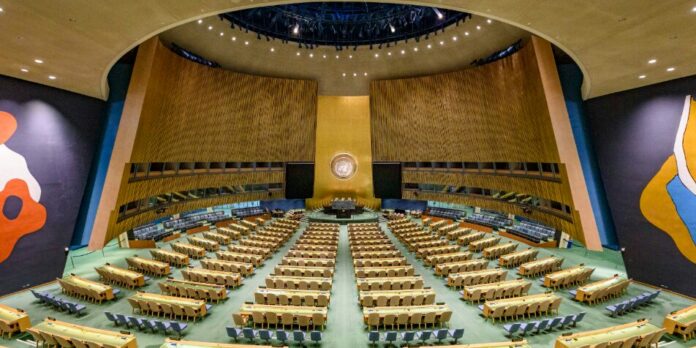
An empty United Nations Assembly Hall

Multiple Mayan languages broke historic records at the United Nations during the annual World Water Day event in March, gradually expanding linguistic accessibility outside the institution’s six official languages. The first‑of‑its‑kind Mayan Language Pilot has opened the door for Indigenous and endangered languages to be represented at an international level where they have long been absent. 

A Historic First at the UN’s World Water Day Event 

On March 19, the UN heard a Mayan language spoken in its halls for the first time. During the World Water Day event, Alicia López, a Maya Awakateka representative, delivered an address on water, gender equality, and the lived realities of Indigenous women. According to the Mayan Languages Preservation Project, López spoke about the Awakateko understanding of water as a subject of rights — something to be protected, conserved, and respected.

Far from a ceremonial greeting or cultural aside, the speech was delivered in an Indigenous Mayan language and marked a quiet but historic and substantive shift in their governmental representation. 

The First UN Document Translated into Mayan Languages

The same project also announced another unprecedented milestone: the UN World Water Development Report 2026 was translated into three Mayan languages — Kaqchikel, Q’anjob’al, and K’iche’ — with support from Editorial Cholsamaj.

It’s the first time a UN document has been translated into Mayan languages. Translation represents a deeper form of accessibility than symbolic recognition. It signals that Indigenous-language speakers are being considered legitimate audiences for UN knowledge production and that Mayan-language institutions are increasingly capable of collaborating on technical, policy‑relevant material.

From Commitments to Implementation for IDIL

Both breakthroughs align directly with the goals of the International Decade of Indigenous Languages (IDIL 2022–2032), led by UNESCO. The Mayan Languages Preservation Project is an IDIL‑affiliated initiative along with 4,246 other organizations and individuals, whose work, which ranges from terminology development to translation, reflects IDIL’s emphasis on strengthening Indigenous-language infrastructure.

The IDIL was established to address the global crisis facing Indigenous languages, many of which are endangered or lack institutional support. Its framework calls for governments, international organizations, and community-led initiatives to expand the visibility, usability, and vitality of Indigenous languages across public life. While much of IDIL’s progress has been conceptual or policy‑oriented, the Mayan-language pilot represents the kind of concrete, on‑the‑ground implementation the decade was designed to encourage.

The Future of Indigenous Interpreting at the UN

The United Nations’ interpretation services remain limited to its six official languages — Arabic, Chinese, English, French, Russian, and Spanish — as outlined by the UN Department for General Assembly and Conference Management.

Indigenous languages are not part of this system, and the UN does not provide interpretation into or out of them. Against this backdrop, the Awakateko-language address on March 19 was not part of a new interpretation program but a rare, one-off moment made possible by the speaker and the Mayan Languages Preservation Project. Its significance lies precisely in its exceptionality: it demonstrates what Indigenous-language presence at the UN can look like, even though it remains outside the institution’s formal linguistic architecture.

No additional Indigenous-language interpretation pilots have been announced, underscoring how rare these developments remain. Yet the Awakateko address and the translation of a major UN report into Mayan languages mark early breakthroughs — small but meaningful steps toward broader Indigenous-language accessibility in international governance.
Fond du Lac Tribal and Community College Awarded $9.2 Million Bush Foundation Community Innovation Grant to Catalyze Ojibwe Language Revitalization

0
Fond du Lac Tribal and Community College

Fond du Lac Tribal and Community College (FDLTCC) has been awarded a $9.2 million Community Innovation Grant from the Bush Foundation to support a bold, eight-year initiative focused on advancing Ojibwe language revitalization across the region and beyond.

This transformative investment will strengthen FDLTCC’s role as one of the many institutions and communities working to advance Ojibwe language revitalization by expanding pathways for adult learners, preserving the voices of first-language speakers, and increasing access to immersive and community-based language learning opportunities.

“Through our Community Innovation program, we look for ideas to develop, test, and spread, and the work of Fond du Lac Tribal and Community College is a great example,” said Mattie Harper DeCarlo, grantmaking officer at the Bush Foundation. “This work will help develop infrastructure that supports adult learners and strengthens the language
pipeline that the Ojibwe language movement is building,” DeCarlo added.

The initiative reflects a long-term commitment to sustaining and growing Ojibwe language through culturally grounded education, intergenerational learning, language documentation, and community partnership. Over the next eight years, the project will focus on developing new pathways and support systems for adult learners, strengthening
relationships with first-language speakers, expanding immersion opportunities, and building long-term language infrastructure.

Dr. Robert Sonny Peacock, Fond du Lac Elder and Tribal College Director, reflected on the importance of language growth and continuity: “I was told by several elder fluent speakers that learning Ojibwe is a life-long learning. One never learns all of it and as we move into the 21stCentury the need to keep our language relative and relatable to change is as important as learning about the old meanings. We live in a new, ever-changing world and if our language doesn’t grow with it, learning Ojibwe will not be relevant. What a challenge for our language learners, to be on the edge of new words that fill the void with new sounds and meaning, creating a thesaurus for tomorrow’s children.”

The initiative comes at a pivotal moment for language revitalization efforts, as communities continue working to preserve and strengthen Ojibwe language for future generations. By investing in adult learners and expanding opportunities for immersion and mentorship, FDLTCC aims to support learners at every stage of their language journey while helping create sustainable systems for long-term growth and proficiency.

A major component of the initiative includes the creation of an Ojibwe Language Documentation and Preservation Research Center dedicated to recording and preserving the sound of the Ojibwe language. The center will focus on documenting first-language speakers and creating an accessible archive for students, educators, and communities.
Building on the college’s two-year Ojibwe Language degree, FDLTCC also plans to explore a bachelor’s degree program in Ojibwemowin. This degree will help prepare the next generation of language speakers, educators, and leaders in revitalization efforts.

“This award addresses the funding needs that have existed for so very long. This long-term commitment is exactly the type of support needed to make FDLTCC a regional hub for language learning and revitalization,” said Biidaasige Tom Howes, FDLTCC Cultural Oversight Board Chair. “We have had dreams like this and to see this come true means so very much, perhaps more than we can truly measure. The impact of this may truly be generational in nature.”

The grant will also expand the long-standing Ojibwemotaadidaa Omaa Gidakiiminaang (OOG) immersion camps, which have been active for more than 15 years and have played a meaningful role in strengthening Ojibwe language revitalization efforts across communities. Through these camps, many participants have gone on to contribute their
language knowledge and teaching skills to other programs, helping extend the impact of immersion learning for the benefit of the language and future generations. The initiative will further increase opportunities for learners to engage directly with first-language speakers through culturally immersive and community-centered experiences grounded in
Anishinaabe ways of knowing and being.

“This opportunity reflects a deep commitment to the future of our language and our people,” said Gaagigegiizhigookwe Nicole Kneeland, Dean of Indigenous and Academic Affairs at FDLTCC. “Through this work, we will honor our first speakers, uplift and support our learners, and ensure the Ojibwe language continues to live, grow, and thrive for generations to come. We are deeply grateful to the Bush Foundation for investing in a vision that will strengthen our college, empower our communities, and create lasting pathways for language revitalization grounded in culture, relationship, and intergenerational knowledge.”

The initiative is grounded in the understanding that Ojibwe is a living language that must continue to evolve alongside contemporary life while remaining rooted in ancestral knowledge.

California Department of Pesticide Regulation Makes Language Services Permanent for County Agricultural Commissioners

0
California Department of Pesticide Regulation

The California Department of Pesticide Regulation (DPR) has announced it will permanently fund language services for County Agricultural Commissioners (CACs). The program offers CAC offices across all 58 California counties no-cost access to a 24/7 interpretation call line and document translation services covering more than 100 languages.

This resource builds on the success of the department’s 2024–2026 pilot program to provide a resource for counties to address language barriers experienced by farmworkers and community members when reporting pesticide incidents or accessing pesticide enforcement information. The announcement accompanies the release of DPR’s Pilot Language Access Hub Summary Report, which documents outreach efforts, usage data and lessons learned from the pilot program.  

“It is critical that all Californians, regardless of the language they speak, can access information on pesticide safety and workers’ rights, and report incidents to their County Agricultural Commissioner,” said Karen Morrison, DPR Director. “Expanding language access resources for counties is central to our strategic goal of fostering engagement, collaboration, and transparency with the communities we serve and increasing capacity for enforcement of pesticide use laws and regulations.”

DPR launched the Language Access Hub pilot in February 2024 to determine whether a centralized language program would meaningfully support CAC offices serving communities with limited English proficiency. As detailed in the summary report, the pilot confirmed both the need for these services and the value of sustaining language access support for counties long-term.

During the two-year pilot program:

  • 27 counties requested interpretation or translation services
  • 15 languages were requested, including: Spanish, Punjabi, Hmong, Mixteco, Korean, and Vietnamese
  • 64 documents were translated, including: pesticide safety posters, meeting materials, permit conditions, violation notices, and civil penalty hearing information
  • 13.5 hours of interpretation were provided

To reach communities most likely to need these services, DPR conducted direct outreach to CAC staff and the public, distributed flyers and brochures, ran social media campaigns, and broadcast radio public service announcements in multiple languages. DPR also hosted a dedicated webinar for CAC staff and established a community outreach partnership with Líderes Campesinas, a California organization that advocates for farmworker women.

“We had a great partnership with DPR to raise awareness about these language services through our 18 chapters and 1 youth group in conjunction with our Pesticide Awareness Month and other outreach efforts,” said Suguet López, Executive Director of Líderes Campesinas. “Ensuring that all workers can communicate with local officials is vital for accessing public services and protecting their rights.”

“California’s farmworker communities speak dozens of languages, including oral‑tradition Indigenous languages that standard translation services rarely reach,” said Celia Pazos, DPR Deputy Director of Environmental Justice and Equity. “Expanding language access is a key part of our equity‑centered approach to broaden education and knowledge‑sharing opportunities.”

Building on feedback from CAC staff, farmworker advocates, and community members, the permanent program will expand services to include:

  • Interpretation services, scheduled in advance, for languages with distinct regional dialects
  • Voiceover services for oral-only languages, including Latin American indigenous languages such as Mixteco
  • Prioritized subcontracting with Latin American indigenous language providers to strengthen interpreter quality and availability

How to Access Services

Californians can request services in their preferred language by contacting their local CAC office. To find your county’s contact information, visit CACASA or call toll-free 1-877-378-5463 (1-87PestLine).

For questions about DPR’s Language Access Hub, email LanguageAccess@cdpr.ca.gov. To learn more about DPR’s commitment to environmental justice and equity, visit the Environmental Justice page.

Read the Full Pilot Language Access Hub Summary Report in both English and in Spanish.

RWS Expands Content Technology Business Into Australia With New Adelaide Office and First Government Client Win

0
RWS

RWS (AIM: RWS.L), a global AI solutions company, is expanding its content technology presence into Australia with a new office in Adelaide, while celebrating its first state government client win. The move is led by Propylon, RWS’s legislative drafting and regulatory content management business.

Appointed to lead the expansion, RWS has named Gareth Oakes as Director of Client Solutions for Propylon in Australia. Oakes brings more than 20 years of experience in legislative technology, including senior roles with direct competitors serving government and parliamentary markets. His established network across Australia and Asia-Pacific legislatures will play a key role in driving growth in the region.

“Australia is a natural fit for structured content technology. Federal and state governments operate complex legislative frameworks, yet many still rely on aging systems for drafting and publishing legal content. There are few providers in the region with the specialist expertise and proven track record to address this need – creating a clear opportunity for RWS,” said Gareth Oakes, Director of Client Solutions at RWS.

The Adelaide office marks RWS’s first dedicated presence in Australia focused on government and regulatory content. The team will combine international expertise with locally hired specialists, creating a base for expansion across Australia and the wider Asia-Pacific region.

which aims to combine international expertise with local specialists to expand services across the region.

“Propylon has supported governments around the world for more than two decades – from US state legislatures to European parliaments. Australian legislatures face many of the same challenges, from legacy drafting systems to the need for digital-first, AI-ready legal content. Securing a major government client in Adelaide confirms both the demand and the relevance of our approach,” said John Harrington, CEO of Content Technology at RWS.

Propylon’s LWB 360 platform – which sits within RWS’s Generate segment – supports the full lifecycle of primary legislation – from drafting and amendment through to approval, publication and ongoing management. Its Word-based XML architecture allows parliamentary drafters to work in familiar tools, while structuring content at a granular level for reuse, traceability and digital delivery.

The platform is already used by legislatures, standards bodies and regulated organizations in markets including the US, where clients include the South Carolina General Assembly and 20% of US states. In Australia, the complexity of managing legislation across federal, state and territory jurisdictions makes this type of specialist solution increasingly important.

RWS’s broader content technology portfolio – including Tridion for web and knowledge management, Fonto for structured authoring and Contenta for aerospace and defense publishing – is trusted by government and enterprise organizations worldwide.

About RWS

RWS, headquartered in the UK, is a global AI solutions company empowering one of the world’s most trusted enterprise AI. It’s proprietary Cultural Intelligence Layer, powered by 250,000 data specialists, cultural and language experts and deep domain professionals, backed by 45+ patents, makes enterprise AI culturally fluent, contextually accurate and secure, ensuring every interaction reflects a brand’s tone, context and customer values. Through its Generate, Transform and Protect segments, it delivers intelligent content, enterprise knowledge, large-scale localization and IP protection for global growth. RWS provides the confidence, governance and expertise organizations need to deploy AI safely, responsibly and at scale.

Persistence and Reinvention: Fabiano Cid on Thriving in the Continually Shifting Translation Landscape

0
Fabiano Cid

Fabiano Cid, Chief Solutions Officer at Powerling, details his rocky start as a freelance translator as well as the major industry shifts, the latest of which being AI. He offers his perspective on the future of the business and his place in it, likening himself to an atomic bomb-surviving cockroach (in the best way possible).

Have you ever read Multilingual magazine? Which is your favorite part?
I am a longtime reader of Multilingual magazine. When I had my localization company in Brazil (Ccaps Translation and Localization), the printed edition of MultiLingual was my main source of information about the industry because we did not have the online resources that we do now. 

It may sound unusual, but I love Multilingual editorials, as they allow me to focus on what truly matters in our field and give me a sense of where things are headed.

How did you get involved in the translation business?
By the hands of Renato Beninatto

I thought I would build a career in the arts, as I had graduated from drama school and loved writing. In 1996, I had just published a slightly too-metalinguistic novella, called Romance. Its stream-of-consciousness narrative may have been a little hermetic to make it a bestseller (and maybe a little too presumptuous for a 25-year-old). 

Theater had its magic, but it wasn’t paying the bills. I began looking for a “proper job” after graduating with a bachelor of arts degree in Language and Literature from the Federal University of Rio de Janeiro. 

In 1997, Renato posted an ad for translators, I applied, and when he learned that I had my own website with my writings (“You have a home page?,” he asked using the lingo of the time), he hired me right there and then. 

I worked for his company (pre-LMI, pre-Berlitz) for only three months. I moved to London that year and became a freelance translator.

Since you entered the translation business, how has the business landscape changed?
Back in the 90s, translation was very promising with the advent of localization. 

In 1999, after returning to Brazil, I opened my own company, and a few months later I found myself in New York talking to a venture capital representative and explaining that, despite the threat of the internet bubble bursting (any resemblance to AI is not a mere coincidence), localization was a solid business because computers were there to stay, and so was globalization.

That seemingly perfect pitch secured me a promise of USD 1 million in investment, as long as I fixed the partnership situation. (My associate was leaving for Ireland to work at Microsoft; I had a laptop and worked from home.) I did and returned to the investor with a very basic structure. 

I built the minimum, but the bubble burst, and I bade my first million goodbye.

Technology has changed the scenario, and while we have managed to stay afloat (as professionals, as businesses, and as an industry) the process of reinventing ourselves has been constant and often brutal. But we persist, and I am sure we will continue thriving.

Could you share your experience working with your first client or on your first project?
In Rio, the project managers I had been working with told me that I should bring a laptop with me to London, as they could send me work. That all sounded very mysterious and absurd, but I was going to London with very little cash in my pocket, and the only thing resembling job security was my friend’s temp gig selling sandwiches in Knightsbridge.

I brought the laptop and applied for a job offer in a Brazilian Portuguese translators’ forum. I had only had three months of experience, with careful support and scrutiny from in-house revisers. Delivering my first translation work, completed on my own, was something else. 

And I failed miserably. 

My work was rejected, I did not get paid for it, the laptop crashed, I overslept and missed the sandwich round, and had to work two weeks for free.

Welcome to your new life! 

This was what I call the three-month curse: Whenever you move to another country, the first three months are hell, but you must endure this rite of passage.

I didn’t know this at the time, but I did persist, and six months later I was making more money than I could have ever imagined — for that same client who had initially refused my work, and a few more clients I had collected along the way.

Do you believe it’s a good time to enter the translation business?
It’s always a good time, just never an easy one.

Every few years someone declares that translation is dead. I’ve heard that since I started: First computer assisted translation (CAT) tools would kill it, then machine translation (MT), now AI (which is statistical MT on steroids). Yet here we are. What’s changing is not the need for translation, but the definition of it.

If you come in thinking that this is a static craft, you’ll be disappointed. If you come in ready to build bridges between people, systems, and cultures, you’ll never be bored.

Where do you see yourself professionally in the next 10 years?
I’ll be 65, so ideally I’d be retired, sipping caipirinhas in Salvador (where I am now, celebrating my 55th birthday). But that will never happen. I’m like Cher and the atomic bomb cockroaches: AI or not, you’ll never get rid of us. 

Hopefully I’ll still be doing work that matters, just at a slower pace.

What predictions do you have for the future of the translation business?
I hate playing The Oracle, but if there’s one thing I’ve learned, it’s that our industry always survives its own obituaries. Every few years we face an “end of translation” moment, and every time, we reinvent ourselves instead.

I think the future will belong to those who stop seeing what we do as a standalone service and start treating it as part of a larger ecosystem: data, governance, content. The boundaries between translation, creation, and strategy will keep blurring.

Technology will get better, faster, and cheaper, but meaning and experience will still need mediation. We’ll adapt, as we always have; not by resisting change, but by translating it.

CETRA Achieves ISO 9001 Recertification

0
CETRA Language Solutions

CETRA Language Solutions has announced that it has received recertification to the ISO 9001:2015 standard for its quality management.

Performance Review Institute (PRI) Certification recognized CETRA for having met the stringent requirements of this international standard, their ongoing commitment to satisfying stakeholders, and their dedication to continual improvement of their management system.

“CETRA Language Solutions has demonstrated its commitment to world class quality management by implementing and becoming certified to the ISO 9001:2015 standard. They have joined an elite number of organizations worldwide who have achieved certification to this globally recognized quality standard,” said Ed Maschmeier, Vice President of PRI Certification. “PRI Certification is proud to partner with CETRA Language Solutions in this accomplishment and look forward to continued support of their objective of quality management excellence.”

The requirements for ISO 9001:2015 certification include having a Quality Management System (QMS) that consistently meets or exceeds customer and regulatory requirements, as well as having a commitment to enhancing customer satisfaction through continuous improvement of the QMS.

The ISO recertification demonstrates CETRA’s adherence to internationally recognized quality management standards and best practices. CETRA is also a corporate member of the American Translators Association (ATA) and follows the ATA’s Code of Professional Conduct and Business Practices. In addition, CETRA adheres to ASTM International’s translation and interpretation quality standard guides.

For more information on its ISO certification and quality management system, please contact CETRA’s Quality Manager.

About PRI Certification

PRI Certification is a not-for-profit organization specializing in third-party management system certification services. In 2024, the organization rebranded after acquiring SRI Quality System Registrar, MCNA, and Platinum Registrar, combining over 60 years of expertise. This merger strengthens its leadership in certification, addressing evolving needs in Quality, Data Security, Environmental, and Health & Safety standards.

The Performance Review Institute (PRI) is a not-for-profit trade association started in 1990. PRI is a global administrator of industry-managed critical process accreditation programs focused on improving process and quality with collaboration among stakeholders in industries where safety and quality are shared goals.

About CETRA

CETRA provides language services to businesses and institutions around the world, including translation, interpretation, transcription, and other language-related services in more than 300 languages. Its global network of more than 5,000 professional linguists, and its dedicated staff in Pennsylvania, California, and Ireland provides professional, responsive service that saves clients time, simplifies the process, and makes working with CETRA a pleasure. CETRA is ISO 9001 certified.

Nimdzi Insights Acquires Localization World Ltd.

0
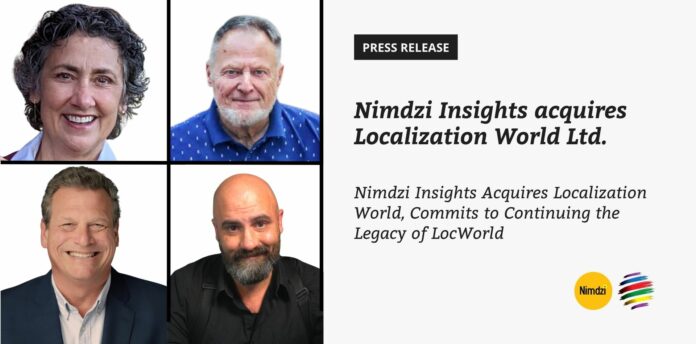
Pictured above from top left: Donna Parrish, Ulrich Henes, Renato Beninatto, and Tucker Johnson.

Nimdzi Insights has announced that it has acquired Localization World, Ltd., the organization behind LocWorld, the long-running conference series for localization, globalization, and language industry professionals. 

Founded in 2003 by Donna Parrish and Ulrich Henes, LocWorld has grown into one of the industry’s most trusted gathering places where buyers, vendors, technologists, academics, and practitioners come together to exchange ideas, build relationships, and shape the future of an increasingly global world.

For Nimdzi Insights, the acquisition is first and foremost a matter of stewardship.

“Donna and Ulrich have served this industry tirelessly for decades,” said Tucker Johnson, co-founder of Nimdzi Insights. “They created more than a conference. They created a meeting place for the global language community built on trust, curiosity, and the belief that people do better business when they are in the room together. We are deeply honored to carry that torch forward, and we hope to continue doing justice to the beautiful conference and community they built.”

Nimdzi plans no sweeping changes and confirms that all currently scheduled LocWorld and Global Toolbox events will continue as planned. LocWorld55 Dublin will take place June 9–11, 2026, and LocWorld56 Vancouver will take place October 19–21, 2026. Future LocWorld events will also continue under Nimdzi’s stewardship and future Global Toolbox, and other Localization Institute activities will continue to be organized by Ulrich Henes in cooperation with Nimdzi Insights and Localization World.

“From the start, our vision for LocWorld was that it would be an opportunity for people to come together, learn, and network in a friendly and open atmosphere,” remarked Localization World cofounders, Donna Parrish and Ulrich Henes, in a joint statement. “We are pleased that Nimdzi plans to continue that legacy, and that the expertise they bring will further enhance the presence of the conference.”

“LocWorld has been part of my professional life for decades,” said Renato Beninatto, co-founder of Nimdzi Insights who will be stepping in as CEO of Localization World after the acquisition. “I have attended these conferences consistently over the years, and I know firsthand how much they mean to this industry. Nimdzi’s role is not to reinvent LocWorld overnight. Our first responsibility is to protect what has made LocWorld special, to listen to the community, and to support its next chapter with humility and care.”

With the acquisition, Nimdzi plans to support the continued growth of LocWorld while preserving the values that made it an essential industry institution: practical knowledge-sharing, inclusive networking, cross-functional dialogue, and a deep respect for the professionals who make global communication possible.

“We understand the responsibility that comes with taking over a legacy like LocWorld,” Johnson added. “Donna and Ulrich built something beautiful and enduring. Our hope is to honor that legacy, preserve the spirit of the conference, and help LocWorld continue serving the localization community for many years to come.”

More information about upcoming LocWorld events is available at LocWorld.com.

Advisory services throughout this deal were provided by Jonathan Otis.

About Nimdzi Insights

Nimdzi Insights is a market research and consulting firm focused on the language industry, international markets, global business development, and acquisitions. Nimdzi helps companies make better decisions about globalization, localization, AI, language services, technology, market entry, and international growth. In conjunction with this acquisition, Nimdzi Insights LLC is restructuring to Nimdzi Insights, Inc.

About LocWorld

Founded in 2003 by Donna Parrish and Ulrich Henes, LocWorld is a leading conference series for localization, globalization, and language industry professionals. LocWorld brings together clients, language vendors, technology providers, academics, and practitioners to learn, network, and conduct business in a collaborative industry-focused environment. 

Smartling Launches Its Largest AI Innovation Release Yet, Redefining Enterprise Translation at Scale

0
Smartling

Smartling, an AI-powered translation company, has announced its largest AI innovation release to date, introducing new capabilities designed to help enterprises scale multilingual content with greater speed, quality, and trust. The release expands Smartling’s enterprise AI translation platform with advancements in translation quality intelligence and automation, helping enterprises scale multilingual content with confidence.

At the center of the announcement is LQA Agent, an automated translation evaluation system that uses the industry-standard Multidimensional Quality Metrics (MQM) framework to identify errors, assign quality scores, and monitor trends over time. Smartling also introduced Auto Select LLM, Style Rules for AI, Instant AI Translation, Language Adaptation, and a preview of AI Image Translation, extending translation quality intelligence and AI-powered automation across enterprise multilingual content operations. 

“This release represents a major step forward in how enterprises create and scale multilingual experiences with AI,” said Bryan Murphy, CEO of Smartling. “We’re focused on unlocking a new era of translation quality, speed, and trust by combining advanced AI innovation with the enterprise controls global organizations require. These innovations help customers move faster, preserve brand voice, and unlock greater business impact from every global customer interaction.”

LQA Agent: Automated Quality Assurance

Using the MQM framework, LQA Agent identifies errors, categorizes them by type and severity, and assigns a numeric score and pass/fail rating per language across all translation methods in Smartling, not just AI translation. Teams can run LQA Agent fully automatically without a human reviewer involved, or configure workflows to route content with detected issues to human review — all while allowing error-free content to publish automatically. In internal testing, LQA Agent achieved 90% agreement with human reviewers and 99% accuracy on severe errors.

Auto Select LLM

Auto Select LLM extends Smartling’s Auto Select technology to large language models, enabling teams to achieve higher-quality translations without additional configuration. Smartling handles model selection, prompt engineering, and continuous benchmarking behind the scenes, including retrieval-augmented generation (RAG) that references customers’ existing Translation Memory and glossaries. The result is higher-quality LLM output with no workflow changes required.

Style Rules for AI

Style Rules for AI applies punctuation, date formats, and regional language standards to AI translation outputs. Default rules cover more than 30 locales, while Smartling’s Language Services team can build custom rules tailored to an organization’s brand voice and translation preferences, helping enterprises maintain consistency and trust across multilingual customer experiences.

Instant AI Translation 

Instant AI Translation makes AI-powered translation available through a synchronous API, powering connector integrations across AEM, Drupal, WordPress, Photoshop, Illustrator, InDesign Plugin, and Figma. Brand-aware, quality-controlled translation is now accessible in real time.

Language Adaptation

Language Adaptation enables teams to adapt existing translations for regional variants, such as US English to UK English or Brazilian Portuguese to European Portuguese, without full re-translation. Powered by LLMs, the capability helps enterprises close a long-standing quality gap while accelerating multilingual content delivery.

AI Image Translation

AI Image Translation extracts text from images, translates it, and rebuilds the image with translated text in place. The same quality standards applied to written content can now extend to product photos, banners, and social assets, helping enterprises scale multilingual visual content with greater consistency and efficiency.

Smartling’s commitment to responsible AI underpins each of these innovations and is reinforced by its recent ISO/IEC 42001:2023 certification, the international standard for AI management systems. Combined with ISO 27001, HITRUST e1, SOC 2, and HIPAA compliance, Smartling maintains one of the localization industry’s most comprehensive AI trust, security, and compliance programs.

Availability

LQA Agent, Auto Select LLM, and Language Adaptation will be available starting May 20, 2026. AI Image Translation, Style Rules for AI, and Instant AI Translation will be available as a preview. 

The innovations will debut at Smartling’s Global Ready Conference on May 20, the company’s annual event focused on the future of AI translation and multilingual content operations. Attendees will hear from leaders at Spotify, IHG Hotels & Resorts, DocuSign, DoorDash, and SumUp and get first access to Smartling’s latest product launches and AI translation strategies. Register at Global Ready Conference.

About Smartling

Smartling is an AI-powered translation company transforming how global enterprises create, manage, and scale multilingual content in the AI era. Its LanguageAI™ platform combines AI translation, workflow automation, and quality assurance infrastructure to help organizations automate multilingual content operations at enterprise scale. Trusted by leading global brands, Smartling enables companies to move faster globally while maintaining the quality, trust, and oversight required for enterprise AI translation.

Lingoport Announces New Localyzer and Globalyzer Release for AI-Driven Localization Workflows

0
Lingoport announces new localyser and globalyzer release for AI-driven localization workflows

Lingoport has released version 4.2.33 of its software localization platform, Localyzer, and internationalization solution, Globalyzer, which includes new workflow control enhancements. The updates are designed to help teams provide better translation context for UI strings, enforce localization rules automatically, and strengthen verification in AI-assisted localization and i18n workflows. 

The release enhances Localyzer and Globalyzer to help teams maintain translation accuracy and workflow integrity across increasingly automated pipelines where persistent challenges in software localization prevail, such as missing context, unenforced rules, and automation without verification. Updates include: 

  • String‑level AI prompting: Translators and AI systems now receive context at every level — connection, project, and individual string — ensuring precise handling of UI labels, brand terms, and legal text.
  • Automatic enforcement of “Do Not Translate” rules: Protected terms such as product names and code snippets are now flagged and verified within the platform, eliminating a major source of preventable errors.
  • Min/max string‑length validation: Layout constraints are checked automatically, catching overflow and truncation issues before QA.
  • Updated ICU/CLDR plural logic: Aligns with current Unicode standards for more accurate linguistic handling across languages.
  • AI‑augmented i18n scanning: Combines ChatGPT and Claude analysis with Lingoport’s rules engine for more reliable detection and remediation of internationalization issues.
  • GPG‑signed commits: Adds cryptographic verification for automated localization pushes, meeting compliance requirements for regulated industries.

These improvements tighten the points where automation, AI, and human review intersect — adding context where guesswork used to occur and enforcing rules that previously lived outside the workflow. The result is stronger verification, fewer silent failures, and localization pipelines that meet enterprise‑grade security and quality standards. 

With this Localyzer and Globalyzer release, Lingoport aims to help teams catch more of these issues earlier — before they reach users.

For teams seeking to understand how these updates apply to their workflows, Lingoport offers tailored consultations and demos through its website.

About Lingoport

Lingoport provides software and services that help global development teams build, internationalize, and localize products at scale. Its platform — Localyzer and Globalyzer — automates translation workflows, enforces i18n quality, and integrates directly with design and development pipelines to keep multilingual releases accurate, continuous, and engineering‑ready.