NYC Department of City Planning Launches NYC Language Explorer

0
NYC Planning

Department of City Planning (DCP) Director Sideya Sherman has announced the launch of NYC Language Explorer, a new interactive web tool that makes it easier to understand what languages New Yorkers speak at the citywide, borough and local levels.

NYC Language Explorer presents intuitive tables, maps and charts on the languages spoken by New Yorkers with limited English proficiency, using high-quality, reliable language data from the U.S. Census Bureau’s American Community Survey (ACS). Offering detailed information on the most commonly spoken languages at the citywide, borough and Community District levels, as well as statistics for additional language groups, the tool provides a powerful new way to examine the city’s rich linguistic diversity and better understand local language service needs.

“New York City is home to hundreds of languages, and that diversity is central to who we are,” said DCP Director Sideya Sherman. “NYC Language Explorer gives agencies, service providers, community organizations and New Yorkers an accessible way to better understand the languages spoken in our neighborhoods. By putting this data at people’s fingertips, we can help support more responsive planning, outreach and services across the five boroughs.”

“New York City is a multilingual city, and NYC Language Explorer serves as another example of this administration’s commitment to language justice,” said Commissioner Faiza N. Ali of the Mayor’s Office of Immigrant Affairs. “The Language Explorer tool makes language data accessible and actionable, helping City agencies and community-based organizations to move beyond assumption-based decisions and towards evidence-based planning so that critical services and information can reach all New Yorkers. We thank our partners at DCP for developing this resource to strengthen language access across our diverse city and empower even more New Yorkers with the tools they need to thrive.” 

Specifically, NYC Language Explorer will help city agencies, non-profit service providers, researchers, advocates and community organizations understand local language needs and provide more useful, accessible services. The tool also offers a wide range of insights into the languages spoken by New Yorkers. Among the findings available through NYC Language Explorer:

  • Across the city, there are roughly 1.8 million residents with limited English proficiency (LEP).
  • The Bronx has the highest percentage of residents who speak a language other than English, at 58 percent.
  • Spanish is the most spoken LEP language in every borough, except for Staten Island where it is Chinese.
  • Queens Community District 4 is home to the city’s largest concentration of Tagalog LEP speakers.
  • 60 percent of the city’s Ukrainian-speaking population has limited English proficiency.

NYC Language Explorer is part of DCP’s broader commitment to making demographic data accessible, useful and easy to understand, including through core tools for exploring New York City’s diverse socioeconomic landscape: Population FactFinder and Population MapViewer. The release also follows the recent publication of DCP’s Newest New Yorkers report, which provides a comprehensive portrait of the city’s foreign-born residents.

About the Department of City Planning

The Department of City Planning (DCP) plans for the future of New York City, working to create thriving and dynamic neighborhoods with access to housing and jobs, resilient infrastructure, and a vibrant public realm. The Department engages communities to develop inclusive plans, expands housing access and economic opportunity, and plans for long-term sustainability.

DCP supports the City Planning Commission in its annual review of hundreds of land use applications. The Department also advises on citywide strategic and capital planning, analyzes data, conducts policy analysis, and creates open data and civic engagement tools
GALA and Welocalize Expand Access to Localization Education Through Subtitling Partnership

0
Welocalize and GALA

The Globalization and Localization Association (GALA) and Welocalize, a leading provider of language and AI-enabled content solutions, has highlighted the success of their ongoing subtitling partnership, which has been expanding access to GALA’s educational programming for language professionals around the world throughout 2026.

Since January, Welocalize has provided professional subtitling services and platform support for select GALA educational content, including webinars, Special Interest Group recordings, and GALA Academy courses. The subtitled programming is available through GALA’s Resource Center, helping make industry education more accessible to GALA’s global membership while supporting a more inclusive learning experience.

As organizations across industries place greater emphasis on accessibility and multilingual engagement, the partnership demonstrates how language services can help remove barriers to education and foster broader participation in professional communities.

“This partnership reflects GALA’s commitment to practicing what we preach,” said Allison Ferch, Executive Director of GALA. “As an association that champions language access and inclusion, ensuring our own content is accessible is both a responsibility and a privilege. We’re proud to highlight the work Welocalize has already contributed to that mission this year.”

The collaboration also highlights the role accessibility services play in today’s digital learning environments. Professional subtitling not only improves accessibility for deaf and hard-of-hearing audiences but also benefits multilingual learners, professionals consuming content in non-native languages, and anyone engaging with educational content in sound-sensitive environments.

“Language access should extend to professional education just as much as it does to customer experiences or public information,” comments Michael Anderson, eLearning and Multimedia Solutions Owner at Welocalize. “We’re proud to support GALA’s mission by helping make valuable educational content accessible to more professionals worldwide. This collaboration reflects our shared belief that removing language barriers creates stronger learning opportunities and a more connected global language community.”

Looking ahead, GALA and Welocalize will continue their collaboration through additional subtitled educational programming and a jointly sponsored webinar focused on accessibility services and language access — topics that continue to grow in importance as organizations expand their global reach and seek more inclusive ways to engage employees, customers, and communities.

Together, GALA and Welocalize remain committed to advancing multilingual communication, promoting accessibility, and supporting the continued growth of the global language industry.

To learn more about GALA’s educational programs and resources, visit gala-global.org.

About GALA

The Globalization and Localization Association (GALA) is an international nonprofit trade association serving the language industry. GALA cultivates a global community of organizations and individuals working to enable communication and business across languages and cultures through education, networking, advocacy, and the exchange of knowledge.

About Welocalize

Welocalize, a Welo Global brand, headquartered in New York, serves localization teams through AI-enabled multilingual content solutions that enable enterprises to operate and scale globally. It combines AI, automation, and human expertise to support enterprises in more than 300 languages, enabling accurate, culturally aligned, and compliant multilingual content at scale. It’s Opal Platform comprises patented technology designed to automate multilingual content and improve workflow performance for enterprises. Opal functions as an agentic system that orchestrates AI, automation, and human expertise to coordinate content workflows across the lifecycle, improving speed, scalability, and operational control for global enterprises. These solutions operate within a secure and compliant environment supported by seven ISO certifications.

Qorden AI Breaks the Language Barrier with World’s First Multilingual, Real-Time Videoconferencing Translator

0
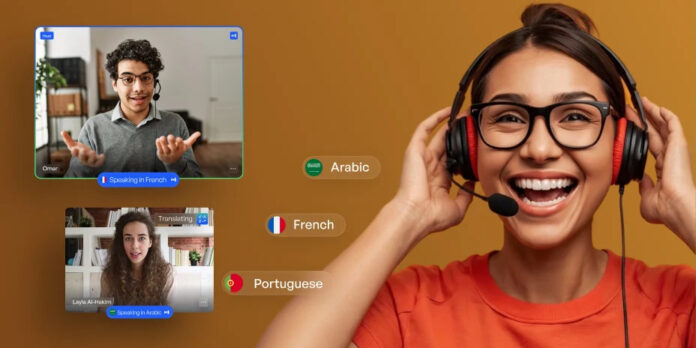
Two individuals speaking in different languages with real-time translation available

Qorden AI, a leader in real-time AI speech translation, has launched Qordenate, a fully multilingual video conferencing platform that delivers simultaneous speech-to-speech translation across up to six languages in a single meeting. Built on Qorden’s foundation-level multilingual AI models, Qordenate enables participants to hear conversations in their own language with ultra-low latency and up to 97% accuracy, supporting 33 languages and more than one million possible language combinations.

Designed for modern global teams — where professionals spend nearly a third of their working hours in meetings and more than one billion people use English as a second language — Qordenate addresses the growing need for seamless, in-call translation. The platform supports up to 300 participants per meeting, prompting each user to select their preferred language and providing real-time translated audio, live captions, and instant chat translation. As a cloud-based solution, Qordenate requires no software installation, allowing users to join on demand from any device.

Qordenate is powered by Amazon Web Services to ensure enterprise-grade scalability, GPU acceleration, and high-bandwidth performance. Qorden is also a member of the Nvidia Inception Program, supporting advanced innovation in multilingual AI.

Beyond translation, Qordenate allows users to customize the speaking tone and register of their translated voice, avoiding the synthetic, generic output common in other tools. The platform also includes VoiceBridge, an embedded text-to-speech feature designed to support users with speech impairments. With more than 170 million people worldwide experiencing speaking disabilities, VoiceBridge expands Qordenate’s accessibility impact.

Qordenate offers flexible pricing through subscription-based meeting access and pay-as-you-go webinar options, enabling high-quality multilingual communication at short notice and across any budget.

“By removing the language barrier, we free people to focus on deeper communication — improving productivity, efficiency, and overall team performance,” said Moeen Khan, founder and CEO of Qorden AI. “Solving this challenge requires a complete language engine and collaboration platform built from scratch, not a feature overlay. Qordenate delivers near-perfect simultaneous translation in real time.”

Qordenate’s language engine is trained on how people actually speak, enabling it to replicate real-world code-switching patterns common in multilingual environments, from Tagalog-English switching in Southeast Asia to German-Japanese business conventions and the formal structures of Arabic communication across the Gulf.

In addition to real-time audio translation, Qordenate provides live captions, instant chat translation, smart recaps, and tools for podcasts and webinars, all managed through an administrator command center. The platform is built on Qorden’s Language Ecosystem, a unified engine that powers the company’s full product suite and serves as an API-accessible foundation for developers and enterprise teams integrating multilingual capabilities into their applications.

Qordenate is available through a freemium model, with Pro, Business, Scale, and Enterprise plans.

About Qorden AI

Qorden AI is a real-time language AI platform headquartered in Dubai. The company builds multilingual AI models at the foundation level — avoiding English-first architectures — and delivers industry-specific solutions across 33 languages with up to 97% accuracy, including in code-switching environments. Qorden’s product suite includes QSAP for contact center analytics, Dubbix for AI dubbing and localization, QDub for real-time voice translation, and Qordenate for live multilingual video collaboration.

Alpha CRC Acquires PureFluent, Strengthening Language Services Capabilities

0
Alpha CRC acquires PureFluent

Alpha CRC, a global leader in localization and multilingual content solutions, has announced the acquisition of PureFluent, a provider of tailored translation and language consultancy services. The acquisition, completed in June 2026, enhances Alpha CRC’s ability to offer endtoend language and cultural adaptation services to clients worldwide. 

With headquarters in Cambridge, UK, and a global network of incountry teams, Alpha CRC serves some of the world’s most recognized brands through its expertise in translation, localization, transcreation, and linguistic quality assurance. The addition of PureFluent’s operations, team, and client portfolio expands Alpha’s reach and supports its position in key markets across technology, ecommerce, and life sciences. 

Through this acquisition, PureFluent clients will be able to benefit from Alpha CRC’s proprietary technologies including securely operated Bespoke Language Models. 

“This acquisition represents a strong strategic fit. PureFluent shares our commitment to linguistic excellence and client service,” said Vassilis Chamalidis, CEO of Alpha CRC. “By bringing our companies together, we are creating an even more comprehensive multilingual content offering for our customers.”

PureFluent, founded in 1997, has built a reputation for combining advanced language technology with a flexible service model that helps clients scale their multilingual operations efficiently. Its integration into Alpha CRC will provide existing PureFluent clients with access to a broader suite of localization, creative copy, and digital content services. 

“Joining Alpha CRC marks an exciting new chapter for PureFluent,” said Sonja Kirschstein, Head of Operations at PureFluent. “We look forward to combining our strengths to deliver even greater value, innovation, and quality for our clients.”

The integration process has already begun, ensuring continuity of service for all customers and partners. 

About Alpha CRC

Alpha CRC is one of the world’s leading localization agencies, providing translation, adaptation, and global content services across diverse industries. Headquartered in Cambridge, UK, Alpha CRC operates through a network of inmarket offices and studios, offering linguistically and culturally adapted solutions for brands operating worldwide

About PureFluent

PureFluent specializes in helping organizations manage their global content strategy and translation workflows. The company provides a full range of language services that enable brands to communicate effectively with audiences in more than 120 languages.

Language Connections Awarded Massachusetts’ Government Interpretation and Translation Services Contract

0
Language Connections

Language Connections has been awarded PRF088, the Commonwealth of Massachusetts statewide contract for government translation and interpretation services, administered by the Operational Services Division (OSD). The award extends a 25-year continuous relationship with the Commonwealth and renews Language Connections’ position as a prequalified vendor for statewide language access services through the COMMBUYS procurement system.

In the most recent competitive evaluation cycle, Language Connections received a score of 96.65 out of 100, ranking 4th among 50 awarded vendors, based on criteria including service quality, staffing capacity and language coverage, interpreter qualifications, pricing competitiveness, and financial and operational stability.

The newly awarded contract extends for six years and covers interpretation and translation services for Massachusetts state agencies and eligible public entities. It allows agencies to access prequalified vendors without initiating separate competitive bidding processes, streamlining procurement for language access needs across government operations.

Language Connections has maintained continuous participation across successive Massachusetts statewide language services contracts for 25 years. Each procurement cycle requires vendors to requalify based on service quality, staffing capability, pricing, and financial stability. Sustained contract award status reflects consistent performance in supporting evolving language access requirements across state agencies, municipalities, and public institutions.

Leo Galperin, President of Language Connections, noted that the award reflects both continuity and accountability, noting, “Massachusetts has trusted us to support its language access obligations for 25 years across successive procurement cycles. Our focus is ensuring that agencies have reliable access to qualified interpreters and certified translation services when they are needed most.”

Scope of services

Under PRF088, Language Connections will provide statewide access to core language services, including:

  • In-person interpretation for public-facing services and meetings
  • Telephone interpreter services for real-time remote communication
  • Video remote interpreting (VRI) for healthcare, legal, and administrative settings
  • Certified translation services for official and regulatory documents

These services support day-to-day communication needs across Massachusetts public-sector institutions, including state agencies, municipalities, school districts, public hospitals, public universities, and eligible nonprofits.

How MA agencies use statewide language services contracts

Eligible entities use PRF088 to support communication with Limited English Proficient (LEP) populations across service delivery environments.

Typical applications include:

  • Public health and hospital intake communication
  • School enrollment and parent engagement
  • Municipal hearings and community meetings
  • Administrative services and benefits coordination

Interpretation modalities are selected based on context, including consecutive interpretation for structured interactions, simultaneous interpretation for live proceedings, and telephone interpreter services for immediate access needs.

Maintaining state and federal language access requirements

Massachusetts agencies are required to provide meaningful access to LEP individuals under Executive Order 526 and Administrative Bulletin #16. These requirements include developing language access plans, providing interpretation services, and translating vital documents where applicable thresholds are met.

Agencies receiving federal funding are also subject to Title VI of the Civil Rights Act and Executive Order 13166, which require nondiscriminatory access to public services.

PRF088 provides a structured procurement pathway that supports compliance with these obligations through prequalified access to interpretation and translation providers.

Professional language services will be available to Massachusetts state agencies and eligible public entities through PRF088 via COMMBUYS.

About Language Connections

Language Connections is a leading translation, interpreting, and localization company based in Boston, MA with over 30 years of experience providing language services to clients in both the public and private sector. It works with a global network of linguists to deliver culturally accurate, industry‑specific B2B solutions in over 100 languages.

Can You Trust AI Translation? Join Industry Leaders for a Deep Dive Into Quality, Risk, and Governance

0
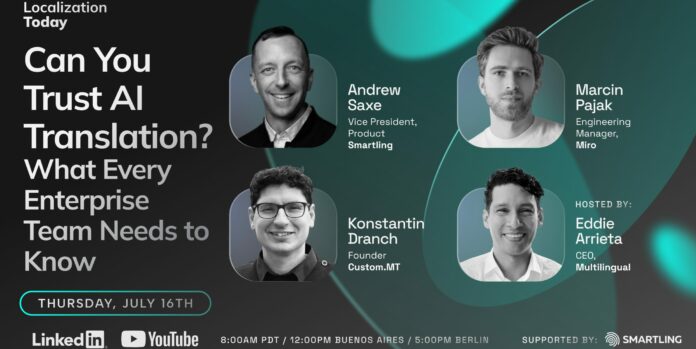
Can you trust AI translation? What every enterprise team needs to know webinar banner

Artificial intelligence has become a defining force in how global organizations create and deliver multilingual content. But as AI-driven translation scales across product, marketing, support, and legal workflows, a new question has taken center stage: how do enterprise teams know when AI output is truly trustworthy? In an era where millions of words move through automated pipelines, quality is no longer just a linguistic concern, it is a governance challenge.

This month’s Localization Today Live webinar, graciously supported by Smartling, brings together some of the most influential voices in the industry to tackle this question head‑on.

The session, “Can You Trust AI Translation? What Every Enterprise Team Needs to Know,” explores how AI is reshaping the definition of quality and why traditional evaluation methods no longer meet enterprise needs. As organizations push content to market faster than ever, they must rethink how they measure accuracy, consistency, and risk. The panel will break down which metrics matter, where legacy approaches fall short, and how leading teams are building more reliable quality signals at scale.

Attendees will also gain insight into when human review adds meaningful value, where automation excels, and how companies are redesigning workflows to balance speed with accountability. Another key focus is content risk tiers. Not all content carries the same stakes, and the panelists will outline how enterprises determine acceptable quality thresholds across marketing, support, legal, product, and user-generated content.

The conversation will go beyond theory, offering practical strategies for building a trusted AI translation program — from automated guardrails that catch hallucinated variables before they break a UI, to treating localization like code with built‑in validation and orchestrations that scale responsibly.

Featuring Marcin Pajak (Miro), Andrew Saxe (Smartling), Konstantin Dranch (Custom.MT), and Eddie Arrieta (MultiLingual Media), this free event is designed for enterprise leaders, localization strategists, and anyone navigating the fast-evolving intersection of AI and global content.

Join us live on July 16 at 8:00am PDT / 12:00pm Buenos Aires / 5:00pm Berlin and be part of the conversation shaping the future of multilingual AI. Register here.

The Week in Review: Language Industry News June 30 – July 6

0
Week in Review June 30 - July 6

This week’s stories reveal an industry confronting its foundations while celebrating the systems, platforms, and creative engines pushing multilingual communication forward. From market expansion to award‑winning innovation, the sector is navigating both structural realities and major leaps in capability. 

Expansion

Translate.One has acquired Vertaalbureau Perfect, including its German operations and cloud‑based Fairlingo platform. The purchase strengthens the company’s presence in the Benelux region and expands its European technology stack, introducing ISO‑certified workflows, in‑house linguistic expertise, and a strong regional client base built over nearly two decades. With its deeper local capacity and enhanced platform capabilities, the acquisition positions Translate.One to scale AI‑backed multilingual solutions across Europe. 

RWS has released Trados Studio 2026, introducing a next‑generation architecture with faster performance, expanded terminology management, and native integration of Language Weaver Pro. The update brings context‑aware AI, support for leading third‑party large language models (LLMs), and improved handling of large files and complex translation memories, giving linguists more accurate first drafts while preserving control over quality and client‑specific requirements. With input from its global community of translators and reviewers, Trados Studio 2026 reflects a shift toward flexible, AI‑enhanced workflows built for high‑volume, high‑complexity translation environments. 

Community

Lionbridge Games has been awarded “Best Overall Use of AI in Gaming” at the 2026 AI Breakthrough Awards for Lionbridge Samurai™, the first production‑ready, game‑specific AI localization platform. Designed to eliminate the trade‑off between speed and reliability and built around linguistic expertise, Multidimensional Quality Metrics, and a closed‑loop evaluation system, Samurai delivers TEP‑equivalent quality while handling character voice, cultural nuance, platform constraints, and live‑service updates across 55 language pairs and 42 titles. The win marks Lionbridge’s third consecutive AI Breakthrough Award, helping to reinforce its position as a leader in purpose‑built AI for complex, creative localization environments. 

MultiLingual has earned its third consecutive APEX Award of Excellence, recognized in the “Magazines, Journals & Tabloids – Electronic” category for its October 2025 issue of the Vargas Sisters. The award highlights the issue’s standout design, editorial quality, and industry‑shaping coverage — from the Vargas sisters’ leadership in tech localization to features on Indigenous language access, game accessibility, and linguistic perspectives on the natural world. The recognition underscores MultiLingual’s ongoing commitment to delivering high‑caliber storytelling and practical insight for the global language industry. 

A new industry analysis by Anna Albinsson argues that AI isn’t the threat game studios fear. Instead, it exposes long‑standing technical debt across localization pipelines, from hard‑coded strings and spreadsheet‑based workflows to missing metadata and underfunded engineering support. As studios attempt to layer AI onto fragmented systems, expectations collide with operational reality, creating what leaders describe as “AI fatigue” driven not by the models themselves but by outdated infrastructure. The piece frames AI as a catalyst forcing the industry to rebuild the foundations needed for scalable, connected workflows where automation, AI, and human expertise can function as a unified system.

___________________________________________________________________________________________________________________________________________

Across awards, acquisitions, and structural diagnostics, this week highlights a sector simultaneously raising its standards and rebuilding its foundations. AI continues to accelerate capability while simultaneously revealing where infrastructure, workflows, and governance must evolve to support the next decade of multilingual communication.

For more stories like these, visit our News section.

Cherokee Nation Ends State Charter to Advance Cherokee Language

0
Cherokee Nation official symbol

The Cherokee Nation has formally ended its state public school charter for the Tsunadeloquasdi Cherokee Language Immersion School, transitioning the program to full tribal governance ahead of the 2026–2027 academic year. The move follows a directive issued by Principal Chief Chuck Hoskin Jr. on May 6, notifying Council leadership of his intent to terminate the charter under authority granted in Section 4, §3 of the Durbin Feeling Language Education Act, as amended. “Our current charter ends with the end of the State of Oklahoma’s fiscal year ending June 30, 2026,” the memorandum states, adding that the Chief of Staff was instructed to communicate non‑renewal to the Oklahoma State Department of Education between May 18 and June 30.

The decision concludes a 15‑year period during which the immersion school operated as an Oklahoma public charter. According to the memorandum, internal reports delivered in 2024 and 2025 recommended ending the charter, citing increased tribal capacity and the need for greater self‑governance in language education. “Administering language immersion education through a state charter public school is incompatible with the principle of self-governance given our present circumstances.”

According to both the memorandum and the legislative text of LA‑23‑26, the shift to full tribal oversight is intended to strengthen Cherokee language revitalization efforts by removing external regulatory barriers and aligning governance with cultural and linguistic priorities. The act states that a “crisis exists… with respect to language preservation” and that expanded oversight, third‑party evaluation, and new advisory structures are necessary to “ensure the continued advancement of language revitalization efforts.” The memo similarly emphasizes that increased tribal capacity makes state‑mandated requirements less compatible with immersion‑focused instruction.

On June 25, the Tribal Council convened a special session called by Chief Hoskin to consider related legislation. The Council advanced Legislative Act LA‑23‑26, which permanently reauthorizes the Durbin Feeling Language Preservation Act and establishes a new oversight structure for immersion education. The act repeals prior resolutions authorizing the state charter and confirms that the charter “has or will be terminated by non‑renewal… effective July 1, 2026,” according to the legislation text.

LA‑23‑26 creates a Cherokee Nation Immersion Education Advisory Board, to be seated no later than December 31, 2026, and requires third‑party evaluation of immersion programs beginning in fiscal year 2027. The Principal Chief indicated his intent to pursue accreditation through the World Indigenous Nations Higher Education Consortium (WINHEC), noting in the memo that the program currently holds temporary accreditation.

The act also authorizes major capital investments across the Durbin Feeling Language Campus and related sites, sets minimum annual funding levels for language programs, and establishes new reporting requirements to support long‑term revitalization efforts. With the legislation now signed, the Cherokee Nation will begin implementing the advisory board structure, accreditation process, and expanded program oversight outlined in LA‑23‑26 ahead of the 2026–2027 academic year. 

Linguidoor Launches Transzlate, a Certified Translation Platform for Individuals in Germany

0
Linguidoor and Transzlate logos

Linguidoor, a Berlin-based translation and localization company, has announced the launch of Transzlate, a new business-to-consumer (B2C) platform offering certified translations of personal documents for individuals in Germany.

Until now, Linguidoor’s language services have been built primarily around enterprise and B2B clients, supporting global brands across more than 65 languages and 100 language pairs. Transzlate extends that same translation infrastructure to individual customers who need a single certified document translated quickly, rather than an ongoing localization partnership.

The platform is aimed at people navigating Germany’s official processes: immigrants and expats applying for residence permits or family reunification, international students submitting academic records through uni-assist, couples registering a marriage at the Standesamt, job seekers needing foreign qualifications recognized, and individuals converting a non-EU driving licence. All of these processes typically require a certified translation accepted by a German authority, court, embassy, or university.

Every translation on Transzlate is produced by a sworn, court-certified translator, with fixed pricing starting at €39.90 per document and standard delivery in three to four business days. Customers can upgrade to next-business-day or same-day delivery, and the platform offers a 100% acceptance guarantee, backed by a reported 99.8% first-attempt acceptance rate across authorities including the Ausländerbehörde, German courts, and Standesamt offices. The service is ISO 17100:2015 certified, with each translation passing through a second independent proofreading step before delivery.

At launch, Transzlate supports 21 document types, including birth certificates, marriage certificates, diplomas, criminal records, and medical records, across more than 50 language pairs, with customers able to upload documents and receive an instant fixed quote online before ordering.

“People shouldn’t need to be a business to get access to fast, reliable, and officially recognized translations,” the company noted. “With Transzlate, we’re applying the same quality standards our enterprise clients rely on to individuals who need a document translated and accepted the first time.”

Transzlate is live now at transzlate.com

About Linguidoor

Linguidoor is an ISO‑certified translation and localization provider based in Berlin, offering multilingual services across 65+ languages and 100+ language pairs. Combining 2,000+ native linguists with advanced localization technology, the company delivers fast, high‑quality website, app, game, and document translations for global brands seeking reliable, culturally precise communication.