What Soccer Teaches Us About Global Audiences

0
Football ball with flags of world countries in the net of goal of football stadium.
Football ball with flags of world countries in the net of goal of football stadium. World cup championship 2022. 3d illustration

Translation is only the kickoff, not the goal

With the World Cup well underway, global brands are speaking to one of the most culturally diverse audiences they’ll ever face — all at the same time. This moment is a useful reminder of how communication actually works across borders.

Soccer is played by the same rules everywhere. The pitch doesn’t change size depending on the country. A goal is a goal in São Paulo, London, or Tokyo. And yet, anyone who watches closely knows the game doesn’t look the same everywhere. Brazil is known for improvisation and flair. England is often associated with structure and tempo. Japan is recognized for discipline and precision in tight spaces. The framework is universal, but the expression is local.

That’s exactly how global communication works.

In many ways, translation is the rulebook. It keeps things accurate. It makes sure nothing essential is lost and the basic meaning travels from one language to another intact. And in some cases, that’s enough. If you’re translating a technical manual, a compliance document, or even certain sections of a careers page, clarity may be all you need. 

But the problem comes when brands assume that linguistic accuracy guarantees impact. It doesn’t. Words can be correct and still fall flat. A message can be grammatically perfect and emotionally empty at the same time.

Instead of thinking in terms of translation versus localization, it’s more helpful to think in terms of levels of adaptation. At one end of the spectrum, you have straightforward translation. A step further is localization, where you adjust tone, references, and expectations to fit the market. Beyond that is transcreation, where creative concepts are reshaped so they spark the same emotional response in a different culture. And sometimes, you need entirely new content built specifically for that audience. The right approach depends on the goal. Just like in soccer, not every situation calls for the same move.

Another important distinction is the difference between understanding words and understanding intent. People are surprisingly good at sensing motivation and tone. When we don’t understand the “why” behind a message, it creates friction. Think about a manager who assigns tasks without explaining the bigger picture. You might understand the instructions, but you can’t fully contribute because you don’t know what you’re working toward.

The same thing happens in marketing. An audience might understand every word you’ve translated, but if they don’t feel the intent, if they don’t connect with what you’re really trying to say, the message won’t land.

That’s why cultural fluency is key. Cultural fluency isn’t just about speaking correctly. It’s about communicating in a way that will be fully understood and felt by the target audience. It’s the difference between being heard and being understood. It’s about making sure the perception on the receiving end matches the intention on the sending end.

In practice, that means paying attention to how persuasion works in different markets. Some audiences respond well to bold, direct claims. Others prefer subtlety and consensus. In some countries, aspirational storytelling resonates. In others, proof points and credibility carry more weight. 

A good way to think about this is to look at players who move between national teams and club teams. A Brazilian player known for creative dribbling doesn’t suddenly stop being Brazilian when he joins a European club. But he does adapt. He learns the coach’s system. He adjusts to the rhythm of his teammates. He refines his style so that it works within a different structure. He’s still himself, just operating in a way that makes him effective in that environment.

Brands entering new markets need to do the same. You don’t have to be from a particular country to communicate well there. Cultural fluency doesn’t require birthplace; it requires intention. The best club teams in the world are made up of players from everywhere, yet they learn to operate cohesively. In global marketing, teams can do the same by combining local insight with a clear understanding of the brand’s overall goal.

This naturally raises a familiar concern: What about consistency? Isn’t there a risk that adapting too much will dilute the brand? It’s a fair question. But consistency and relevance don’t have to be enemies.

Take McDonald’s as an example. In the United States, the tagline is “I’m Lovin’ It.” In Mexico, the equivalent expression is “Me Encanta.” You wouldn’t translate that phrase back into English and expect it to feel natural. It works because it’s culturally fluent in its market. At the same time, once that adaptation is set, it stays consistent within that country. The customization happens first. Then consistency amplifies it over time.

So really, the goal isn’t just reach — it’s resonance. In soccer, success is simple: score more goals than the other team. In content marketing, success is measured in engagement, understanding, and trust. It’s about helping your audience recognize their problem and see your solution as credible and relevant.

Now that the World Cup is bringing together fans from every corner of the globe, it highlights the fact that the rules may be shared, but the expression of the game reflects culture, history, and identity. You can see it in the way teams move and celebrate.

Language and marketing are no different. Translation gets you on the field. Cultural fluency helps you play the game well. And when the objective is real connection, that extra level of adaptation often makes the difference between simply participating and actually scoring.


Kurdish Language Conference Establishes Transnational Confederation to Safeguard the Future of Kurdish

0
Kurdish flag waving.

Delegates at the Kurdish Language Conference in Amed (Diyarbakır), held on 29 June, have voted to establish a transnational confederation of Kurdish language institutions. The new body, formally named the Confederation/Commune of Kurdish Language Institutions (KSZK), is designed to coordinate Kurdish language planning, cultural programming, and institutional cooperation across all parts of Kurdistan.

Kurdish, an Indo‑Iranian language spoken across southeastern Turkey, northern Syria, northern Iraq, and western Iran, has long faced fragmented policy environments and inconsistent access to Kurdish‑medium education. Public visibility of the language varies widely across regions, and institutional support often depends on local political conditions. Amed, a cultural center for Kurdish communities in Turkey, has become a focal point for language activism, publishing, and civil‑society organizing, making it a strategic location for a conference aimed at building unified structures.

ANF News reported and published the conference’s final declaration, which outlines a comprehensive 15‑point roadmap. In addition to establishing KSZK, the plan calls for expanding Kurdish‑language media, redesigning cityscapes in Kurdish, institutionalizing folklore work, launching an online school, and prioritizing Kurdish as the primary language of institutional communication. The declaration also calls for mandatory language workshops for public employees, expanded cultural broadcasting, and dedicated support for Kirmanckî/Zazakî development.

The conference, organized by the Democratic Language Institutions — a regional coalition of cultural and linguistic organizations — under the theme “A New Framework for Negotiation: From Status to Education,” brought together writers, municipal cultural officials, and representatives of Kurdish language organizations. 

Speakers outlined the pressures facing Kurdish in public life and the need for coordinated action. Writer Dilawer Zeraq described the effects of assimilation policies on linguistic vitality, while Tahir Baykuşak, Director of the Language Protection and Development Branch of the Diyarbakır Metropolitan Municipality, emphasized restoring Kurdish visibility in urban spaces, including signage and place names. Zeki Peker and Murat Bilgiç, Co‑Chair of the Amed Kurdish Institute, highlighted the importance of long‑term planning and community‑driven initiatives.

Together, the measures outlined in the declaration point to a future in which Kurdish gains greater institutional visibility, expanded media presence, and more consistent access to education across regions. By creating a unified structure for language coordination, the conference’s decisions mark one of the most ambitious community‑driven revitalization efforts in the region and signal a strategic shift toward cross‑regional cooperation aimed at strengthening Kurdish across public, cultural, and institutional domains.

TAUS Launches Industry-First Canadian French Quality Estimation Model to Cut Localization Backlogs

0
TAUS's new specialized quality estimation model now available

TAUS, a leader in language data and automated quality estimation, has announced the general availability of its English-to-Canadian-French (EN→FR-CA) Specialized Quality Estimation (QE) model. Available via the TAUS EPIC API, this new model challenges the localization industry’s reliance on European French defaults, delivering a 3x leap in efficiency savings while ensuring strict compliance with Canadian regional standards.

The launch introduces TAUS’s new three-tiered infrastructure framework for the real-time MTQE market:

  • Generic Models: Broad, out-of-the-box language coverage with high error rates in regulated markets.
  • Specialized Models: Region- or domain-specific engines—like the new EN→FR-CA model—engineered for distinct language variants.
  • Custom Models: Hyper-tailored engines trained exclusively on an enterprise’s proprietary data.

Solving the “Euro-Centric” AI bias

Most generic large language models (LLMs) default to European French. This bias forces human editors to waste time correcting Euro-centric stylistic errors and causes automated systems to flag authentic Canadian terminology as incorrect.

To fix this, TAUS trained the specialized model on localized institutional knowledge and administrative terminology harvested from over forty Canadian government and public sectors. The engine actively filters out European idioms, natively validating the acronyms and vocabulary used daily across Canada’s technology, legal, healthcare, and government frameworks.

“Many QA solutions on the market simply call public LLMs behind the scenes, yielding inconsistent quality scores,” says Jaap van der Meer, CEO at TAUS. “Because we maintain independent control over our training environment, we build highly targeted models that give enterprises a predictable automated quality gate.”

Quantifiable efficiency gains

In workflow testing, the TAUS Specialized Model reduced costly false alarms by recognizing distinct regional conventions. While a generic model penalizes standard Canadian terms — such as preferring courriel over the European e-mail, or using Canada’s institutional acronym BLLAD instead of the English FDALO — the TAUS model pairs and validates these regional rules automatically.

For language service providers and enterprise localization teams, this means a 3x efficiency improvement and an immediate reduction in post-editing backlogs.

Get started

The English-to-Canadian-French Specialized QE model is available globally. Teams can integrate it directly into existing localization workflows via the EPIC API.

To learn more or request a technical demonstration, visit TAUS.net.

About TAUS

TAUS was founded in 2005 as a think tank with a mission to automate and innovate translation. It began by evangelizing the simple idea that machine translation is a useful tool for the translation industry and emphasized the need for innovation, open platforms and cross-industry cooperation. Ideas transformed into actions, becoming a language data network offering the largest industry-shared repository of data, deep know-how in language engineering and a network of Human Language Project workers around the globe. TAUS now also offers EPIC, an API for Quality Estimation (QE) and Automatic Post-Editing (APE).

RWS Launches Trados Studio 2026, Delivering Major Advances in AI, Performance and Productivity

0
RWS

RWS (AIM: RWS.L), a global AI solutions company, has announced the launch of Trados Studio 2026, the newest version of the world’s most widely used computer-assisted translation (CAT) tool.

Built with direct input from the Trados community, including professional freelance translators and RWS’s language specialists, Trados Studio 2026 offers significant performance, AI and terminology enhancements, including brand new options to bring the world’s most advanced AI translation engine, Language Weaver Pro, into the Trados ecosystem. Together they help language professionals work faster while keeping control of the quality, terminology and client-specific knowledge that define their work.

The release gives Trados Studio users greater capacity for complex translation work. The next-generation architecture is built for demanding translation environments, so teams can manage larger files, bigger translation memories, richer term bases and AI-powered features with greater speed and stability. That means smoother project handling and more confidence when working on high-volume translation projects. In testing, large and complex files opened up to seven times faster than in previous versions.

“Trados Studio 2026 reflects the way professional translation is changing. Language professionals need tools that are faster, more flexible and more intelligent, but they also need to retain control over the quality and knowledge that define their work. This release brings performance, context-aware AI and trusted linguistic resources together in one environment, helping users take on more complex projects while continuing to deliver the standards their clients expect,” said Matt Hardy, SVP of Products at RWS.

Trados Studio 2026 also brings large language models (LLMs) directly into the professional translation workflow. Users can now benefit from access to Language Weaver Pro natively within Trados. Released in March 2026 and built specifically for translators, Language Weaver Pro outperforms alternative AI models on translation tasks in 31 of 32 languages. Trados Studio 2026 also supports the most common third-party models such as ChatGPT, Claude and DeepSeek for full flexibility and sophistication.

AI-generated translations are grounded in trusted linguistic resources, including translation memories, terminology and custom prompts. This gives users more accurate first drafts while keeping them in control of quality, style and client-specific requirements.

Another key innovation is the move toward more context-aware AI. Instead of relying only on isolated sentence-by-sentence processing, Trados Studio 2026 can take the broader document context into account before generating a suggestion, so first drafts land closer to the intended meaning, tone and terminology and need less correction. The result is a more practical way to work with AI, with human expertise at the center of the process.

More than 250,000 translation professionals use Trados Studio worldwide. Trados Studio 2026 builds on that community, with many of its improvements shaped directly by the translators, reviewers, project managers and enterprise teams who rely on Trados Studio daily.

Trados Studio 2026 is available now through subscription and upgrade options.

About RWS

RWS, headquartered in the UK, is a global AI solutions company empowering one of the world’s most trusted enterprise AI. It’s proprietary Cultural Intelligence Layer, powered by 250,000 data specialists, cultural and language experts and deep domain professionals, backed by 45+ patents, makes enterprise AI culturally fluent, contextually accurate and secure, ensuring every interaction reflects a brand’s tone, context and customer values. Through its Generate, Transform and Protect segments, it delivers intelligent content, enterprise knowledge, large-scale localization and IP protection for global growth. RWS provides the confidence, governance and expertise organizations need to deploy AI safely, responsibly and at scale. 

Gov. Evers, Stockbridge-Munsee Community Celebrate Unveiling of Dual Language Highway Signs

0
Tony Evers Office of the Governor, State of Wisconsin

Gov. Tony Evers, together with Stockbridge-Munsee Community Band of Mohican Indians President Shannon Holsey and Wisconsin Department of Transportation (WisDOT) Secretary Kristina Boardman, have celebrated the newest set of dual-language highway signs unveiled for placement on state highways as part of WisDOT’s Dual-Language Sign Program

The unveiling, which took place at the North Star Mohican Casino Resort, marks a historic achievement and culminating effort of the Dual-Language Sign Program, which was established and launched by Gov. Evers and the Evers Administration in 2021. Part of Gov. Evers and his administration’s broader efforts to bolster Tribal sovereignty and language preservation statewide, the announcement marks the 11th and final federally recognized Tribe in Wisconsin to participate in the program. The new signs identify the Stockbridge-Munsee community, three lakes, and the Red River crossing in both the Mohican and Munsee and English languages.  

“These dual-language signs are more than markers on a roadway — they tell a story of our people,” said President Holsey. “Though we were displaced from our original homelands, we have always carried our language, our culture, and our identity with us. Today, these signs reflect both where we come from and the place we now call home, honoring our continued presence here as we celebrate our journey, our resilience, and the pride we carry in our culture and languages.”

“Today, the Stockbridge-Munsee Community Band of Mohican Indians becomes the 11th federally recognized Tribe in Wisconsin to install dual-language signs, which has been a project my administration has been proud to partner on with the Tribal Nations over the last several years,” said Gov. Evers.

“Every dual-language sign we’ve installed is a shared decision, built through collaboration, consultation, and mutual appreciation and respect. Since Day One, my administration and I have remained committed to supporting efforts like this that promote Tribal sovereignty and language preservation for Tribal citizens and communities across our state. These lands have been home to Native Peoples and Nations since time immemorial, generations of whom have made an immeasurable impact on the state of Wisconsin as we now know and love it—and, today, our road signs reflect that basic fact and help tell that important story.” 

The Stockbridge-Munsee Community Band of Mohican Indians is the 11th and final federally recognized Tribe in Wisconsin to install dual-language signs, along with the Bad River Band of Lake Superior Chippewa, Forest County Potawatomi Community, Lac du Flambeau Band of Lake Superior Chippewa, Menominee Indian Tribe of Wisconsin, Lac Courte Oreilles Band of Lake Superior Chippewa Indians, Ho-Chunk Nation, Oneida Nation, Red Cliff Band of Lake Superior Chippewa, St. Croix Chippewa Indians of Wisconsin, and the Sokaogon Chippewa Community, Mole Lake Band of Lake Superior Chippewa.

“Transportation connects people to places, and these new signs help connect Wisconsinites and visitors alike to the history and cultural identity of the Stockbridge-Munsee Community,” said WisDOT Secretary Boardman. “Through our dual-language sign program, we’re proud to partner with Tribal leaders to recognize and celebrate this important part of Wisconsin’s history. These dual-language signs do more than guide travelers — they help tell the story of the people who have called this land home for generations and strengthen public awareness of Wisconsin’s rich Indigenous heritage.”

The new dual-language signs feature the Stockbridge-Munsee seal next to the Tribal name. The translation is in both Mohican and Munsee, “Wãapana’keyak Weetkãandowãakan” (Mohican) and “Waapanahkiiwak Wiitahkaaltuwaakan” (Munsee). The English translation is “People of the dawn lands. A Living-Together-as-Neighbors.” The Tribe also received dual-language signs for Big Lake, Beaulieu Lake, Big Turtle Lake, and the Red River.

In Debt We Trust: When AI Exposes Hidden Debt in Game Localization

0
a magnifying glass, representing AI, illuminates a ball and chain, depicting debt, attached to a computer

In a conversation with Eddie Arrieta on the Localization Today podcast, I shared an idea that has since become the heartbeat of Gridly’s strategic discussions: the localization triathlon

Just as a triathlete masterfully balances swimming, cycling, and running, modern localization requires a cohesive mastery of three disciplines: artificial intelligence (AI) for speed and scale, automation for efficiency and flow, and humans for creativity and cultural nuance. 

The core of this framework is the rejection of silos; we cannot treat these as three separate events. Instead, the goal is to move from being manual executors to becoming “AI-friendly linguistic orchestrators” who design connected workflows where content flows seamlessly from AI generation through automated quality gates to final human refinement. 

While the triathlon provided a winning spirit for the industry, it also set the stage for a much more uncomfortable conversation about what happens when one of those disciplines — the infrastructure beneath it all — begins to fail under the weight of history.

Over the past few months, conversations with game localization leaders have repeatedly reinforced this same idea. Whether discussing AI adoption, live game operations, or vendor collaboration, one challenge continues to surface: the growing complexity of managing localization at scale. Among those conversations was an online panel discussion with three game localization experts — Denis Ivanov, Tucker Mills, and Mike Kim — who carry over 45 years of combined localization battle scars. 

The atmosphere was what Denis described as a “dark forest vibe,” where many studios are wandering in the shadows, terrified that AI might swallow their creative lore or trigger player backlash. The skepticism in the room was palpable, yet Mike Kim dropped a bombshell that shifted the energy: His company no longer employs internal translators, choosing instead to automate the first draft of every single string via AI and utilizing linguists strictly for high-level contextual refinement. 

Despite their different approaches, these experts arrived at a singular, sobering consensus: The game localization industry is drowning in technical debt. We realized that the hidden debt of outdated infrastructure and workflow bottlenecks is the true ghost in the machine that no amount of fancy prompting can exorcise. It was hilarious to watch three seasoned experts agree that our greatest hurdle isn’t the “scary” AI, but the “rusty” spreadsheets we refuse to let go of.

When we pulled back the curtain on these technical challenges, the “debt” was more than just a metaphor; it was a series of literal structural failures. 

One of the most glaring issues is the persistence of hard-coded strings, where developers still embed text directly into the game code rather than using localizable files — a practice that makes AI integration effectively impossible. We also discussed the “Excel hell” of legacy file management, where teams are still manually processing hundreds of spreadsheets instead of using streamlined APIs or connectors. 

Furthermore, AI tools often “sit beside the pipeline” rather than inside it, creating extra steps and complexity instead of removing them. This debt is compounded by a lack of metadata and classification; without knowing which character is speaking or the specific intent of a hero’s skill, large language model (LLM) is a blind messenger. Without source consistency and “templatized” English, AI output requires a “ton of rework,” essentially negating any efficiency gains the technology promised.

However, the debt goes even deeper into the organizational and legal marrow of our companies. We have historically neglected engineering resources for localization, often forcing departments to wait a year or more for internal tools. There is also a significant legal and IP debt; without robust glossary management, AI can inadvertently generate translations that reference trademarked terms from other franchises, creating massive liability. 

This realization resonates deeply with the localization triathlon. Long before AI was the headline of every magazine, we were talking about automation, yet many game studios struggled even then because they weren’t ready for true scale. Now that AI has arrived, it has made our existing debt visible and undeniable. 

I see a growing AI fatigue beginning to appear in many organizations, but it is often misunderstood: AI fatigue can happen when expectations created by impressive AI demonstrations collide with fragile real-world systems. When teams attempt to layer AI on top of fragmented game localization pipelines, inconsistent source text, and manual file management, the technology becomes another source of complexity rather than relief. 

AI fatigue is not caused by AI itself but by the repeated friction between AI expectations and operational reality. For years, the game localization industry has quietly operated under the assumption that the existing system would somehow continue to hold: trust that another spreadsheet, another workaround, another manual patch would carry us through the next release. In debt we trust! 

AI did not create this debt. It simply illuminated it. The models are not rebelling against our workflows; they are faithfully reflecting them. And that reflection can be uncomfortable.

But perhaps this is also the opportunity. If the localization triathlon taught us anything, it is that speed alone never wins the race. Sustainable scale comes from a balance between AI, automation, and human expertise. 

AI may be the loudest leg of the triathlon today, but it is also the one exposing where the other two have been neglected.

In that sense, the real promise of AI is not that it replaces game localization professionals. It is that it finally forces the industry to rebuild the systems we have been trusting for far too long.


Translate.One Acquires Vertaalbureau Perfect, Expanding Its Regional Presence and Strengthening Technology Capabilities

0
Translate.One and Vertaalbureau Perfect logos

Translate.One, a leading global technology and language services company, is proud to announce the acquisition of Vertaalbureau Perfect, a Netherlands-based language services agency. The acquisition also includes its German operations and proprietary cloud-based platform, Fairlingo, further strengthening Translate.One’s European footprint and technology offering.

Founded in 2007, Vertaalbureau Perfect has evolved from a specialist German translation agency into a full-service provider serving clients across the Netherlands and Germany. With ISO-9001 and ISO-17100 certifications, a team of experienced in-house translators and project managers, and a strong reputation for quality and innovation, the company has become a trusted partner in the region.

“We are excited to welcome Vertaalbureau Perfect to the Translate.One team,” said Peter Smith, CEO of Translate.One. “This acquisition establishes a strong foundation in the Benelux market, expands our presence in Germany, and enhances our technology capabilities. Their experienced team and loyal client base create valuable opportunities to grow and deliver even more innovative, AI-backed language solutions.”

“We are proud of what we have built over the past 20 years and are excited to join Translate.One at this stage of our journey,” said Sam van Gentevoort, Founder of Vertaalbureau Perfect. “Our focus has always been on delivering high-quality language services with transparency and efficiency. Becoming part of Translate.One allows us to scale our capabilities, benefit from advanced technology, and continue delivering exceptional value to our clients.”

About Translate.One

Translate.One is a global technology‑driven language services company offering AI‑powered translation, interpretation, localization, and cultural consulting. Through its Magna platform, it unifies multilingual workflows, automation, and human expertise to help enterprises scale content, reduce costs, and manage global communication with consistency, quality, and real‑time visibility.

About Vertaalbureau Perfect

Vertaalbureau Perfect, based in the Netherlands, is a Dutch ISO‑certified translation agency delivering high‑quality, native‑speaker translations supported by smart technology. With transparent pricing, in‑house expertise, and a customer portal for project tracking, the company provides fast, reliable multilingual solutions for businesses seeking accurate, consistent international communication.

Blackbird.io Announces Availability of CSA Research Vendor Briefing on Blacklake

0
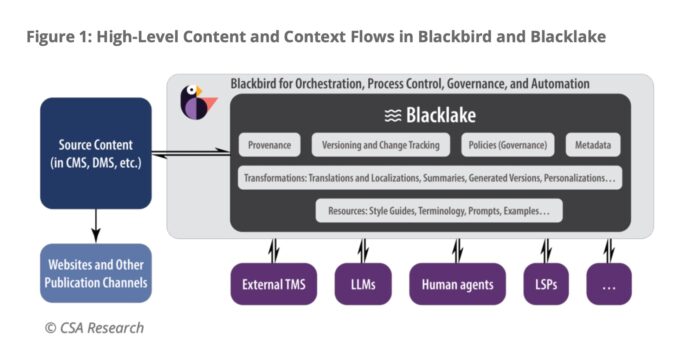
CSA research vendor briefing example within the Blacklake platform

Blackbird.io has announced the availability of a new CSA Research Vendor Briefing, Blacklake: Operationalizing the Post-TMS Future, authored by Arle Lommel and published in June 2026. The report examines Blacklake, Blackbird.io’s content and context layer for multilingual operations, and highlights its role in helping enterprises govern, track, and orchestrate content transformations across systems, markets, and AI-enabled workflows.

The CSA Research briefing describes Blacklake as a “system of record for content transformations,” providing a unified layer that manages changes to content regardless of where they occur or how they are produced. The report notes that Blacklake differs from traditional translation technologies by maintaining a continuously updated record of content, metadata, decisions, and transformations, rather than storing only translated segments for later reuse.

“As enterprises move beyond translation-only workflows, they need infrastructure that can preserve context, govern AI usage, and make multilingual content operations more efficient,” said Bruno Bitter, CEO and co-founder of Blackbird.io. “CSA Research’s analysis confirms what we’ve seen with our own customers: translation is becoming one governed transformation among many, and the market needs a content+context layer built for that shift.”

According to the report, Blacklake works alongside Blackbird’s orchestration platform to connect content and business management systems, translation technologies, quality tools, and workflow automation into a coordinated ecosystem. CSA Research highlights Blacklake’s ability to bring terminology, style guides, and quality metrics together with business metadata, provenance, and auditability in support of AI-driven content operations.

One of the key capabilities highlighted in the briefing is Blacklake’s granular change tracking. Because Blacklake maintains a complete record of content states and relationships, organizations can process, translate, or regenerate only the portions of content that have actually changed.

The briefing identifies three primary audiences for Blacklake: enterprises with mature localization and content operations, tech-forward organizations pursuing AI-driven content models, and language service providers seeking to offer differentiated value. Across these audiences, the report points to a shared need for greater control over fragmented content ecosystems, lower reliance on legacy processes, and more scalable governance for AI-enabled content operations.

CSA Research concludes that Blacklake points toward a future in which content is governed and linked across applications, processes, context, and metadata, fitting well into the analyst firm’s expanded view of the language sector as a broader transformation and governance sector.

Blackbird.io has secured rights to distribute the CSA Research Vendor Briefing. The report is now available for download at Blackbird.io.

About BLackbird.io

Blackbird.io is a content transformation platform built as a Transformation Management System (TMS), connecting AI models, vendors, CMSs, and automation into unified, governed workflows. Its Blacklake platform extends this ecosystem with scalable orchestration, enabling enterprises to manage multilingual content operations more efficiently, accelerate production, and maintain quality across complex global content lifecycles.

Creative Words Launches re[words], an AI-powered Post-Editing Tool for Translation Teams

0
re[words] by Creative Words

Creative Words has announced the launch of re[words], an AI-powered post-editing tool designed for teams managing high volumes of translated content.

The tool addresses a gap that has become increasingly familiar as MT adoption grows: while machine translation speeds up production, the review process has not kept pace. Post-editors still spend significant time on repetitive corrections, often with limited visibility into what actually needs fixing and why.

re[words] analyses XLIFF files across six MQM quality dimensions and returns a corrected file alongside a processing log that documents the reasoning and changes applied per segment. It supports the major CAT tool formats in use across the industry: .sdlxliff (SDL Trados), .mxliff (Phrase/Memsource), .mqxliff (memoQ), and .xlf (Okapi Framework), processing up to 20 files per job.

A quality layer, not a shortcut

What distinguishes re[words] from using a general-purpose LLM directly is the layer of linguistic expertise behind it. The tool is the result of more than two years of research into translation quality and language technology, developed by a team that includes professional linguists and localization specialists. Rather than a single prompt sent to a model, re[words] runs structured sequences of prompts designed around how translation quality is actually assessed and evaluates output dimension by dimension.

Users can attach a terminology glossary in Excel format, which is automatically injected into every prompt to ensure consistent application of domain-specific terms across all segments. While re[words] comes with a set of default prompts, output quality is directly shaped by how well the tool is configured to your content. Before running their first job, all clients work with Creative Words’ team to develop custom prompts tailored to their register, brand voice, and content type. This onboarding step is a standard part of every subscription.

re[words] supports multiple AI models — including GPT-4.1, GPT-5 (OpenAI) and Claude Sonnet 4 (Anthropic) — with a recommended configuration pre-set based on independent quality evaluations. For high-volume projects, a Review pass with a second model can be activated to balance quality and cost.

On data privacy, the tool uses a BYOK (Bring Your Own Key) architecture: users provide their own API key, which is used exclusively during processing and never stored, giving teams full control over data access and usage. For teams without an existing API key, Creative Words can advise and help identify the best setup for their workflow.

“AI in translation isn’t going away, but how we use it matters,” said Marta Castello, Innovation Manager at Creative Words. “re[words] was built around the idea that automation should handle repetitive work, so human expertise can focus where it actually matters. Speed and quality don’t have to be a trade-off.”

The tool is positioned explicitly as a support layer for human review, not a replacement for it. A final check by a qualified translator remains recommended — and the quality report is designed to make that step faster and more targeted.

To request a demo or discuss how re[words] fits into an existing post-editing workflow, reach out to the Creative Words Team.

About Creative Words

Creative Words is an Italy‑based language services company blending linguistic expertise with technology to support global communication. Offering localization, content creation, AI‑powered solutions, and multilingual strategy, it helps over 500 companies expand internationally with faster workflows, quality‑driven processes, and innovative tools like CW‑Elab and re[words] as a part of its AI solutions portfolio.