MultiLingual Magazine Wins Third APEX Award of Excellence

0
APEX Awards

MultiLingual magazine is proud to announce that it has received an Award of Excellence from the APEX Awards in the category of “Magazines, Journals & Tabloids – Electronic.” This marks the third consecutive year the publication has been recognized by the organization, which has honored professional communicators in corporate, nonprofit, and independent sectors since 1988.

Multilingual's October 2025 issue with The Vargas Sisters magazine cover

The award recognizes MultiLingual’s October 2025 issue for its exceptional graphic design, editorial quality, and in-depth coverage of the language industry. The issue featured a profile of the Vargas sisters, who lead localization programs at prominent technology firms. It also included insightful articles on the role of AI in Indigenous language access, strategies for making video games accessible, and how linguistic traditions frame our relationship with the natural world, alongside practical resources for localization professionals.

According to CJ Turturo, CEO of the APEX Awards, the caliber of submissions for the 38th Annual Awards for Publication Excellence was exceptionally high. “The quality of entries continues to impress our judges year after year,” Turturo stated. “Each cycle, selecting the winners grows more difficult because of the high caliber of so many submissions.”

Receiving this recognition for the third consecutive year is an honor, but what matters most is that it reflects our team’s commitment to telling the stories that move the language industry forward,” said Eddie Arrieta, CEO of MultiLingual Media. “We’re grateful to our contributors, readers, and partners around the world who make that mission possible every day.”

The MultiLingual team extends oursy deepest gratitude to the global readership. We remain dedicated to providing the highest quality insights and coverage for the language industry.

About APEX Awards

The APEX Awards recognize excellence in publishing, communications, PR, and marketing, honoring standout work across writing, design, digital media, campaigns, and specialized publications. Now in its 38th year, APEX guides professionals on best practices while celebrating high‑quality content across diverse media formats.

Lionbridge Games Wins Best Overall Use of AI in Gaming Award in 2026 AI Breakthrough Awards Program

0
Lionbridge's AI Breakthrough Award Certificate

Lionbridge Games, one of the world’s leading providers of game localization, audio, testing, and player experience services, has announced that its AI-driven localization platform, Lionbridge Samurai™, has won “Best Overall Use of AI in Gaming” award at the 9th annual AI Breakthrough Awards program, conducted by AI Breakthrough, a leading market intelligence organization that recognizes the top companies, technologies, and products in the global Artificial Intelligence market. The accolade recognizes Samurai as the first production-ready, game-specific, AI-driven localization solution that removes the trade-off between innovation and reliability.

Game localization sits at the intersection of creative storytelling, technical complexity, and high-stakes player expectations. Most general-purpose AI translation tools have struggled to handle this combination. Generic large language models (LLMs) frequently miss nuances in character voice, cultural references, and platform constraints, thus producing errors that require costly manual remediation before titles can ship.

Samurai was built specifically for this context. It places linguistic and cultural expertise at the center of a game-specific AI workflow, allowing studios to capture the speed and efficiency advantages of AI without compromising quality control that loyal player communities demand. From the customer perspective, Samurai operates as a familiar Translation, Editing, and Proofreading (TEP) engagement, with the AI gains applied behind the scenes through expert configuration tailored to each specific intellectual property.

“Game developers are under enormous pressure to ship globally without sacrificing the experiences their players expect,” said Tugdual Delisle, Managing Director, Lionbridge Games. “Samurai was built to take that pressure off by supercharging human expertise with AI speed to deliver the uncompromising quality control that great games demand. This recognition affirms what our customers are already telling us: a purpose-built solution for games makes all the difference.”

Underpinning the workflow is a structured Linguistic Quality Evaluation framework aligned with Multidimensional Quality Metrics principles. This approach captures AI and human quality in the same environment and feeds a closed-loop system to monitor delivery against TEP-equivalent thresholds and refine configurations for live-service content updates. Since its launch, Samurai has delivered 26 million target words across 42 game titles, with 55 language pairs in production for 29 active customers.

“Lionbridge Samurai impressed us with the care and craftsmanship behind its design, and with the depth of expertise the team has brought to a difficult problem,” said Steve Johansson, Managing Director, AI Breakthrough. “We are proud to recognize Lionbridge Games as our 2026 Best Overall Use of AI in Gaming winner.”

The achievement marks the third consecutive year Lionbridge has been honored by the AI Breakthrough Awards program for its industry-defining AI leadership. Lionbridge previously won “AI Model Validation Solution of the Year” for Aurora AI Studio™ in 2025, and “Best Machine Translation Solution” for Smart MT™ in 2024.

About Lionbridge Games

Lionbridge Games delivers the gaming experience your players demand. Its network of global gamers, combined with our award-winning AI-powered globalization solution, brings every aspect of your game to life across any language, culture, and platform. From concept to launch and beyond, it helps developers and publishers break through cultural barriers to engage players everywhere through localization, audio, testing, player experience, and multimedia services. With offices around the world, its follow-the-sun approach ensures that wherever your project is, a Lionbridge Games team is ready to pick it up in-market, in-culture, and around the clock.

The Week in Review: Language Industry News June 23-29

0
Week in Review June 23-29

This week’s stories reveal a sector in the middle of a structural recalibration — not just adopting AI, but redefining benchmarks, rebalancing authority, and building the governance layers that will determine who gets to participate, who gets represented, and what “quality” even means in a multilingual world.

Benchmarks

Wordly’s new 2026 State of AI Translation & Captions Report shows a dramatic shift in enterprise sentiment: 66% of event planners now say AI translation and captions deliver higher quality than human interpreters, increasing to 79% among regular users. The study highlights rapid improvements in AI quality, strong economic incentives, and surging multilingual demand, with 96% of organizations now treating comprehensive language access as a formal priority. Despite near‑universal adoption of live AI translation and captioning, enterprises are already looking beyond real‑time output toward full multilingual implementations that extend language access across the entire event lifecycle. 

The Association of Language Companies in Africa (ALCA) has published its first African Language Services Industry Report, offering the most comprehensive data to date on a sector underrepresented in global research. The findings reveal a rapidly evolving, highly entrepreneurial market: 85% of providers already use AI, 70% report positive business impact, half entered the industry within the past five years, and 96% plan geographic expansion despite persistent challenges. The report highlights rising demand for African languages across many industries, positioning the continent’s language sector as both a growth engine and a critical frontier for AI‑enabled multilingual communication. 

Community

UNESCO and the Unicode Consortium have announced a strengthened collaboration to advance digital inclusion for Indigenous and digitally disadvantaged communities. Aligning their efforts with the Global Action Plan of the International Decade of Indigenous Languages (IDIL 2022–2032), the partnership will focus on joint activities aimed at ensuring that Indigenous writing systems are accurately represented and usable across devices that rely on Unicode. By pairing UNESCO’s global networks with Unicode’s technical expertise, the collaboration lays groundwork for a more multilingual and equitable internet where Indigenous communities can create, communicate, and participate online in their own languages. 

RWS has won “Machine Translation Solution of the Year” at the 9th annual AI Breakthrough Awards, marking its third consecutive win. The honor underscores the momentum behind Language Weaver Pro, the company’s 100+ billion‑parameter, Cohere‑built enterprise translation model purpose‑trained for high‑stakes, context‑heavy content. Language Weaver Pro outperformed competitors in both human and automated benchmarking and is fully integrated across the Trados portfolio for scalable, secure enterprise deployment. Positioned at the core of RWS’s Language Intelligence capability, the model reflects the company’s push to deliver culturally fluent, governance‑ready AI translation for regulated, brand‑sensitive environments. 

Park IP, a Welo Global brand, has received the IDP Innovation Award at the 2026 AI Breakthrough Awards for Legal Studio, its AI‑enabled platform. Designed to manage patent and IP workflows across global portfolios with jurisdiction‑specific automation, real‑time analytics, and review by credentialed IP specialists, the platform provides end‑to‑end patent prosecution orchestration, standardizing global filings through automated formatting, jurisdiction‑specific deadlines, and real‑time risk and cost visibility.

_____________________________________________________________________________________________________________________________________________

Across reports, awards, and global collaborations, this week’s stories point to a deeper shift of who sets the standards, who benefits from them, and how those standards get enforced across markets, jurisdictions, and communities. From Indigenous language inclusion to African market data to enterprise‑grade translation and IP governance, the real story is the emergence of new centers of authority shaping how multilingual communication will function in the next decade.

For more stories like these, visit our News section.

UK Government Funds Major Expansion of Specialist Interpreters for the Deafblind Community

0
UK Government

The UK government has announced new funding to significantly expand specialist interpreter capacity for Deafblind people, marking one of the largest increases in qualified support in recent years. Backed by £15,000, the initiative will fund competency assessment sessions designed to grow the number of registered interpreters from just eight nationwide to 68 — a substantial shift for an estimated 12,000 Deafblind individuals who rely on tactile and adapted forms of British Sign Language (BSL) for communication. 

The funding follows recommendations from the British Sign Language (BSL) Advisory Board, which identified interpreter scarcity as a critical barrier to communication access. Working with Signature, the UK’s leading awarding body for Deaf and Deafblind communication qualifications, and the National Registers of Communication Professionals working with Deaf and Deafblind People (NRCPD), the board helped design a series of weekend assessment sessions to validate interpreter competence and expand the national register. 

Government officials framed the investment as part of a broader effort to reduce structural barriers for disabled people and strengthen access to essential communication services. Increasing interpreter capacity is expected to reduce waiting times, ease supply pressures, and improve access to qualified professionals trained in Deafblind communication modalities. Leaders from the BSL Advisory Board and NRCPD emphasized that the expansion represents both a milestone and a foundation for future collaboration across education, research, and practice, particularly as demand for qualified interpreters continues to grow. 

The announcement also aligns with wider disability policy developments. The government is currently preparing a UK Government Plan for Disability and has increased staffing for the Access to Work scheme by 72% to address backlogs affecting disabled workers, including those who rely on BSL interpreters. Departments are additionally updating their British Sign Language action plans, which will be published alongside the fourth BSL report in July 2026 — part of a commitment to exceed the reporting requirements set by the BSL Act 2022

The organizations involved play central roles in the UK’s language‑access ecosystem: the BSL Advisory Board advises on Deaf community priorities; NRCPD regulates communication professionals across multiple modalities; and Signature has supported more than 600,000 learners in BSL education since becoming an independent body in 1982. Their collaboration underpins the government’s effort to expand interpreter availability and strengthen long‑term access for Deafblind people.

Enovate Acquires cApStAn, Strengthening its International Position in Education, Certification and Multilingual Assessments

0
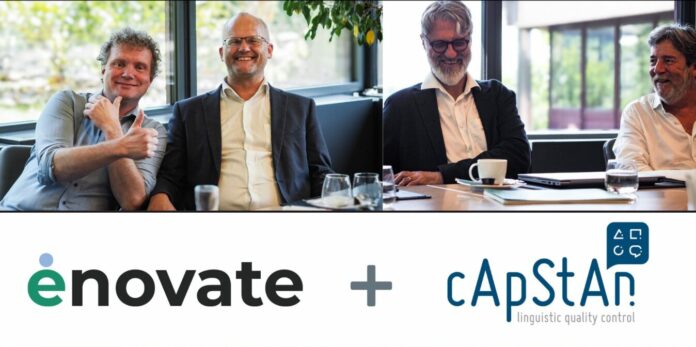
cApStAn's Steve Dept and Enovate's Øyvind Meistad pictured together

Enovate AS has acquired cApStAn SA, a globally recognized language solutions integrator and linguistic quality assurance provider for assessments, questionnaires and psychometric tests, in education as well as in HR testing and certification. The acquisition is a milestone in Enovate’s strategy to build and manage a leading European platform for digital testing, certification and assessment solutions with a global reach.

For over twenty-five years, cApStAn have established their reputation as a leading specialist in translation, adaptation and quality assurance of international large-scale assessments and data collection instruments. One of their flagship projects is the OECD Programme for International Student Assessment (PISA), for which they have been the contractor in charge of linguistic quality control in each of the nine PISA cycles to date, and currently preparing the work for PISA 2029, their 10th consecutive cycle. In PISA 2025, over 90 countries and economies participated, and the assessments were administered in 54 languages. Some of cApStAn’s other major projects include IEA/TIMSS, IEA/PIRLS, OECD/PIAAC, UNICEF/SEA_PLM, CONFEMEN/PASEC or the European Social Survey (ESS).

cApStAn operates out of their Brussels headquarters and their office in Philadelphia. Their international network includes over 700 linguists and subject matter experts, all based in the target countries. “cApStAn represents a unique combination of expertise, international experience and proven quality. Through their work on programmes such as PISA, the organisation has helped ensure that millions of students around the world can take comparable assessments in their own language. We are proud to welcome cApStAn to the Enovate group,” said Øyvind Meistad, CEO at Enovate.

cApStAn’s expertise in multilingual assessments complements Enovate’s digital solutions for examinations, certification, e-learning and competency management. Together, the companies will be able to offer clients a complete value chain, from item authoring to assessment delivery and administration, and from translation and cultural adaptation to international deployment.

“Enovate has built digital platforms that are both robust and flexible, and they made themselves a name as reliable partners in testing and certification. We see promising opportunities arising from this cross-pollination: together, we shall develop innovative solutions for international clients,” said Steve Dept, founder at cApStAn.

The combined group will serve customers across education, government, international organisations and professional certification programmes throughout Europe, North America and other global markets. The transaction was completed in Brussels on June 22, 2026.

M&A advisor

The shareholders of cApStAn SA were advised on the sale to Enovate AS by HSCie. HSCie is an independent, partner-led M&A advisory firm specializing in cross-border mid-market transactions. The mandate was led by partner Andreas Jacobi.

“cApStAn is a one-of-a-kind business with a global client base and a remarkable track record. It was a privilege to advise the shareholders on finding the right partner in Enovate to carry that legacy forward,” said Andreas Jacobi, Partner at HSCie.

The acquisition was partly financed through a growth loan from Innovation Norway. Enovate is grateful for Innovation Norway’s support in helping realize the company’s international growth ambitions.

About Enovate

Enovate is a Norway‑based testing and assessment company specializing in secure, scalable digital exam delivery for high‑stakes environments. Originally built as educational software, it has grown into a trusted provider for global organizations seeking reliable, integrity‑focused testing solutions. Today, Enovate continues expanding its capabilities, combining technical rigor with user‑centric design to support complex assessment needs across sectors.

Eclipse Scheduling Completes SOC 2 Type II Examination

0
Eclipse Scheduling logo

Eclipse Scheduling, a scheduling and management platform for interpreting, translation, and accessibility services, has announced it has completed its SOC 2 Type II examination. The independent attestation, conducted by Prescient Assurance against the American Institute of Certified Public Accountants (AICPA) Trust Services Criteria, evaluates how an organization’s controls are designed and whether they operate effectively across an extended observation period.

Unlike a Type I report, which assesses controls at a single point in time, a Type II examination tests whether they hold up in practice over a sustained period. in Eclipse’s case, the testing is done across its production infrastructure, development lifecycle, access and change management, and incident response.

“SOC 2 Type II is a milestone for any software company, but it carries extra weight in our field,” said Tyler Herron, CEO and co-founder of Eclipse Scheduling. “Our customers coordinate some of the most sensitive conversations people have — medical appointments, court proceedings, IEP meetings, immigration interviews. The system that schedules and tracks this work has to be held to the same standard as the linguists doing it.”

Why SOC 2 Type II matters in language services

The data inside a language-services platform is rarely routine. It records which patients needed an interpreter for a diagnosis, which families met with a school district about a child’s services, and which defendants required counsel in a language they understand. Safeguarding that information is a fundamental responsibility of any vendor entrusted with it.

What has changed is that customers now expect that responsibility to be demonstrated, not simply asserted. Language service providers and in-house language access offices operate inside regulated environments — hospitals answer to HIPAA and Section 1557, school districts to FERPA, courts to Title VI, public agencies to their own security standards — and those obligations pass downhill to the vendors they depend on. A platform’s word that it handles data securely no longer carries a procurement or security review on its own; the controls behind that claim have to be independently verified.

That is what a SOC 2 Type II report provides — not a vendor’s claim about security, but an independent auditor’s confirmation that the controls work and have kept working over time. It is among the more demanding attestations a software provider can put in front of a procurement or security review. For the organizations that build on Eclipse, that verification does a few practical things:

  • Shortens enterprise and public-sector RFP cycles that require third-party attestation.
  • Helps customers demonstrate their own compliance to the healthcare, legal, education, and government clients they serve.
  • Cuts down on the custom security questionnaires they would otherwise complete one at a time.

One platform, more than one kind of language access

Eclipse was founded by career interpreters and language service provider (LSP) operators who had lived with fragmentation: disconnected scheduling tools, credentialing tracked in spreadsheets, billing in a separate system, and provider communication scattered across email and text. They built the platform to bring workflows into one place and to cover the full range of language access, not interpreting alone.

Today it coordinates spoken language and sign language interpreting, live captioning, and accessibility services for blind and low-vision audiences. Agencies, accessibility providers, and in-house language access teams across industry settings use it as a single system to manage their full service catalog.

A few structural choices shape how the platform works. Eclipse coordinates services but does not employ or supply linguists, which keeps it from competing with its own customers. Its data model reflects how language services are actually managed — including language pairs, certification and credential expirations, service modality, specialty matching, and the billing structures that come with them. Automation is used where it adds operational leverage, while the decisions that affect a patient, student, or defendant are left to humans.

“Security attestations like SOC 2 are sometimes treated as a box to check,” said Shelby Edwards, co-founder and chief experience officer of Eclipse Scheduling. “We treat them as the floor. Language access touches civil rights, health outcomes, and due process. The infrastructure under it should be held to the same standard as the work itself.”

What it means for the industry

For LSPs, consolidating a stack that has often required four to six separate tools frees up coordinator time and removes the handoffs where errors tend to creep in. For in-house language access offices, it provides a system of record they can put in front of regulators, leadership, and the communities they serve. And for the people on the receiving end — patients, students, people in court, and community members with limited English proficiency — reliable coordination is often what determines whether the right qualified linguist is actually present when the appointment begins.

Availability

Eclipse’s SOC 2 Type II report is available to current and prospective customers under NDA. Organizations evaluating the platform for procurement or a security review can request it through their account contact or the company’s contact page.

About Eclipse Scheduling

Eclipse Scheduling is a New York-based software company that provides a management platform for interpreting, translation, and accessibility services. Founded by language-industry professionals, it serves language service providers, accessibility offices, and enterprise language access teams that want to modernize operations on HIPAA-aligned, SOC 2 Type II–attested technology.

Frenchside Launches Premium Bill 96 Compliance Service

0
Frenchside

Frenchside, a Canadian translation agency, has launched a premium Bill 96 compliance service for English-speaking companies operating in Quebec.

The service arrives one year into active enforcement of Quebec’s French-language law. Since June 2025, the Office québécois de la langue française (OQLF) has pursued major retailers and small businesses over signage and packaging, with fines that can reach tens of thousands of dollars per violation. Another deadline is approaching: Non-compliant products made before June 2025 may be sold only until June 2027.

Frenchside built the service on a year of practice. The agency has guided brands and industrial manufacturers through product labelling, signage, contracts, websites, and francization filings under real OQLF review. Those projects have shaped the new offering.

“In this environment, translation cannot be an approximation,” said Benjamin Beaudor at Frenchside. “A near-correct label or a misjudged sign is no longer a small detail. It is legal exposure. Compliance-grade French is a discipline, and it calls for certified experts who know the law behind every requirement.”

The new service covers the areas the OQLF examines most closely: signage, product packaging and descriptive terms, websites and e-commerce, advertising, customer contracts, employee documentation, and OQLF francization registration. Companies based outside Quebec are increasingly affected as well, often through a single Quebec employee or a base of Montréal customers.

“English-speaking companies want to operate here without friction,” added Benjamin Beaudor. “We remove the regulatory uncertainty so they can focus on growth.”

About Frenchside

Frenchside is a certified French translation agency based in Canada, serving clients in Montréal, Toronto, Ottawa, Calgary, and Vancouver since 2014. Its linguists are accredited by leading Canadian associations, including OTTIAQ and ATIO, and the agency is a member of GALA and the Canadian language industry association. Frenchside has completed work for more than 1,200 clients across the public, financial, industrial, and cultural sectors, providing certified translation, localization, and interpretation in English and Canadian French.

Alconost Launches a Free Tool That Builds Glossaries From Your Content

0
Alconost Glossary Extractor tool display

Alconost has launched a free AI‑powered glossary generator that converts JSON, XLIFF, Excel, CSV, or text files into a structured, production‑ready term base in minutes. The tool scans entire documents, identifies real terminology, and uses leading language models to deliver clear definitions, exact usage counts, and existing translations when present. The result is a fully editable, CAT‑tool‑ready term base that streamlines terminology management for localization teams.

Four steps to your glossary

  1. Upload your files — JSON, XLIFF, Excel, CSV, or TXT.
  2. Find candidate terms — the tool pulls a shortlist of likely terminology.
  3. AI review & definitions — AI keeps the real terms and writes a definition for each.
  4. Review & download — check the final glossary, edit anything you want, and download as CSV.

For every term, you get the part of speech, a definition, a count of how often it appears, and translations when your files contain them. This is the format your translators and CAT tools work with.

Accurate by design

Instead of relying on AI alone, the tool works in two steps, so each part does only what it’s actually good at.

First, fast traditional algorithms such as natural language processing (NLP) scan the whole document and pull out candidate terms: key nouns, multi-word phrases, product names, and brands. This step handles the heavy lifting on volume, so AI doesn’t need to look at every word.

Then a large language model (LLM) takes only that shortlist and applies real judgment. It removes ordinary words that aren’t real terms, writes a clear, context-aware definition for each one it keeps, flags terms that should stay untranslated (like brand names), and pulls the right translation when your file already contains translations.

You get AI-level accuracy without running an LLM over the entire document, which would take much longer. Statistics manage the bulk processing, while the LLM provides the judgment. Frequency counts aren’t left to the AI either — exact code walks the text and counts every occurrence precisely, so the numbers you see are always reliable.

The glossary generator is powered by leading AI models from OpenAI, Anthropic, and Google.

The new tool is free to use and is made available at alconost.mt/glossary.

About Alconost

Founded in 2004, Alconost is a leading provider of localization services, offering professional translation, localization testing, and language quality assurance services. Headquartered in Virginia, the company serves clients across gaming, software, mobile apps, and digital content industries worldwide, with offices in multiple countries and a network of over 3,000 professional linguists.

Park IP Legal Studio Receives IDP Innovation Award in 2026 AI Breakthrough Awards Program

0
Park IP a Welo Global Brand

Park IP, a Welo Global brand, has been recognized in the AI Breakthrough Awards with its Legal Studio platform receiving the “IDP Innovation Award”. Legal Studio by Park IP is an AI-enabled platform that manages patent and intellectual property work at enterprise scale across patent families and global portfolios. It combines jurisdiction-aware automation, AI-driven quality control, real-time analytics, and review by credentialed IP specialists to deliver file-format-ready filings that stand up in prosecution across global markets.

The most recent release of Legal Studio functions as a workflow and decision layer embedded within IP operations, ensuring every filing is prepared, formatted, validated, and aligned to jurisdiction-specific requirements before submission. The studio surfaces real-time data and analytics on status, risk, quality, and cost, giving IP teams the visibility to make confident business decisions in the fast-paced, ever-changing world of global patent prosecution. It dynamically adjusts formatting, terminology, and document structure to each destination market, while a rules engine automates priority filing start-date calculations, 12-month and 30-month PCT deadline chains, and document instruction requirements across entire patent families.

Behind the platform sit credentialed IP specialists, many of them patent attorneys, former examiners, and engineers who remain accountable for technical accuracy across mechanical, electrical, chemical, life-sciences, and other subject matters. Legal Studio handles the full complexity of patent content, including chemical structures, sequence listings, and patent-specific visual elements, and produces file-format-ready filings engineered to stand up in prosecution. Every deliverable is reviewed against jurisdiction-specific requirements and client terminology, with patentability impact assessed on each substantive change.

“Legal Studio embeds AI into the orchestration of the entire prosecution process, not just one step of it. It is the operating system for global patent work where filing strategy, jurisdiction rules, and credentialed specialist review come together in a single, auditable workflow,” said Jackie Kelly, Head of Commercial, Park IP.

“Patents don’t live in isolation. They live in portfolios and patent families, inside an IP ecosystem that never stops moving. By pairing deep IP specialization with real-time data and analytics, we give IP teams what they need to make fast, confident business decisions and to file with output that stands up in prosecution accurately, accountably, and consistently, in every jurisdiction.”

For nearly a decade, the AI Breakthrough Awards have researched, analyzed and recognized the most important advances in artificial intelligence, and this year’s field is the strongest yet. Thousands of nominations from over 20 countries poured in across categories including Agentic AI, Generative AI, Computer Vision, AIOps, Robotics, Natural Language Processing and industry-specific AI applications – underscoring the explosive global growth of AI and its importance as the defining technology of our time.

“Legal Studio improves consistency and reduces variability across documents and markets. IP teams can’t afford surprises when trying to manage global filings with confidence, predictability, and control. Traditional solutions fail to deliver the visibility needed to ease complex, multi-jurisdictional filing requirements, deadlines, and shifting compliance and prosecution demands,” said Steve Johansson, managing director, AI Breakthrough.

“Legal Studio’s AI approach enables it to manage complexity across jurisdictions, document types, and regulatory environments in a way that generic AI tools cannot. Teams can streamline patent prosecution and filing workflows with real-time visibility, compliance controls, and credentialed specialist oversight.”

Legal Studio’s interface comes with configurable homepage widgets tailored to each customer’s service profile (patent prosecution, compliance, or litigation), an integrated magic link for onboarding flow, and a budgeting tool for European Patent (EP) filing cost management. Its proprietary budgeting tool uses predictive analytics to forecast filing costs and deadlines across 180+ jurisdictions giving IP teams real-time data to plan portfolios and make business decisions with confidence.

About Park IP

Park IP, a Welo Global brand, is a global IP solutions partner built for modern intellectual property work. It combines deep IP expertise with AI-powered workflows that reduce risk, improve predictability, and deliver greater visibility and control across the IP lifecycle, from prosecution to litigation and compliance. Its Legal Studio platform strengthens portfolio and patent-family management through jurisdiction-specific coordination and real-time analytics, while credentialed IP specialists remain accountable for quality and judgment. Operating under the most ISO-aligned quality and security standards in the industry, Park IP advances a disciplined and transparent approach to managing intellectual property worldwide.

About Welo Global

Welo Global is a leader in multilingual AI, technology, and content solutions serving clients in over 300 languages. The company combines globally scaled multilingual infrastructure with advanced NLP, computational linguistics, and best-in-class compliance backed by 7 ISO certifications. Welo Global’s five brands — Welocalize, Adapt, Park IP, Welo Life Sciences, and Welo Data — serve distinct customer segments with purpose-built expertise, solutions, and technology.

About AI Breakthrough

As a part of Tech Breakthrough, a leading market intelligence and recognition platform for global technology innovation and leadership, the AI Breakthrough Awards program is devoted to honoring excellence in Artificial Intelligence technologies, services, companies and products. The AI Breakthrough Awards provide public recognition for the achievements of AI companies and products in categories including Agentic AI, Machine Learning, Generative AI, Robotics, AI Hardware, Computer Vision and more.