Fewer Than You Think: The Hidden Reality of Language Pairs in AI Models

0
Children Peeking Behind Curtains

Big‑tech companies often boast about advancing language support in their artificial intelligence (AI) models, many claiming to offer dozens of language pairs. However, this marketing narrative doesn’t tell the whole story, obscuring the fact that most of these models rely on an English‑pivot architecture that precludes true multilingual interoperability. 

For consumers who depend on non-English language pairs to communicate, incomplete or misleading statements about language support can be far from helpful. Companies in Silicon Valley owe it to their global users to be transparent about the data used to train their AI and what effect that has on its multilingual capabilities.

The English-Pivot Bias

Synthetic data is the driving force behind today’s AI models. While there is no official report on how much synthetic data used in AI is strictly English-centric, we know that an overwhelming majority of AI is built on data in the English language. When there is little to no synthetic generation pipeline for non-English to non-English language pairs, the models route translations through English as an intermediate step — resulting in what’s known as an English-pivot bias and lower-quality translation. 

This structural tendency leads evaluation benchmarks, prompting formats, and reinforcement learning reward models to function only the way they do within an English-language setting. And of course, this information often gets left out of marketing campaigns when a new model is released or when languages are added to a product. 

Pair‑Level Transparency

When looking at claims from the top five big tech companies with AI models — Amazon, Apple, Google, Meta, and OpenAI — there is a noticeable pattern of excluding specific information on supported language pairs. Two models — Meta’s No Language Left Behind (NLLB) and Google’s TranslateGemma — do have publicly available model cards, but no company provides pair-level transparency in its entirety. Models are marketed as having been trained on 55 language pairs (TranslateGemma) or supporting over 200 languages (NLLB), for example, but these claims are not verifiable with a full language-pair matrix.

Currently, there are no ISO standards, European Union AI Act provisions, or United States regulations that require companies to disclose language-pair coverage or non-English translation directions. Perhaps it’s no surprise that this information is hard to find.

Why It Matters

For consumers who rely on non‑English communication, the difference between “200 languages” and “200 translation directions” is enormous. The lack of complete information on language pairs can distort the true depth of multilingual coverage these products are able to provide to non-English-speaking consumers.

In the race to support the most languages, AI companies benefit from advertising with ambiguity. After all, simple language counts are easy to market — but at what cost to the consumer? Until the industry adopts pair‑level transparency, multilingual AI will continue to be marketed as global while functioning primarily as English‑centric.
Keylingo and Bureau Works Partner to Bring Next-Gen Tech Enablement to Premier Localization Services

0
Keylingo and Bureau Works future-proof partnership

Keylingo, a recognized leader in high-touch, reliable global language solutions, and Bureau Works, a pioneer in generative-AI translation management, have announced a new strategic partnership. This collaboration unites Keylingo’s legacy of unshakeable reliability and partnership with Bureau Works’ cutting-edge technology to set a new benchmark for the language services industry.

This is not a pivot, but an evolution. Keylingo has long been optimized for service excellence. By integrating Bureau Works, the agency is now deploying next-gen tech enablement across its entire production chain—enhancing automation, streamlining workflows, and empowering linguists to deliver higher quality assets with greater efficiency.

Future-proofing excellence

For Frederick Marx, CEO of Keylingo, the decision to integrate Bureau Works was about ensuring that Keylingo’s technology stack matches the world-class quality of its people. “We have spent years optimizing our service model to be the most responsive partner in the industry. That commitment to excellence hasn’t changed, but the tools available to achieve it have,” says Marx.

“Partnering with Bureau Works isn’t about fixing a gap; it’s about seizing a future. We are bringing in next-generation technology that enhances every step of our production chain. From instant quotes in the client portal to automated workflows that allow our project managers to focus on strategy, we are ensuring our infrastructure is as robust as our relationships.”

Augmenting the production chain

While the partnership offers clients immediate benefits like real-time transparency and accelerated turnaround times, the impact runs deeper. Keylingo is leveraging Bureau Works’ context-sensitive technology to transform the translator experience.

By utilizing advanced orchestration and automation, the platform reduces administrative “noise” and cognitive load for linguists. This allows Keylingo’s expert translators to work with less stress and more focus, resulting in higher quality translation assets and a healthier, more sustainable supply chain.

Redefining standards

For Gabriel Fairman, Founder and CEO of Bureau Works, Keylingo represents the ideal use case for modern localization technology: a successful agency that refuses to rest on its laurels. “Keylingo is already a powerhouse of reliability. They didn’t need us to tell them how to run an agency; they wanted a technology partner that could amplify what they already do best,” says Fairman.

“This partnership blends their flexibility and responsiveness with our context-sensitive technology. It’s a powerful union that improves the life of the translator, accelerates delivery for the client, and proves that you can integrate deep automation without sacrificing the human touch that Keylingo is famous for.”

About Keylingo

Keylingo is a premier language services provider built on the foundation of enduring partnerships and service excellence. Headquartered in Atlanta, Georgia, it combines the reach of a global agency with the responsiveness of a local partner, ensuring its clients’ messages resonate in every language and market.

About Bureau Works

Bureau Works is a leader in generative AI-powered translation management. Headquartered in Lafayette, California, the company focuses on context-sensitivity and the translator experience, enabling global brands and agencies to scale their content without losing their soul.

DeepL Launches Voice API for Real-Time Speech Transcription and Translation Enabling Instant Multilingual Communication

0
DeepL

DeepL, a global AI product and research company, announced the general availability of DeepL Voice API. This innovative product empowers developers to integrate real-time voice transcription and translation capabilities into their applications, significantly enhancing multilingual support for businesses. 

The DeepL Voice API allows businesses to stream audio and receive transcriptions in the source language, along with translations into up to five target languages. The API provides a seamless experience for users, ensuring that language barriers do not hinder effective communication.

DeepL Voice API will be widely available for customers with spoken communication at their core, with contact centres and business process outsourcing (BPOs) providers being the earliest adopters of this solution. 

Transforming Multilingual Support

The DeepL Voice API turns language support from a staffing problem many contact centers face, into an easy-to-use solution that fits well with current systems. By adding real-time transcription and translation to how agents work, supervisors can handle issues better, and agents can assist customers in different languages without needing to pass them on to a colleague or revert to written communication to allow for translation. 

On the operational side, the Voice API provides clear transcripts and translations that help with quality checks and training of customer service teams. This allows for quicker reviews, fairer evaluations across different locations, and clearer feedback on agent performance and gaps in knowledge. By minimizing issues caused by language barriers, like longer calls, repeated contacts, and expensive misunderstandings, the DeepL Voice API changes the overall experience for the end user.

“When interacting with a customer service representative, the end user is often trying to resolve an important issue, so facing communication barriers often leads to a negative experience. By equipping contact center teams with tools that enable real-time communication in any language, we can turn what is often perceived as a cost center for a business, into a revenue generating one through customer excellence. This also makes the work of contact center agents smoother, reducing the need to pass tasks to others or seek workaround solutions,” said Gonçalo Gaiolas, Chief Product Officer at DeepL.

The DeepL API will enable the following for users: 

  • Hire for expertise, not language coverage:
    DeepL Voice API lets contact centers staff agents who understand the customer issue and the business context, even when they do not speak the customer’s language.
  • Expand talent pools while managing costs:
    By reducing the need for language specific staffing, teams can centralize or distribute support more flexibly, which can lower operating costs and improve coverage planning.
  • Provide reliable coverage in urgent moments:
    Real time translation helps teams maintain service levels during nights, weekends, and holidays, when fewer specialized language agents are available.
  • Two-way understanding, not just text on screen:
    Agents can follow the conversation through live translated audio, alongside on screen transcription and translation, so they can respond naturally and confidently in the moment.

Business Value and Operational Resilience

For leaders in the industry, the business value is multifold. Organizations can expand language coverage without overhauling their hiring models, add new geographies quickly, and support more client programs with the same core team. This control over customer experience, compliance, and cost becomes increasingly important as operations grow.

The launch also includes a six-week early access program for voice-to-voice capabilities, set to run from mid-February. This feature will allow agents to hear translated audio while communicating with customers in their preferred languages in real-time, further streamlining the customer experience.

Availability

The DeepL Voice API will be available to all DeepL API Pro customers starting February 2. Interested businesses can get started by accessing the DeepL API documentation or contacting sales for Voice API access.

For more information on DeepL Voice API, including supported languages, please visit the website here

About DeepL

DeepL is a global AI product and research company focused on building secure, intelligent solutions to complex business problems. Over 200,000 business customers and millions of individuals across 228 global markets today trust DeepL’s Language AI platform for human-like translation, improved writing and real-time voice translation. Building on a history of innovation, quality and security, DeepL continues to expand its offerings beyond the field of Language, including DeepL Agent – an autonomous AI assistant designed to transform the way businesses and knowledge workers get work done. Founded in 2017 by CEO Jarek Kutylowski, DeepL now has over 1,000 passionate employees and is supported by world-renowned investors including Benchmark, IVP, and Index Ventures.

CPSL Language Services Awarded EcoVadis Sustainability Rating

0
CPSL Language Services Receives Ecovadis Sustainability Rating

CPSL Languages Services has announced they have received a sustainability rating from EcoVadis within their January 2026 assessment, recognizing its commitment to responsible and sustainable business practices.

EcoVadis assesses companies in relation to internationally recognized CSR standards in four key areas: Environment, Labor & Human Rights, Ethics, and Sustainable Procurement. In the January 2026 assessment, CPSL achieved an overall score of 55/100, placing it in the 43rd percentile with a “Good” sustainability performance rating.

The assessment results highlight CPSL’s strong performance in Labor & Human Rights (61/100) and Environment (58/100), provided with a clear roadmap for improvement supported by an operational Corrective Action Plan.

Achieving an EcoVadis rating represents an important addition to CPSL’s five ISO certifications. The rating, through an independent and widely recognized framework, underscores CPSL’s commitment of going beyond merely delivering quality and information security as a trusted service provider and extends to how it operates as a business.

While CPSL’s ISO standards demonstrate robust, audited management systems for quality and sector-specific delivery — ISO 9001, ISO 17100, ISO 13485, ISO 27001, and ISO 18587 — EcoVadis adds a broader CSR lens for assessing its policies and actions across the stated four key areas, where it is strongest in Environment and Human Rights. In addition, EcoVadis’ sustainability rating aligns perfectly with the challenges and objectives set forth by the UN Global Compact, an initiative CPSL has strongly supported and been committed to since 2018.

This combination of the EcoVadis rating and the company’s existing ISO qualifications serve to strengthen client confidence, while demonstrating that not only is CPSL rigorous in operational excellence and compliance, it is also committed to responsible practices throughout our value chain — an increasingly important requirement in supplier qualification, tenders, and global procurement decisions.

About CPSL Language Services

CPSL is a trusted language services partner with more than 60 years of experience supporting global organizations. Founded in 1963, it combines human expertise with a commitment to quality, innovation, and empathy. Its long‑standing client relationships reflect its ability to adapt in a constantly evolving market. Guided by the principles of the UN Global Compact, it prioritizes social responsibility, environmental stewardship, and equality while delivering tailored solutions for every project. CPSL is headquartered in Spain with global offices in the U.S. and Germany.

About EcoVadis

EcoVadis is a global leader in business sustainability ratings trusted by more than 150,000 companies worldwide. With a rapidly expanding international team, EcoVadis delivers actionable insights that help organizations improve environmental, social, and ethical performance across their value chains. Through innovative solutions like EcoVadis IQ, the Carbon Action Manager, and the EcoVadis Academy, the company empowers businesses to drive measurable impact and advance responsible practices at scale.

Events.Studio Introduces Caption Bookmarking to Preserve Key Moments in Live Events

0
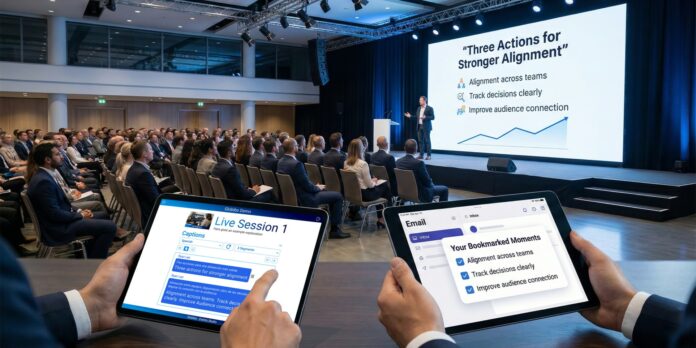
Caption bookmarking used during a conference

Events.Studio, a multilingual event technology platform, has announced the launch of a new caption bookmarking feature that allows attendees to capture and revisit important moments during live events.

In conferences, annual general meetings, panel discussions, and training sessions, critical information often appears briefly- a key decision, a quote, or a data point that attendees want to remember but may not have time to note down. Caption bookmarking addresses this challenge by enabling users to save exact segments of live captions in real time, without disrupting their attention or participation.

With a simple tap on any caption line, attendees can bookmark a specific moment instantly. A confirmation message indicates that the segment has been saved, allowing users to continue following the event seamlessly. Participants can bookmark as many caption segments as they wish during a session.

Once the event concludes, all bookmarked caption segments are automatically compiled and sent directly to the attendee’s email. This removes the need for screenshots or manual notetaking and provides a precise record of the words and moments that mattered most to each individual. Live captions, often consumed only once, are transformed into actionable, reusable takeaways.

Benefits for attendees

The caption bookmarking feature helps participants:

  • Capture key insights without distraction.
  • Save decisions, quotes, and action points exactly as spoken.
  • Review important content after the event, in their own inbox.
  • Turn live captions into lasting reference material.

Insights for organizers and speakers

In addition to attendee benefits, caption bookmarking offers new analytical opportunities for event organizers and speakers. Aggregated bookmarking data helps teams understand:

  • Which sessions or speakers resonated most with audiences.
  • Which topics generated sustained attention.
  • How different audience groups engaged with specific content.
  • Where content design and delivery can be improved.

These insights support better program planning, speaker alignment, and audience engagement across future events.

Designed for multiple event formats

Caption bookmarking can be used across a wide range of live and hybrid scenarios, including conferences, board and shareholder meetings, training programs, workshops, and multilingual events where clarity and retention are essential.

By allowing attendees to decide what matters and ensuring those moments are preserved, Events.Studio extends the value of live captions beyond the session itself. The feature supports deeper engagement during events and more meaningful follow-up afterward, benefiting both participants and event teams.

About Events.Studio

Events.Studio is a multilingual event‑technology platform by Globibo, extending the company’s global expertise in translation, interpretation, and multilingual communication. Combined with its training and event‑service capabilities, the platform empowers organizations to engage audiences, streamline understanding, and capture essential moments across live and hybrid environments.

ELAN Named “Tech of the Week” by Nimdzi Insights

0
ELQN Languages as Tech of the Week

ELAN, a provider of advanced localization and interpreting solutions, has been named “Tech of the Week” by Nimdzi Insights in recognition of ELAN AI Bridge, a model-agnostic product designed to integrate AI seamlessly into localization workflows in a way that respects existing systems.

ELAN AI Bridge enables organizations to deploy AI across their translation operations while maintaining full compatibility with major translation management systems (TMS), including memoQ, Phrase, XTM, and Trados Studio. The solution allows for leveraging large language models (LLMs) across domains, languages, and use cases, giving clients full control over performance, security, and customization.

The core innovation of ELAN AI Bridge lies in its ability to bypass traditional translation memory segmentation — a long-standing limitation in modern localization workflows. Instead of processing content segment by segment, the Bridge bundles segmented content into a single continuous text stream for the LLM to process. Once translated, the system accurately writes the output back into the original segments of the TMS of choice. This approach significantly enhances translation consistency and accuracy, as well as post-editing productivity. Recently, ELAN measured a 43% productivity increase for one of its key clients after deploying the Bridge.

ELAN AI Bridge also provides a suite of additional capabilities such as:

  • Support for a range of AI-driven use cases, including LLM-based machine translation, automated post-editing, quality estimation, and LLM-driven QA.
  • Deep customization through so-called context stores, leveraging style guides, terminology and other linguistic resources, as well as more advanced customization techniques.
  • Fast and accurate bilingual terminology extraction, straight from jobs in the TMS, ensuring terminology consistency across languages and projects.
  • Dedicated TMS endpoints, allowing precise configuration, workflow chaining, and seamless integration into existing localization pipelines.
  • Model consultancy, helping clients select and optimize language models for specific content types and use cases.

The “Tech of the Week” recognition highlights ELAN’s contribution to advancing practical, production-ready AI adoption in localization, solving real workflow constraints and thus bridging the gap between generative AI and the realities of enterprise translation environments.

“ELAN AI Bridge embodies our vision of bringing AI, technology, and localization together. Beyond leveraging best-in-class language models, we take pride in knowing that we can enable AI in different workflow steps — from machine translation to quality assurance — integrate with different systems via a comprehensive API, as well as produce targeted results through a deep customization layer,” said Jourik Ciesielski, Chief Technology Officer at ELAN Languages.

About Nimdzi Insights

Nimdzi Insights is an international market research and consulting company. Nimdzi advises on international trade & development, language services, language technology, and localization programs. Nimdzi guides companies through investment and M&A activities. Nimdzi consultants are committed to providing opportunities for continuous professional development and resources for business professionals worldwide.

Boostlingo’s New Study Helps Define How AI Interpreting Should Be Measured

0
Boostlingo

Boostlingo released its AI Accuracy Study, an evaluation of how AI interpreting systems perform in real medical scenarios. The study applies established translation benchmarks to real-world medical audio to give customers a clearer way to assess AI interpreting accuracy. 

AI interpreting adoption is accelerating across healthcare, but unlike machine translation, the industry lacks widely accepted standards for measuring accuracy. Buyers are often left to rely on demos, anecdotes, or unreliable scores that do not reflect real-world conditions. 

Boostlingo’s study was designed to address that gap. 

“We wanted to move beyond demos and show what accuracy actually looks like in practice,” said Zac Bolton, Senior Machine Learning Engineer at Boostlingo and author of the study. “That means testing real medical conversations, scoring against expert human references, and using multiple metrics so no single number hides meaningful errors.” 

The study evaluated two Boostlingo AI interpreting pipelines and compared them against a leading open-source model and a leading commercial system. Testing included real and staged medical audio with background noise, interruptions, and disfluencies common in healthcare environments. 

Each system was evaluated using three industry-standard machine translation metrics. Using multiple metrics made it possible to identify consistent quality patterns and reduce reliance on any single score. 

Across all metrics, Boostlingo’s AI interpreting systems outperformed both the open-source baseline and the commercial competitor. Results were consistent across language directions and held up under real-world audio conditions. 

The study also includes failure examples to show where AI interpreting can break down, even when average scores appear strong. In healthcare, small omissions or incorrect details can have serious consequences. 

“This study is not about claiming AI has solved medical interpreting,” said Brian D’Agostino, Chief Product Officer at Boostlingo. “It is about creating a clearer standard for how AI interpreting accuracy should be measured and giving customers evidence they can use to decide when AI fits responsibly and when human interpreters remain essential.” 

This study is seen as a first step toward a practical industry standard for AI interpreting accuracy. By publishing its methodology, results, and limitations, the company aims to support more transparent evaluation and better buying decisions. 

The full AI Interpreting in Medically Complex Scenarios study is available at boostlingo.com. 

About Boostlingo 

Boostlingo builds technology that helps businesses connect across languages. Based in Austin, TX, it serves more than 3,000 organizations through interpreting, translation, multilingual events, and interpreter management solutions. Its AI-powered platform helps every organization reach the right language professional or service when they need it. 

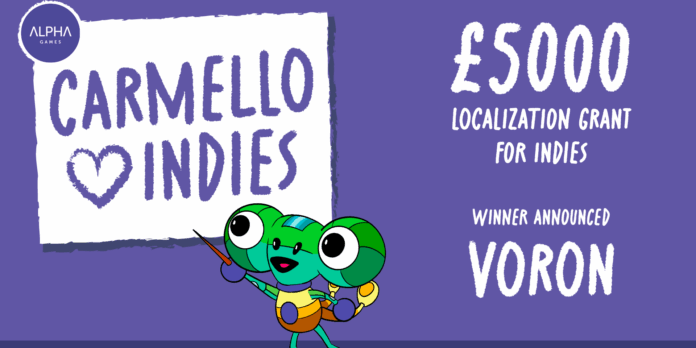
Alpha Games Announces Winner of “Carmello Loves Indies” Localization Grant

0
Carmello Loves Indies Localization Grant winner announcement

Leading games localization company Alpha Games is proud to announce the winner of its inaugural Carmello Loves Indies localization grant: VORON, a Norse-inspired open-world adventure created by Serbia-based developer Merk Games.

The Carmello Loves Indies program supports independent developers by offering £5,000 (USD $5,000/€5,000/¥1,000,000 JPY) in professional localization services to help bring distinctive indie titles to global audiences.

Chosen from a wide range of international submissions, VORON stood out for its emotive storytelling, accessible gameplay, and unique approach to exploration and worldbuilding. In this flight-based adventure, players embody a raven on a journey through life, death, and the search for meaning, guiding lost souls to the World of Gods while unravelling the mysteries of an ancient evil.

Jack Simpson, Marketing Manager at Alpha Games, commented, “Competition for this year’s Carmello Loves Indies grant was incredibly strong, but VORON immediately resonated with our team. Its beautiful visual style, coupled with its almost meditative gameplay in which you gradually discover new words, perfectly reflects the values we champion as a localization agency: creativity, accessibility, and storytelling that transcends borders.”

Aleksandr, from Merk Games, said, “Huge thanks to Alpha Games for this opportunity and for supporting indie developers. It really means a lot to see VORON resonate with the team and be recognized. As an indie developer, professional localization is an enormous step for me, and I’m genuinely excited to bring the game to more players around the world and let them experience its Norse-inspired story in their own language through professional translation.”

Alpha Games will collaborate closely with Merk Games to bring VORON to new global audiences through tailored localization services, ensuring that players everywhere can experience the game’s narrative depth and charm in their own language.

The Carmello Loves Indies initiative underscores Alpha Games’ ongoing commitment to independent development talent worldwide, helping creators on tight budgets expand their reach without compromising artistic or cultural authenticity.

About Alpha Games

Alpha Games is a games localization company that believes every player deserves an authentic and immersive experience, no matter their language or location. With a team of passionate gamers and localization experts, Alpha Games helps developers capture the cultural nuance, humour, and emotion that make games resonate worldwide.

The Week in Review: Language Industry News January 20-26

0
Week in Review Jan 20-26

This week’s stories highlight compliance milestones, workflow challenges in AI media, partnerships, quality‑focused tooling, engineering‑driven collaboration, and a forward‑looking perspective on AI in interpreting. Together, these top five stories show an industry sharpening its operational backbone while actively negotiating the future of human–machine partnership.

Collaboration and Awards

memoQ has achieved SOC 2 Type 2 compliance, validating the company’s long‑term security and data‑protection controls. The audit confirms memoQ’s commitment to safeguarding customer information and maintaining rigorous operational standards, reinforcing trust among enterprise clients who rely on the platform for secure localization workflows.

Alconost has released a free Multidimensional Quality Metrics (MQM) annotation tool to support structured translation‑quality evaluation. The web-based tool enables customizable error categories, quality control, and collaborative review. Alconost positioned the launch as a way to make MQM‑based analysis more accessible to teams seeking consistent evaluation methods without the overhead of enterprise systems.

Vistatec and Lingoport have introduced a joint solution integrating Localyzer with VistatecVerifier. The combined offering aims to catch localization issues earlier in the software development cycle, improve linguistic and functional quality, and reduce engineering rework for designers. The partnership reflects a growing emphasis on tooling that bridges localization and development environments for more streamlined workflows. 

Community

In his article, Nicolas M. Martin Fontana speaks with conference interpreter Karolina Jarmołowska as she shares her perspective on how AI will shape the future of interpreting. Rather than viewing AI as a threat, she envisions AI boothmates that support interpreters by handling terminology lookup, note‑taking, or other cognitive load–heavy tasks. She emphasizes that human interpreters remain essential for nuance, empathy, and real‑time judgment but believes AI can become a collaborative partner. Her outlook reflects a pragmatic, human‑centered approach to integrating AI into high‑stakes communication settings, all while emphasizing that only time will tell how AI will affect these roles.

In her article, Ligia Sobral Fragano explains why AI‑generated subtitles that look “accurate” often fail in real production environments. The issue isn’t translation quality but segmentation — line breaks, timing, and reading flow that don’t meet professional subtitling norms. Without proper segmentation logic, even strong machine translation output creates friction, rework, and viewer frustration. She argues that improved segmentation, whether automated or human‑guided, is essential for scalable subtitle workflows.

______________________________________________________________________________________________________________________________________________

From compliance achievements to hybrid human–AI workflows, this week’s stories show an industry investing in both operational rigor and future‑facing experimentation. Together, these developments point to a sector that’s not just adapting to change but actively shaping the frameworks, partnerships, and safeguards that will define its next chapter.

For more stories like these, visit our News section.