GTE Localize Appoints Matt Grotenstein as Vice President of North America

0
GTE Localize

GTE Localize, a global translation and localization provider, announces the appointment of Matt Grotenstein as Vice President of North America, effective immediately. Matt brings over 20 years of expertise in localization, business development leadership, and global growth strategies to help drive the company’s expansion in the region.

In this position, Matt will spearhead North American operations, focusing on business development, and innovative solutions leveraging AI and data analytics. His mandate includes scaling GTE Localize’s existing presence among Fortune 500 clients in sectors like software & technology, finance and healthcare.

His career includes roles as Enterprise Account Director at Smartling, VP of Client Development at Acclaro, and leadership positions at Boston.ai and Crowdin, where he excelled in US market entry and multilingual strategies. 

As his first growth strategy, Matt will co-found and lead LocReset – GTE Localize’s flagship North American GTM engine. LocReset, at its core, will focus on a thought leadership series demystifying AI localization trends while reframing it as a growth lever for emerging markets. With Matt’s deep industry network, he will curate guests and convert thought leadership into client partnerships, blending LocReset’s content engine with his mandate for a long-term client engagement & relationship across SME’s and Fortune 500 clients. This collaboration accelerates GTE Localize’s mission to transform localization from cost center to strategic asset.

CEO Brian Dao stated, “Matt’s profound experience, skill set and capability align perfectly with GTE Localize’s direction to strengthen our position in the North America market. I believe he will bring an enormous contribution to the growth of GTE Localize and help us add even more values to our client’s businesses. We greatly welcome Matt as our partner for the next growth stage of our company.” 

About GTE Localize

Founded in 2017 with offices in the US, Singapore, London and Vietnam, GTE Localize is a mid-size Language Service Provider (LSP) headquartered in Hanoi. Its mission is to help global businesses, international organizations, and government agencies with multilingual communication. It tailors its services to match your specific goals, industry, and budget to deliver fast, accurate, tech‑enhanced translation and localization services worldwide.

Vistatec and Lingoport Announce Joint Solution Integrating Localyzer and VistatecVerifier

0
Lingoport Localyzer collaborates with VistatecVerifier

Vistatec and Lingoport announced a joint solution that brings shift-left localization into the heart of product design and development, enabling faster releases and improved translation quality. Lingoport and Vistatec have unveiled a significant breakthrough for localization and design.

Imagine if localization were not a step after development, but a seamless part of design. Lingoport’s new Localyzer release introduces an innovative approach to reinvent the localization design workflow.

Lingoport Localyzer automates localization workflows from design through development. From design tools like Figma, Localyzer enables designers to see translations in real-time, eliminating the need for extracting strings and sending files for translation. The results are a flow from Figma → dev → production that leads to fewer review cycles, faster releases, and improved quality.

“We are excited to launch our Localyzer service. This solution integrates directly into design and development workflows, eliminating manual file handling and accelerating global product delivery,” commented Adam Asnes, CEO at Lingoport.

By embedding translation directly into design and code, companies can deliver multilingual products at the same speed they provide features. Instead of treating translation as a late-stage task, Localyzer integrates it at the start of design and development.”

VistatecVerifier adds an AI-powered QA layer designed to identify specific errors in translations, including spelling, profanity, language accuracy, and modality issues. Whether you’re using LLMs, human reviewers, or a TMS, VistatecVerifier guides you towards meeting your standards.

“The result is faster approvals and more confidence in every release. VistatecVerifier and Lingoport’s Localyzer are a winning combination,” added Simon Hodgkins, CMO, Vistatec.

This new design initiative will include an online event scheduled for February 2026.

For further details, please visit: https://www.vistatec.com/localyzer-and-verifier

About Lingoport

Since 2001, Lingoport has been a leader in helping companies internationalize and localize their software. It began by offering internationalization (i18n) services, enabling companies to deliver applications efficiently to multilingual users. This foundational experience continues to guide its product development of Localyzer and Globalyzer, ensuring solutions meet the needs of global software development. At its core, Lingoport is focused on developer-oriented solutions, making software localization a natural and integrated aspect of product development, so that companies can reach more customers with better software in their languages and cultural formats. Lingoport’s technology is trusted by global enterprises, including Fortune 500 companies, across industries such as software, technology, manufacturing, and regulated sectors.

About Vistatec

Vistatec works with many of the world’s most iconic brands to optimize their global commercial potential. Operating since 1997, Vistatec is a recognized leader in AI, localization, and multilingual content solutions. It partners with businesses to navigate the complexities of global markets and ensure impactful, culturally relevant communications. With global headquarters in Dublin, Ireland, and locations worldwide, Vistatec continues to lead industry benchmarks through innovative technologies and strategic insights.

Standards We Rely On: The Critical Role of the Language Coding Agency

0
Businessperson with tablet

As the language industry becomes increasingly interconnected through globalized content, an official governing body sits behind every multilingual database and digital platform — one most people have never heard of, yet whose decisions quietly shape billions of interactions each day. That organization is the Language Coding Agency (LCA), and it’s one of the industry’s most critical tools, shaping the metadata infrastructure that holds the entire ecosystem together.

The LCA maintains standardized codes that identify the world’s languages and language families within databases, software, and digital libraries. Known as ISO 639, this language coding system was originally created by the International Organization for Standardization (ISO) in 1967. It uses one- or two-letter codes to designate languages, like “En” for English and “Fr” for French.

The LCA’s governance is shared among three institutions designated by the ISO. ISO 639-1, the two-letter coding set used to describe major languages, is governed by the International Information Centre for Terminology (Infoterm). ISO 639-2 — which covers widely used languages — and ISO 639-5 — which addresses language families and groups — are governed by the United States Library of Congress. ISO 639-3, the list of all known individual languages, is managed by SIL Global. Each institution reviews change requests, maintains code lists, and ensures updates are distributed to users and systems around the world.

The applications of ISO 639 span virtually every aspect of multilingual content. These codes form part of the default configuration for digital interfaces and devices, and they enable platforms to distinguish between different language versions of online content. They also play a foundational role in organizing information across publishing, library systems, and large-scale digital networks.

Most language service providers (LSPs) don’t call attention to it, but their language lists, quoting tools, and workflow engines all rely on ISO 639 codes. These small identifiers sit beside language names on service pages and dashboards — a detail that reveals how deeply this standard is woven into everyday operations.

Without a labeling standard like ISO 639, every system that relies on language identification — from translation workflows to global content delivery — would lose its shared reference point. In that way, the LCA’s vital work helps enable the cooperation and interoperability that define the modern language industry.  

Youpret Makes Instant Interpreting Accessible to Everyone in Estonia with the Youpret App

0
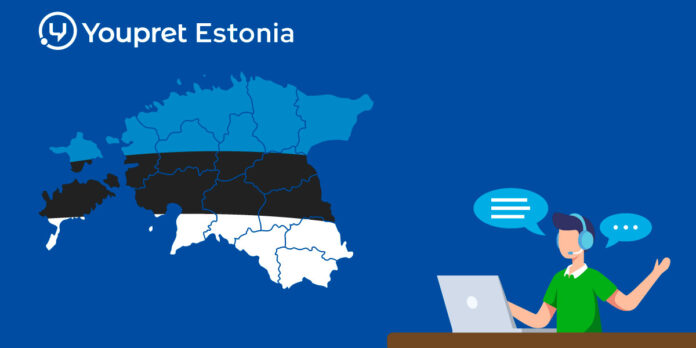
Youpret Estonia interpreting

Interlex and Youpret, the Finnish market leader in remote interpreting, have joined forces to launch a joint venture that brings modern remote interpreting services to everyone’s smart devices. Youpret’s interpretation app now provides instant access to on-demand interpreting services.

Youpret’s interpretation app brings together the client in need of interpreting and the interpreter in real time, eliminating the need for long-term advance planning and time-consuming correspondence. Until now, ordering interpreting has required long planning and exchanging letters, but now a new era is beginning in the Estonian market.

Whether it’s a quick doctor’s visit or an official meeting at a notary’s office. Youpret’s interpretation app ensures professional help is available anywhere and anytime. By removing traditional barriers to accessing language support, Youpret connects clients who need interpreting services with qualified professionals in real time via the app — in just a few minutes.

Key features

  • Speed and availability – You no longer need to book an interpreter weeks in advance. Through the app, you can connect with a language professional exactly when you need one – either immediately or at a scheduled time.
  • Remote interpreting via video or phone – Depending on the confidentiality of the situation or your specific needs, you can choose between video interpreting or audio-only phone call.
  • Transparent pricing – Forget lengthy quote requests and high minimum fees. With Youpret, pricing is based on minutes, meaning you only pay for the time you actually use.
  • Quality and trust – All Youpret interpreters on the platform are recruited and assessed by language service professionals. Interlex’s experience ensures that the interpreting services offered in the Estonian market meet high linguistic and ethical standards.

Who is the remote interpreting service suitable for?

Youpret’s service is intended for everyone who needs the help of a professional interpreter: the public sector, companies and private individuals.

  • Healthcare institutions who come into contact with foreign-language patients on a daily basis.
  • Companies that need to quickly resolve language barriers in meetings, administration and customer service.
  • Public authorities who wish to make their services more accessible to all residents, regardless of their mother tongue.
  • Private persons who need the help of a professional interpreter in their daily affairs.

Interlex and Youpret – a joint step towards the future

According to Inge Rätsep, CEO of Estonian translation agency Interlex OÜ, founding Youpret Baltic OÜ is a logical step in the company’s development.

“We have always believed that technology and human know-how must go hand in hand. In cooperation with Youpret, we can offer Estonian clients something truly new — flexibility and speed that traditional translation services have not been able to provide until now.”

Teemu Purmonen, Chair of the Board of Youpret Oy, a pioneer in the interpreting industry in Finland, adds that Estonia’s highly digitalized environment makes it an ideal market for expanding the platform.

Our goal is to make interpreting services accessible for everyone. In Finland, over 80% of interpreting assignments are handled remotely. Remote interpreting is widely used across public services and businesses because it combines accessibility, speed, and cost efficiency without compromising quality. We trust that the Estonian market is ready to take this leap into a new era of language services.”

You can now download the Youpret interpretation app from the Google Play Store or App Store and find an interpreter right away.

About Youpret

Youpret is a Finnish-origin company specializing in interpreting and translation services, as well as language technology solutions. Its mission it to be the most sustainable operator in the language industry while supporting the daily work and well-being of our interpreters. In Finland, we intermediate over 1,000 interpretations on a daily basis to the health care and social services, government institutions, businesses and private individuals. Services are now also available in Iceland and Estonia

Alconost Launches Free MQM Annotation Tool for MQM-Based Quality Analysis

0
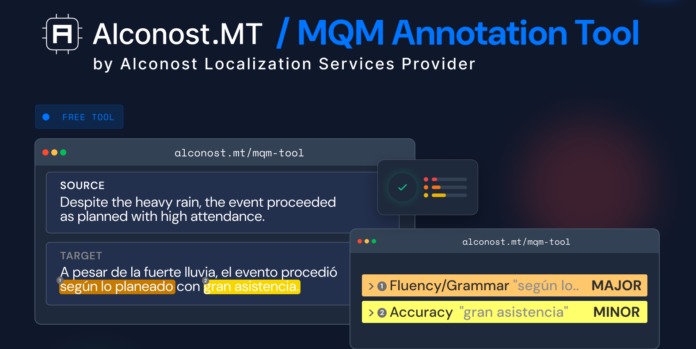
MQM Annotation Tool by Alconost

Alconost, a localization company working with a network of 3,500+ professional linguists across more than 120 language pairs, has launched the Alconost MQM Annotation Tool — a free, web-based tool for annotating translation errors using the MQM framework to support translation quality evaluation.

The free tool is available at alconost.mt/mqm-tool and can be used immediately, with no registration required.

MQM (Multidimensional Quality Metrics) is an industry-standard framework for assessing translation quality through human error annotation. It works by identifying and classifying translation errors by type (such as accuracy, fluency, or terminology) and by severity. MQM is widely used in the localization industry and is the methodology used in evaluations conducted by the Workshop on Machine Translation (WMT).

With MQM, trained reviewers annotate errors in a translation, creating a consistent, human-labeled reference (“ground truth”) for quality analysis. These annotations make it possible to calculate quality scores, compare results across machine translation systems or vendors, and document quality issues in a structured and reproducible way.

In practice, however, MQM annotation has often been difficult to adopt. Existing solutions typically require technical setup, expensive enterprise platforms, or manual work in spreadsheets, making consistent MQM use hard to scale in real-world projects.

The Alconost MQM Annotation Tool addresses these challenges with a simple, browser-based workspace designed specifically for MQM error annotation. It makes professional MQM-based quality analysis more accessible for linguists, localization teams, and researchers. Users can annotate translations themselves, assign annotation tasks to linguists, or request professional MQM annotation services from Alconost.

Key features include:

  • Start immediately — no account creation or registration required.
  • WMT-compatible MQM error typology — annotate using the full MQM taxonomy aligned with international standards.
  • Customizable error severity weights — control how annotated errors contribute to quality scores.
  • Automatic score calculation — segment-level and overall document scores derived from annotations.
  • Pass/fail results — quality decisions based on configurable thresholds.
  • TSV and JSON import/export — easy integration with existing tools and workflows.
  • Detailed reports (online and PDF) — including error breakdowns by category, severity distribution, segment-level scores, overall weighted score, pass/fail outcome, and annotation time.

“Most existing MQM tools are built for research and require a lot of setup, which makes them hard to use in everyday localization work,” said Alex Murauski, CEO of Alconost. “We wanted something simpler. The result is a practical tool: you open it, paste your segments, annotate errors, and then export the data or generate a report. That report can be used internally or shared with a linguist, vendor manager, or customer to clearly explain quality issues.”

Who the tool is for

Localization managers can annotate translations themselves or assign the task to linguists to evaluate vendor quality, compare machine translation systems, and create clear documentation for quality discussions — without purchasing specialized software.

ML researchers and engineers can create MQM annotation data compatible with WMT methodology, build gold-standard evaluation datasets, and produce reproducible quality benchmarks based on human annotation.

Language service providers (LSPs) can standardize how linguists annotate translation errors, demonstrate quality to clients using professional reports, and train teams on MQM methodology.

For teams that need expert support, Alconost also offers on-demand MQM annotation services performed by trained professional linguists. Custom MQM datasets are available as well, particularly for ML teams building evaluation benchmarks or researchers who require gold-standard annotation data.

About Alconost

Alconost handles every aspect of localization – from translation and cultural adaptation to continuous multilingual content updates and engineering – letting you focus on the top priority of growing your business in international markets. In addition to localization services, Alconost provides MQM-based annotation services and custom MQM dataset creation, following methodology aligned with the Workshop on Machine Translation (WMT).

Aglatech14 Acquires Centrolingue S.r.l.

0
AGLATECH14 Acquires centrolingue S.r.l

Aglatech14 has announced that it has acquired the business unit of Centrolingue, further strengthening its role as a language services partner for companies, public bodies, and institutions alike. The company begins 2026 with a significant step in its growth journey: the acquisition of Centrolingue S.r.l., a long-established language services agency that has been operating in Padua for over 30 years.

From 1 January 2026, Aglatech14 has taken over the management of Centrolingue’s language services, integrating a team of professionals with extensive experience in translation, interpreting and language training, particularly in the public and cultural sectors.

Over the years, Centrolingue has developed strong partnerships with universities, museums, artistic and cultural foundations, as well as with leading Italian and international companies, especially in the Triveneto area. For Aglatech14, this expertise represents a significant enhancement of its capabilities in the institutional and cultural language services sector, as well as a strategic presence in North-East Italy, where the local economic fabric is among the most dynamic and internationally oriented in the country.

A year of expansion and new perspectives

The acquisition of Centrolingue’s business unit follows a year, 2025, already marked by important milestones for Aglatech14. In February, the company opened its first international branch in Germany, further consolidating its internationalisation strategy and reinforcing its presence in the European market.

With this acquisition, Aglatech14 reaffirms its commitment to expanding its network, increasing its nationwide reach, and enriching its portfolio of expertise, while continuing to place service quality and attention to each client’s specific needs at the centre of its approach.

A shared vision of values and expertise

The integration of the two organisations is based on a shared vision: delivering excellence in language services through a consultative, flexible, and client-focused approach. Aglatech14 embraces the values that have always defined Centrolingue, placing strong emphasis on a direct and personal relationship with clients — a distinctive feature that has made the Padua-based agency a trusted partner for many public and private organisations.

Through this acquisition, Aglatech14 further strengthens its position as a strategic language partner for companies, public bodies, cultural institutions, and international organisations.

About Aglatech14

Aglatech14 is a professional language services provider supporting companies, public bodies and institutions, with over 20 years of experience. Headquartered in Italy, the company operates primarily within the legal and patent, technical and regulatory, medical and scientific, and institutional sectors, delivering tailored solutions built on specialist expertise and structured workflows.

Aglatech14 adopts a consultative, client-focused approach, combining advanced language technologies with quality-controlled processes certified in accordance with ISO 17100 and ISO 18587 standards, and maintaining a strong focus on consistency, reliability and service quality.

Why Accurate AI Subtitles Fail in Production — and How Better Segmentation Can Help

0
Television and remote

Artificial intelligence (AI) has rapidly become part of audiovisual translation (AVT) workflows. Automatic speech recognition has improved dramatically, turnaround times have shrunk, and subtitling teams now routinely work with machine-generated drafts. Yet, despite these advances, a persistent frustration remains: subtitles that are technically “accurate” but practically unusable in production.

The reason for this is simple, though often overlooked. Subtitling is not just about converting speech into text. It is about shaping language so it can be read comfortably, understood instantly, and synchronized with image and sound. This is where many AI-generated subtitles still fall short.

Today, the main bottleneck in professional environments is no longer recognition accuracy — it’s segmentation. Segmentation refers to how meaning is distributed across subtitle units: where lines break, how clauses are grouped, how timing supports reading rhythm, and how much information a viewer can process at once. Poor segmentation disrupts comprehension even when every word is correct. It forces viewers to reread, anticipate, or mentally reassemble sentences while also following the visuals on screen.

From a workflow perspective, this creates a paradox. AI is meant to reduce manual work, but poorly segmented output often increases it. Subtitlers and quality controllers spend significant time restructuring subtitles — merging or splitting units, adjusting line breaks, and restoring syntactic cohesion — before they can even begin to address nuance, tone, or cultural adaptation.

In other words, the work was not eliminated — it was relocated.

This has led many AVT teams to a quiet reassessment of how they evaluate language technology. Accuracy scores and word error rates, while important, are proving insufficient as standalone quality indicators for audiovisual use. Increasingly, professionals are re-centering their criteria on readability, rhythm, and linguistic integrity within subtitle constraints.

These criteria are not new. They are foundational principles of professional subtitling, developed long before AI entered the picture. What is new is the realization that automation must be designed around them, rather than expecting human professionals to retrofit machine output after the fact.

This shift has important implications for AVT workflows:

  • First, it reframes post-editing. When segmentation is handled poorly, post-editing becomes mechanical and time-consuming, focused on fixing structure rather than improving language. When segmentation aligns with audiovisual grammar, post-editing becomes genuinely editorial — about refinement, register, and meaning.
  • Second, it affects scalability. Teams working at volume cannot afford workflows where every subtitle requires structural reconstruction. Tools that respect subtitling constraints upstream allow professionals to maintain quality standards without sacrificing efficiency.
  • Finally, it changes how success is measured. A usable subtitle is not one that mirrors spoken language word for word, but one that communicates meaning clearly within the cognitive and temporal limits of the screen. This distinction is obvious to experienced subtitlers, yet it is still inconsistently reflected in AI-driven solutions.

As AI adoption matures, the industry appears to be entering a correction phase. The initial excitement around automation is giving way to more nuanced expectations. Rather than asking whether AI can generate subtitles, teams are asking whether it can generate subtitles that behave like subtitles. I believe this is a healthy development.

AVT has always operated at the intersection of language, technology, and perception. Successful workflows acknowledge that subtitles are not transcripts, and that audiovisual language has its own grammar. AI systems that align with these realities can become powerful allies. Those that ignore them risk adding friction instead of removing it.

The future of AI in AVT will likely be shaped by how well technology understands the conditions under which language is read, not just written. Segmentation is not a formatting detail. It is the backbone of readability — and, increasingly, the line between automation that helps and automation that hinders.

Conference Interpreter Karolina Jarmolowska Foresees a Future With AI “Boothmates”

0
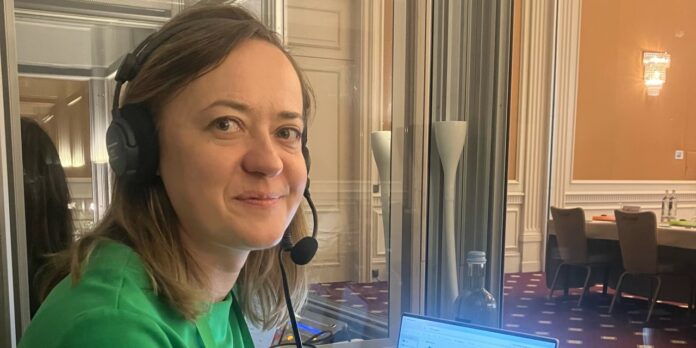
Karolina Jarmolowska

Karolina Jarmolowska’s interpreting career has taken her from courts and police stations to conferences across Europe. Here, she discusses the language services industry’s changing landscape and why she predicts that artificial intelligence (AI) will continue to shrink the field.

How did you get involved in the language services business?

I studied for my master’s degree in English Studies at the University of Warsaw, always intending to become a translator. After my fourth year — just weeks after Poland joined the European Union (EU) and Polish citizens could work legally in some member states — I went to Ireland in search of a summer job. As it happened, I ended up staying much longer. In 2005, I applied for a freelance community interpreter role. At the time, I had only a vague idea of what community interpreting involved, but I had to learn quickly.

My career began in Dublin, interpreting in courts and police stations for Polish witnesses and defendants. Meanwhile, I completed my MA thesis. After two years, I realized I could no longer handle waking up in the middle of the night to interpret at police stations, only to then appear in court in the morning. The subject matter was also challenging — often involving serious cases like rape and murder — and it became too much.

However, I loved the challenges of interpreting and the fact that it was never boring. So, I decided to return to Poland and pursue a qualification in conference interpreting at Jagiellonian University in Kraków. Still, my time in Ireland was the decisive factor that shaped my professional life. I drew on my experience as a court interpreter to delve deeper into communication issues in Irish police stations and courts, which led to my PhD dissertation on the impact of translated witness statements on criminal trials.  

Since graduating from the postgraduate conference interpreting course in Kraków, I have worked full-time as a conference interpreter with Polish, English, and Italian.

Since you entered the language services industry, how has the business landscape changed?

For me, the landscape changed dramatically after COVID. Following a few scary months of no work and lockdowns, we had to adapt quickly to remote simultaneous interpreting. Some clients embraced Zoom meetings almost immediately, while others waited for a return to “business as usual” — but that never really happened.

Today, most of my interpreting work is done remotely from my home office, with occasional trips for face-to-face meetings. I love this change because it gives me even more freedom than before. Thanks to the shift to remote work, I was able to move and now live in a small town near Rome. As an introvert, working from home suits me perfectly, allowing me to do what I love — interpreting — while enjoying a better work-life balance.

For example, this Monday through Wednesday, I work from home during a European Works Council meeting (the participants are on-site, but interpreters connect remotely). After finishing work today, I’ll fly to Germany to work on-site in a physical booth on Thursday and Friday, then return to Rome on Saturday. I’m writing this in October, which is high season for conferences, so it’s not always this busy, but the combination of remote and on-site work makes it manageable. I’ve welcomed this change with open arms!

Could you share your experience working with your first client or on your first project?

Yes, and I have to say it was by far my most difficult assignment. I was recruited by a Dublin-based agency that provided interpreters for Irish courts. They hired me because a high-profile Polish-English trial in the High Court was about to start. I had little experience and was initially reluctant, but the agency assured me that there would be an official court interpreter who would interpret out loud, while I would serve as a language assistant to one of the defendants, helping him communicate with his legal team and discuss strategy. That seemed reasonable, so I agreed.

Little did I know (nor did anyone else!) that on the first day, the defendant would dismiss his entire legal team and decide to represent himself in court. I’ll never forget the judge’s words: “Now, please come with your interpreter to the front bench.” Suddenly, I was the interpreter, responsible for interpreting everything the defendant said in court, including his closing speech to the jury. Thanks to the collaboration with the main court interpreter, the judge, and the legal teams, the trial proceeded smoothly, but it was an incredibly stressful experience. The trial lasted three weeks, and I could hardly eat from the stress. The silver lining is that, since then, no assignment has seemed too difficult or stressful.

Do you believe it’s a good time to enter the language services business?

To be completely honest, I don’t think so. There is little room for new professionals in the ever-shrinking translation and interpreting market. I don’t believe the job will disappear entirely — there will always be a need for certified translators or interpreters with security clearance, i.e., someone who bears responsibility for the content of the translation. However, for translators, much of the work has already disappeared, and the remaining jobs often involve post-editing machine-translated texts.

This hasn’t happened yet in conference interpreting, but there are experiments and pilot projects with speech-to-speech automated language processing, and in some applications, such tools may soon replace interpreters. At the moment, the quality and delay of these tools leave much to be desired, but progress is inevitable, and soon the interpreting market will also experience a dip due to AI-driven tools. In other words, there is less and less work for human translators and interpreters, so I wouldn’t recommend this path to someone who is still undecided about their career. In a recent study published by Microsoft, translators and interpreters ranked first in terms of replaceability by AI — the data speaks for itself.

Where do you see yourself professionally in the next 10 years?

In 10 years, I’ll be 10 years away from retirement age, and I would love to retire while still doing what I love — interpreting. I have my doubts about whether that will be possible, but time will tell. I might move into language consulting or public speaking training, or perhaps return to university lecturing. I do reflect on this, but it doesn’t keep me awake at night. I believe that, as interpreters, we have a wealth of unique skills that can be valuable in almost any profession.

What predictions do you have for the future of the language services business?

AI will continue to transform the way we work. Some translators and interpreters will leave the profession, while others will embrace technology rather than resist it. I imagine that, in the future, interpreters will work alongside AI “boothmates” — a human interpreter working with an AI partner, correcting the text generated by AI, much as translators now post-edit machine translations. Or perhaps we’ll be paid to be on standby, called in whenever a language issue arises. Maybe our work will resemble that of theater prompters, whispering the missing words to people speaking a foreign language when they struggle to find the right term.

Eventually, our work as we see it today may become dispensable, but in the meantime, new jobs will emerge for people with our skillset.

memoQ Earns SOC 2 Type 2 Compliance

0
memoQ earns SOC 2 type 2 compliance

memoQ, a global leader in enterprise translation technology solutions, announced that it has achieved SOC 2 Type 2 compliance, confirming that its security, availability, and confidentiality controls are not only designed effectively but are consistently operational over time. This compliance reinforces memoQ’s position as a trusted partner for enterprises handling sensitive and mission-critical data worldwide.

SOC 2, developed by the American Institute of Certified Public Accountants (AICPA), is the gold standard for data security in technology services. While SOC 2 Type 1 verifies the design of security controls at a single point in time, SOC 2 Type 2 validates that these controls operate effectively over months, which is required by many top-tier U.S. enterprises and regulated industries.

“Security is not a one-time achievement. It is a commitment that must be proven every day,” said Peter Reynolds, CEO of memoQ. “Achieving SOC 2 Type 2 compliance demonstrates that memoQ does not just meet industry standards. We live them. Our clients can trust that their data is protected with enterprise-grade controls every day across every translation workflow.”

memoQ already holds ISO 27001 certification and achieved SOC 2 Type 1 in October 2025. By completing SOC 2 Type 2, memoQ now provides end-to-end, independently verified assurance of its security practices, meeting the stringent expectations of global organizations in finance, life sciences, banking, and technology sectors.

“SOC 2 Type 2 compliance validates that our security practices are robust, repeatable, and reliable,” said Adam Klar, Chief Information Security Officer at memoQ. “It is the highest proof we can give our clients that memoQ’s systems are continuously secure and compliant. This is more than compliance. It is operational excellence in protecting critical enterprise data.”

memoQ’s ongoing investment in security includes its public Trust Center, powered by Sprinto, which provides customers and prospects with real-time insights into compliance reports, operational controls, and security measures. This transparency sets memoQ apart in an industry where confidence and trust are paramount.

“Achieving SOC 2 Type 2 compliance is a defining moment for memoQ,” added Reynolds. “We are not just following compliance requirements. We are leading the way in secure, enterprise-grade translation solutions.” 

For more information, please visit the memoQ Trust Center.

About memoQ

Headquartered in Budapest, memoQ is a leading collaborative translation environment and TMS delivering premium solutions to the translation industry since 2004. memoQ is dedicated to providing innovation through diverse developments and generative AI, empowering hundreds of thousands of enterprises, translation companies, and freelance translators worldwide.