ZOO Digital Announces Final Results for the Year Ended 31 March 2025

0
ZOO Digital logo

ZOO Digital, the localization and digital media services partner to the global entertainment industry, announces its audited financial results for the year ended 31 March 2025.

Stuart Green, CEO of ZOO, commented:

“ZOO has shown resilience through a period of market transition and made significant progress to restructure its operations to position the Group to deliver operating profit and cash generation in FY26. I believe we have struck a balance between creating a sustainable platform for the future while retaining the flexibility to scale as we deliver increased order volumes.

 “As a trusted partner, with a technology-enabled, end-to-end model, we can build solutions for customers’ specific needs. Our new Fast Track service, tailored for localising live and near-live content, has been well received and although revenue is modest at this stage, the Board is encouraged by the potential growth opportunity this presents the Group as we seek to increase our share of spend by several global streamers over the longer term.

“Today we believe most media companies are operating profitable streaming platforms, supported by new content formats and monetisation models. We enter FY26 better positioned to navigate this environment and capture profitable revenue opportunities as the market continues to evolve.”

HIGHLIGHTS

Key Financials

  • Revenue increased by 22% to $49.6 million (FY24: $40.6 million).
  • Adjusted EBITDA1 returned to a profit of $1.1 million (FY24: loss of $13.6 million).
  • Operating loss of $6.5 million (FY24: loss of $19.1 million).
  • Reported loss before tax of $8.3 million (FY24: loss of $20.5 million).
  • Gross cash at year-end of $2.7 million (FY24: $5.3 million) with no amount drawn on the invoice financing facilities; strong focus on cash management.

Operational Highlights

  • During the period, $8.4 million of annual fixed cost cash savings were delivered (including $1.6 million of capitalised R&D costs), and further actions implemented in FY26 that the Board expects will deliver at least a further $2.5 million of annual fixed cost savings, highlighting the Company’s focus to be profitable and cash generative.
  • Retained sales2 of 98.4% (FY24: 92.3%), demonstrating recovery in demand and customer satisfaction.
  • Strengthened relationships with non-traditional studios to support customer diversification.
  • ZOO named a Preferred Fulfilment Vendor for Amazon Prime Video.

Current Trading and Outlook

  • Current reduced demand for dubbing led to FY26Q1 revenue 18% lower than the same period in FY25.
  • Service lines excluding dubbing have generated three consecutive quarters of revenue growth to FY26Q1.
  • Continuing cost reductions resulted in an EBITDA profit for FY26Q1 after restructuring costs in line with management expectations.
  • The combination of the implementation of AI and other forms of automation, together with the operational efficiencies delivered in FY25 and continuing in FY26, provide a leaner operating model to enable enhanced margins as revenues recover.

Adjusted EBITDA means earnings before interest, tax, depreciation, amortisation and share-based payments.

Retained sales represents the proportion of client revenues retained from one year to the next and provides a quality indication that helps to assess customer satisfaction.


Osaka Students Translate Atomic Bomb Story Into Over 100 Languages

0
osaka multilingual translation

A Community Translation Effort

In Osaka, Japan, a student-led project has translated a Hiroshima atomic bomb survivor’s picture-story performance, called a kamishibai, into more than 100 languages — widening access to first-person testimony for global audiences. The 12-page work titled The Cloud That Won’t Disappear is based on the account of Keiko Ogura, an 87-year-old hibakusha (person affected by the atomic bombings of Hiroshima and Nagasaki) who has shared her experience of the 1945 bombing for decades. According to an article in Japanese newspaper The Mainichi, the script was created by Osaka publisher and kamishibai creator Daisaku Yoshimura; illustrations were drawn by an artist who relocated to Japan from Ukraine. Japanese and English versions served as the source texts.

Human-in-the-Loop Workflow

Eleven students from the mechatronics research club at Osaka Prefectural Miyakojima Technical Senior High School completed the translations over three months. Although the club typically builds robots, its members have pursued social engagement projects; this initiative grew out of earthquake-relief work that connected their adviser, Minato Kimura, with Yoshimura. According to the Mainichi article, the team combined machine translation for first drafts with rigorous human review and back-translation into Japanese to detect meaning drift. When literal renderings conflicted with intent — such as a mistranslation that turned “bodies floating in the river” into “swimming” — students collaborated to replace phrases with semantically accurate, culturally sensitive alternatives.

Languages covered range from widely used ones like French and Spanish to Tamil and Igbo, reflecting a goal of reaching beyond the most common pairs. By including underrepresented languages, the project supports classrooms, museums, and community groups that work with diverse diasporas and multilingual audiences. Students also engaged with local wartime histories — listening to an Osaka bombing survivor, interviewing elders, and reflecting on the meaning of peace — showing how translation work can double as civic education.

Why It Matters for the Language Industry

For localization professionals, the project illustrates a compact human-in-the-loop model: machine output accelerates scale, while human editors safeguard tone, context, and the ethics of representing trauma narratives. The students’ method mirrors professional quality assurance — iterative review, back-translation checks, and collaborative terminology decisions — highlighting practices that help maintain fidelity when content carries heavy historical and emotional weight. Organizers say the translated materials and kamishibai are available online for viewing and download, creating a ready resource for multilingual programming. Beyond surpassing 100 language versions, the effort underscores a broader point: translation, handled with accuracy and empathy, can extend access while honoring the integrity of lived experience.

Global10x Announces Sixth Cohort of Strategic Localization Course on Maven

0
Global10x

Global10x is thrilled to announce the launch of the sixth cohort of its highly successful cohort-based course, Strategic Localization: Mastering Influence and Global Impact. Designed for professionals working on international teams on the buyer side, the new session of this specialized program will begin on September 18. Over the course’s history, more than 70 localization leaders have participated, making this the sixth cohort and continuing a track record of strong engagement.

Developed by international growth experts Kevin O’Donnell and Pavel Soukenik, the course equips localization leaders, product managers, and marketers with skills and tools to shift their focus from operational tasks to high-impact strategies. Participants will engage in interactive live sessions and hands-on projects, with direct access to instructors and included follow-up 1:1 consultations. This structure is designed to help attendees gain insights into strategic localization, apply them in real-world scenarios, and enhance their ability to influence global business outcomes.

“With ever-changing market demands, the need for up-leveling the role of localization professionals has never been more critical. This course is designed to transform practitioners from operators delivering on localization requests into strategists driving their company’s global growth,” said Kevin O’Donnell, co-creator of the program.

Course topics cover aligning localization with corporate objectives, building influence across departments, measuring impact in ways that resonate with executives, and identifying opportunities to maximize return on localization investment. These elements aim to prepare participants to take on leadership roles in shaping their organization’s global strategy.

Registration is now open, and prospective participants can explore full details on the Maven course page: https://maven.com/global10x/strategicloc

About Global10x

Global10x empowers companies to broaden their global reach, attract and retain international users, and boost global revenues. The company provides international growth planning, optimization of localization efforts, and leadership coaching. Through its services and courses, Global10x helps businesses become competitive global players, drawing on the extensive experience of founder Kevin O’Donnell, who has held senior roles at Dropbox, Microsoft, and Nitro.

GPT-5: A Model Made for Multicultural Content?

0
GPT-5

OpenAI has unveiled GPT-5, describing it as its “smartest, fastest, most useful model yet” and positioning it as a significant upgrade over previous versions GPT-3 and GPT-4, which will be deprecated. The company says GPT-5 is already in use by clients such as Amgen and BBVA for tasks ranging from coding to healthcare.

However, despite the marketing push, published benchmarks suggest that GPT-5 offers only marginal gains—or even slight declines—in multilingual performance compared to some of OpenAI’s existing models.

Benchmarks Tell a Mixed Story

In the absence of a language-industry-specific demo, OpenAI’s release pointed to results from its GPT-5 System Card, which evaluated the model’s multilingual understanding using the MMLU benchmark. While MMLU is not designed as a translation-specific test, it is commonly used as a proxy for a model’s ability to understand and generate accurate text in different languages.

According to OpenAI, the MMLU test set was translated into 13 languages by professional human translators to assess knowledge and problem-solving capabilities. The system card notes that GPT-5’s language understanding is “generally on par” with existing models.

The published results show that GPT-5-main underperformed slightly across all 13 languages when compared to OpenAI’s o3-high model. The GPT-5-thinking variant fared somewhat better, with performance on par in Brazilian Portuguese, slightly worse in Arabic, French, German, Italian, and Spanish, and marginally better in Bengali, Chinese, Hindi, Indonesian, Japanese, Korean, Swahili, and Yoruba.

Expanded Features, Not Multilingual Breakthrough

While the multilingual gains appear modest, OpenAI has introduced new features that could be relevant for some workflows. These include expanded context windows and a new “minimal” reasoning setting, which researcher Michelle Pokras said allows users to trade reasoning depth for faster response times without switching between models.

The company also highlighted improvements in voice capabilities—such as more natural speech, video integration, and smoother language switching across turns—though it confirmed that Voice mode is still powered by GPT-4o, not GPT-5.

Health interactions are another stated focus area, with OpenAI suggesting that accuracy gains could support healthcare AI interpreting and other clinical applications.

Adoption and Industry Outlook

OpenAI expects early adopters to drive “industry leadership” in AI applications powered by GPT-5, with benefits including faster decision-making and more effective collaboration. The model is now being rolled out to all ChatGPT Plus, Pro, Team, and Free users globally on web, mobile, and desktop.

For the language industry, however, the takeaway from OpenAI’s own data is clear: GPT-5 may offer new features and interface improvements, but its multilingual understanding—based on the company’s own benchmarks—remains largely in line with existing models, with no clear leap forward.

Los Angeles County Marks 50 Years of Multilingual Voting Access

0
multilingual voting access

Los Angeles County has marked a major milestone in its commitment to inclusive democracy: 50 years since Section 203 of the Voting Rights Act mandated multilingual ballot materials and language support for eligible voters. According to the Santa Monica Daily Press (SMDP), the anniversary was celebrated at the Japanese American Cultural & Community Center under the theme We Speak Your Language: 50 Years of Language Access and Empowerment.”

A Landmark in Voting Rights

Signed into law on August 6, 1975, Section 203 expanded the original Voting Rights Act of 1965, requiring jurisdictions with significant language-minority populations to provide election materials in those languages. For Los Angeles County, one of the most linguistically diverse regions in the United States, the provision has become a cornerstone of electoral access.

In the SMDP article, Dean C. Logan, Registrar-Recorder/County Clerk, emphasized the enduring importance of this mandate:

“Language access is fundamental to fair and inclusive elections. Every eligible voter should have the opportunity to cast their ballot with confidence and in the language they understand.”

Setting a National Standard

Today, Los Angeles County offers election materials in English and 18 additional languages, more than any other jurisdiction in the country. This extensive program covers sample ballots, Vote-By-Mail materials, in-person bilingual assistance, and audio ballots, ensuring accessibility for voters across communities. The County also works closely with a Language Accessibility Advisory Committee, made up of community leaders and advocates, to improve services and respond to evolving needs.

Voters can request multilingual materials by calling the Bilingual Assistance Hotline at 1-800-815-2666 (option 3) or visiting LAVOTE.gov. The County’s Vote Centers provide in-person bilingual staff, and its interactive sample ballot system offers a customizable voting experience in multiple languages.

A Broader Vision for Democracy

Hilda L. Solis, Los Angeles County Board Chair Pro Tem and First District Supervisor, noted in the SMDP article that language equity is integral to democratic participation:

“The Voting Rights Act of 1965, with its amendment to Section 203 in 1975, affirms that language, like race, must never be used to deny someone their voice in our democracy.”

While the anniversary celebrates decades of progress, it also underscores the ongoing need to safeguard and expand language access—particularly as demographic changes, technology shifts, and political pressures challenge electoral systems. Los Angeles County’s approach offers a model for other jurisdictions, demonstrating that multilingual communication is not only a service, but a democratic right.

AirPods May Soon Offer Live Translation with iOS 26

0
AirPods live translation

Apple’s AirPods could soon move beyond music, calls, and noise cancellation to become real-time translation tools. According to a discovery in the beta 6 version of iOS 26, Apple is preparing to integrate live voice translation into its wireless earbuds — a development that could mark a significant step in the company’s accessibility and multilingual communication strategy.

A Gesture That Speaks Volumes

The leak reveals that users might trigger live translation by pressing the stems of both AirPods simultaneously, activating the iPhone’s Translate app. This gesture-based control could make it possible to hold cross-language conversations without reaching for a phone or tablet mid-discussion.

The feature appears designed for AirPods Pro 2 and the upcoming AirPods 4, though it won’t run directly on the earbuds. Instead, processing would happen on a connected Apple device equipped with Apple Intelligence capabilities — likely an iPhone 17 or newer, certain iPads, Macs, and Apple Watch models like the Series 9 and Ultra 2.

From WWDC to Real-World Conversations

At WWDC 2025, Apple introduced live translation for FaceTime, Messages, and phone calls. However, in-person conversations — where translation earbuds could have the most impact — were notably absent from the announcements. This beta discovery suggests Apple has been developing that missing link all along.

If implemented, the AirPods gesture could allow multilingual interactions in a variety of contexts: business meetings, international travel, academic discussions, or healthcare consultations where speed and accuracy are critical.

Supported Languages and Accessibility Potential

Early indications suggest support for widely used languages including English, Spanish, French, German, Brazilian Portuguese, and Korean at launch. While this is a practical starting point, it also underscores the importance of expanding to less commonly taught languages to maximize inclusion.

For professionals in interpreting, localization, and language technology, Apple’s entry into real-time translation hardware could influence market expectations. The combination of wearable convenience, Apple’s ecosystem integration, and its AI framework could challenge established players like Google’s Pixel Buds and standalone translation devices.

Looking Ahead

The official reveal could happen as soon as Apple’s September 9, 2025 event, alongside the iPhone 17 and next-generation AirPods. If confirmed, the move would reinforce Apple’s positioning at the intersection of consumer tech and language access, while also raising questions about accuracy, latency, and the role of human interpreters in high-stakes scenarios.

In the broader context of multilingual communication, the rumored AirPods feature represents both a technological advance and a potential shift in user expectations — where seamless, wearable, on-demand translation becomes part of everyday life.

Reverso Launches Reverso Define, an English Dictionary Built for the Modern User and Learner

0
reverso-define-english-dictionary

The translation pioneer’s new dictionary offers clearer content and a cleaner experience to promote meaningful learning and literacy

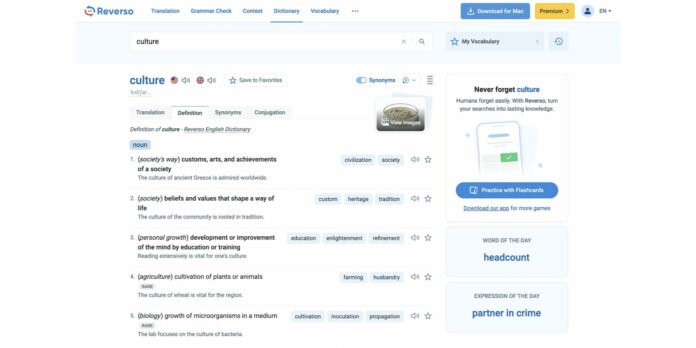
Reverso, the global leader in online language tools, has expanded its pioneering translation platform with a disruptive new English dictionary for its website and apps: Reverso Define (https://dictionary.reverso.net/). Providing clear, concise definitions for over 500,000 meanings and growing, Reverso Define is built to make it easier for native and non-native users to understand English.

“Our mission in creating Reverso Define is as clear as its new definitions: to help everyone grow their vocabulary and increase literacy in a fun and simple way,” said Théo Hoffenberg, founder and CEO of Reverso. “Reverso Define is reimagining the dictionary as a digital-first companion, delivering quick, rich—and unlike chatbots—consistent information about English words, all just one click away and easily saved for deeper learning.”

Combining the rigor of linguistics, power of data, best practices in education, and assurance of meticulous review, Reverso Define provides a host of AI-powered features:

  • Shorter definitions illustrated with real-world examples, context labels, and synonyms for every meaning
  • Comprehensive coverage: over 100,000 expressions and idioms, 5,000 abbreviations, and extensive slang, technical language, and more
  • Instant results for 98% of lookups, including inflected forms and phrases as headwords
  • Clickable links on every word in definitions for effortless exploration
  • Pronunciations for every definition, meaning, and example in American and British English
  • Images for 50,000+ meanings, especially high-frequency concrete nouns
  • Regular revision, with approximately 10,000 meanings upgraded each update
  • Immediate, cross-referenceable translation in Reverso’s 25+ languages

Developed by Reverso’s team of language specialists, data scientists, and engineers and backed by the company’s nearly 30 years of innovation in language technology, Reverso Define offers a clean experience seamlessly integrated into Reverso’s all-in-one language ecosystem.

Perfect for English as both a first and foreign language, Reverso Define enables teachers to easily create thematic and leveled word lists, which students can study using quizzes, flashcards, and multimodal listening and pronunciation practice tools. With one tap, everyday users get short and sweet definitions in a snap—whether reading articles, writing, emailing, texting, or watching videos online.

“Most of today’s electronic dictionaries have evolved from traditional dictionaries. They were not created specifically for on-screen reading,” said Dr. Ana Frankenberg-Garcia, member of the editorial board of Oxford Academic’s International Journal of Lexicography and longtime contributor to renowned dictionaries. “Reverso is a new English dictionary designed to help you understand unfamiliar words and expressions with minimal disruption while concentrating on what you are reading.”

Reverso Define is free and now available on the web (https://dictionary.reverso.net/) and app (https://context.reverso.net/translation/mobile-app/) as well as through Reverso’s desktop downloads and browser extensions.

In June, Reverso released a new version of its award-winning app, Reverso Translate and Learn, the first of its kind able to be set as the default translator in devices running iOS 18.4 and later.

About Reverso

Reverso is a global leader in online translation and language tools, helping millions of people and professionals read, write, learn, and communicate across the world’s languages. For over 100 language combinations, Reverso provides AI-powered contextual voice, image, text, and document translation and an all-in-one learning ecosystem with a top grammar checker and user-first English dictionary. Each month, it serves over 50 million active users on the web, 5 million app users, and 5 million users in corporate environments.

Wordly AI Surpasses 5 Million Users and Ranks as 196th Fastest-Growing Software Company on Inc. 5000

0
Wordly Inc. 5000

Wordly, the pioneer and largest provider of live AI translation, has landed on the prestigious 2025 Inc. 5000 list, ranking 196th among small business software companies nationwide and 1,707th across all small business industries. In a field of approximately 34.8 million small businesses in the U.S., Wordly stands out as one of the rare innovators achieving rapid, sustained growth despite significant global and economic challenges.

The honor comes as Wordly marks several major milestones: surpassing 5 million users, achieving over 200% sales growth over the past 3 years, and expanding its platform with new innovations like AI Summaries and support for additional translation languages to meet the surging global demand for inclusive, real-time multilingual communication.

“Reaching 5 million users in just six years is an incredible milestone and a testament to the global need for what we’ve created,” said Wordly Founder & CEO Lakshman Rathnam. “Being ranked #196 among software companies on the Inc. 5000 shows that our AI solution is meeting the market need for high quality, affordable translation and captions. Our ability to grow proves the lasting value of what we deliver. Innovation is in our DNA, and every feature we launch is shaped by user feedback and driven by our mission to bring communities closer.”

As Wordly celebrates its place on the Inc. 5000 and rapid momentum in 2025, the company is also marking a fundamental shift in global communication. From translating city council meetings in San Jose, CA and emergency wildfire alerts in Los Angeles County, to making off-Broadway shows, like The Perfect Crime, accessible at The Theater Center in NYC, and powering multilingual conferences like Cvent Connect and Imex, Wordly real-time AI translation is transforming how people connect across languages. With support for more than 3,000 language pairs and new features consistently added through agile development cycles, Wordly is helping organizations eliminate communication barriers, without the high cost and complexity of traditional interpretation.

Used by businesses, non-profits, schools, governments, and houses of worship, Wordly enables people to engage, collaborate, and be heard, instantly and in their own language. With triple-digit growth, and a robust product roadmap focused on innovation, Wordly is proving that when you speak every language, everyone belongs.

About Inc. 

Inc. is the leading media brand and playbook for entrepreneurs and business leaders shaping our future. Through its journalism, Inc. aims to inform, educate, and elevate the profile of its community: the risk-takers, the innovators, and the ultra-driven go-getters who are creating the future of business. Inc. is published by Mansueto Ventures LLC, along with fellow leading business publication Fast Company. Find the complete 2025 Inc. 5000 ranking and information on the Inc. 5000 methodology. For more information, visit www.inc.com.

About Wordly

Wordly is the pioneer and leader in AI translation, providing a high-quality, secure, easy-to-use, and affordable live AI translation and caption solution for communicating across multiple languages. Wordly translates dozens of languages in real-time, making in-person and virtual meetings and events more inclusive, accessible, and engaging. Its SaaS platform meets enterprise-grade security & privacy standards and eliminates the need for human interpreters or special equipment. Millions of users across thousands of organizations – including corporate, nonprofit, government, education, and religious sectors – trust Wordly for their multilingual communication needs. Wordly is continually innovating, introducing features that anticipate the evolving needs of a global audience and redefine what AI-powered communication can achieve. For more information, visit www.wordly.ai. 

How AI Bridges the Gap Across 22 Indian Languages

0
AI in Indian languages

From street-level delivery to national-scale inclusion

In Mumbai’s relentless traffic, delivery driver Vineet Sawant has one less thing to worry about these days: language barriers. The BBC reported that Sawant, a native Marathi speaker with limited English reading skills, once had to rely on colleagues to interpret delivery instructions written in English. For a job where speed is everything, guesswork was costly.

According to the BBC article, that changed when Sawant’s employer, Zepto — India’s ultra-fast grocery delivery service — partnered with Reverie Language Technologies to integrate artificial intelligence (AI)-powered translation into its driver app. Now, Sawant can switch between six languages, including Marathi, and receive instructions like ring bell in words he understands. His daily deliveries have tripled, from 10 to about 30. “When the app speaks our language, we feel more confident, and we work better,” he told the BBC.

Building India-specific AI

India’s linguistic diversity is vast: 22 official languages and hundreds of dialects. Without technology that “understands and speaks” these languages, millions remain excluded from the digital revolution, Professor Pushpak Bhattacharyya of IIT Mumbai told the BBC. The challenge lies in building AI models for languages that lack digitized, high-quality datasets — a stark contrast to English or Hindi, where abundant data exists.

To address this, the Indian government launched Bhashini in 2022 — an initiative developing datasets, AI models, and translation services tailored to the nation’s linguistic diversity. Today, Bhashini hosts 350 AI-based language models, has processed over a billion tasks, and supports 22 languages. It powers multilingual chatbots for public services and translates government schemes into local vernaculars. “Bhashini ensures India’s linguistic and cultural representation by building India-specific AI models rather than relying on global platforms,” says Amitabh Nag, CEO of Digital India’s Bhashini Division.

The goal is bold: Within a few years, rural users could access government services, financial tools, and information systems in their native tongues through voice-enabled AI.

Researchers are also exploring AI for complex, language-sensitive services. At IIT Mumbai’s Koita Centre for Digital Health, Professor Kshitij Jadhav is developing an AI to assist people in quitting smoking — identifying the kind of support each person needs and delivering it in multiple languages, with empathy and emotional nuance. Initial trials are in English and Hindi, but the vision spans all 22 languages. “It will be very customized, not something off the shelf,” Jadhav explained to the BBC.

The human impact

For Sawant, the benefits are immediate and personal. “Not everyone understands English,” he says. “When the app speaks our language, we feel like we belong.” From empowering delivery workers to expanding inclusive public services, India’s AI language initiatives are not just about efficiency — they are about inclusion, dignity, and cultural preservation.