LanguageLine Contributes to New eBook Exploring the Future of AI in Translation

0
AI in Translation How Experts are Rethinking Language and Quality

LanguageLine Solutions has joined forces with MultiLingual Media and XTM to publish AI in Translation: How Experts Are Rethinking Language and Quality, a new eBook featuring perspectives from some of the leading voices shaping the future of language services, localization, and multilingual communication.

The publication comes at a time when organizations across industries are evaluating how artificial intelligence can help them translate more content, support more languages, and reach global audiences more efficiently, while maintaining the quality, trust, and accountability that effective communication requires.

“AI is not just changing translation technology,” LanguageLine President & CEO Simon Yoxon-Grant said. “It’s changing how organizations think about language, quality, customer experience, and global communication.”

The eBook explores a range of topics currently confronting the language industry, including human-AI collaboration, quality assurance, risk management, language access, low-resource languages, and the future of translation workflows.

“What I appreciate most about this book is that it doesn’t pretend there is a single answer,” Yoxon-Grant said. “You’ll find differing opinions about automation, quality, risk, human expertise, language access, and the future role of linguists. What emerges is a much more useful picture of where our industry stands today and where it may be headed next.

Among the featured contributors is Antonio Tejada, LanguageLine’s Vice President of Translation and Localization, who shares his perspective on how AI is reshaping multilingual communication and the evolving role of language professionals.

Contributors also include experts from organizations such as Adobe, TikTok, Uber, TED, Revolut, Cincinnati Children’s Hospital, RWS, TAUS, Nimdzi Insights, and others.

AI in Translation was authored by Cameron Rasmusson and Edinson Arrieta and produced through a partnership between LanguageLine, MultiLingual Media, and XTM.

The eBook is available now as a free download

About LanguageLine Solutions

LanguageLine Solutions, headquartered in California, provides on‑demand interpreting, translation, and AI‑powered language services for real‑time and written communication. Serving healthcare, government, and enterprise sectors, it delivers secure, compliant, 24/7 support across hundreds of languages, combining professional linguists with scalable technology to remove communication barriers at high volume and high stakes.

The Week in Review: Language Industry News June 9-15

0
Week in Review June 8-15

This week’s developments reveal an industry moving decisively toward hybrid intelligence, pairing AI‑driven scale with human‑anchored precision, governance, and community impact. From acquisitions in legal and healthcare language access to platform‑level shifts in global content operations, multilingual communication is becoming more continuous, more contextual, and more strategically embedded across sectors. 

Expansion

DigitalTolk has acquired Hieronymus Ltd, Switzerland’s premier legal translation firm, marking its second acquisition in less than a year. Strengthening its position across the DACH region, the deal unites three complementary capabilities, creating a full‑spectrum group that spans high‑volume AI‑assisted work to the most precise legal standards. With strict Swiss‑aligned data‑sovereignty controls and all teams remaining in place, the acquisition positions DigitalTolk as one of Europe’s few providers able to offer both AI scalability and uncompromising human precision for banking, insurance, legal, and public‑sector clients. 

Phrase has rolled out a major set of enhancements designed to extend brand context, quality governance, and language assets across both human and agent‑based content workflows, addressing the growing challenge of AI agents generating content without access to enterprise standards. The update introduces new APIs, expanded Model Context Protocol (MCP) capabilities, general availability of style guides, and API‑driven quality profiles, creating a shared intelligence layer that lets organizations use their own models and agents while maintaining consistent, on‑brand output at scale.

AMN Healthcare has acquired Jaide Health, an AI‑enabled medical interpretation and translation solution designed to support everyday administrative communication for LEP patients, extending AMN’s language‑access capabilities beyond clinical encounters. The move reinforces a hybrid model in which AI handles routine intake, discharge, and non‑clinical exchanges, while medically qualified human interpreters remain central for complex, sensitive, and critical conversations. With Jaide already deployed across multiple healthcare environments, the acquisition pairs AMN’s clinical‑quality standards with real‑time AI assistance to close communication gaps before and after care, giving LEP patients a more seamless and supported experience. 

Community

Terra has promoted Belén Agulló García to its newly created role of Chief Innovation Officer, recognizing her leadership in guiding the company’s evolution from a traditional language service provider (LSP) into a consultancy‑driven global content solutions partner. Over the past 18 months, she led cross‑team innovation efforts, including Terra’s ROI Calculator for video game clients, helping organizations navigate increasingly complex multilingual content ecosystems. Her appointment formalizes Terra’s commitment to strategic, people‑first innovation.

A new Crowdin feature argues that in the era of AI‑driven localization, there is no such thing as a final translation, because both models and the surrounding system parameters evolve continuously. The piece outlines why older AI output quickly becomes legacy content, why manual refreshes are technically fragile, and how Crowdin’s new Re‑Translation feature solves the refresh loop. It positions the future localization role as a “localization architect,” focused on refining guardrails and pipelines rather than micromanaging strings, as multilingual content becomes a continuously optimized system rather than a static asset. 

_____________________________________________________________________________________________________________________________________________

Across legal, healthcare, and global content operations, this week shows an industry moving toward hybrid systems where AI handles scale and humans anchor quality, governance, and trust. The result is a multilingual ecosystem that’s becoming more continuous, more contextual, and more strategically aligned with real‑world stakes. 

For more stories like these, visit our News section.

Google Launches Gemini 3.5 Live Translate With Real-Time Speech-to-Speech Capabilities

0
Gemini 3.5 Live Translate

Google has unveiled Gemini 3.5 Live Translate, a new speech‑to‑speech model designed to deliver continuous, near real‑time translation across more than 70 languages. The update represents one of the company’s most significant steps toward low‑latency multilingual communication since the launch of Google Translate, which now processes over a trillion words each month.

Unlike earlier turn‑based systems, the new model simultaneously produces translated speech as the speaker talks, typically staying only a few seconds behind. Google says the system preserves intonation, pacing, and pitch to generate more natural‑sounding output. It also automatically detects languages without requiring manual input and is engineered to perform reliably within noisy or unpredictable environments.

A major component of the rollout is its integration into Google Meet, where the company is expanding translation support from a limited set of English‑centric pairs to more than 2,000 language combinations. Previously, Meet’s live translation features were restricted to only to and from English workflows. The new model allows supported languages to be translated directly into any other, significantly broadening access for global teams, classrooms, and multilingual events.

Developers can begin testing the model through the Gemini Live API and Google AI Studio, now available in public preview. Enterprise users will see the Meet integration in private preview this month, with a wider release planned later in the year for general users on Android and IOS. The Google Translate mobile app is also receiving updates, including a new Android “listening mode” that routes translated audio through the phone’s earpiece for more discreet use.

Early pilot partners including Grab, CJ ENM, LiveKit, Vision Agents, and Agora reported improvements in latency, accuracy, and automatic language detection. Grab, for instance, is evaluating the system to support multilingual communication across its 10 million monthly voice calls.

All audio generated by the model is said to be watermarked using SynthID, Google’s imperceptible watermarking technology intended to help identify AI‑generated content and mitigate misinformation risks. For additional details on its approach to safety and responsibility, please review the model card.

Sorenson Named to Newsweek’s List of America’s Greatest Workplaces for 2026

0
Sorenson Communications, connect beyond owrds

Sorenson Communications, a global leader in communication solutions for Deaf, Deafblind and Hard of Hearing individuals has announced it has been selected by Newsweek as one of America’s Greatest Workplaces for 2026. In addition to being named one of America’s Greatest Workplaces in 2026, Sorenson earned recognition in America’s Greatest Workplaces for Tech 2026 as well.

The Newsweek lists highlight organizations that excel in creating positive employee experiences and fostering environments where team members can thrive. Newsweek’s evaluation considered factors such as workplace culture, employee engagement, compensation, career development opportunities, work-life balance and technological advancement.

“Recognition as one of America’s Greatest Workplaces for 2026 speaks to the exceptional people behind Sorenson and the company culture they help shape every day,” said Kevin Keleghan, Chief Executive Officer at Sorenson. “We are committed to building a workplace where people feel valued, supported, and empowered to make a meaningful impact. We continually invest in our workforce and the technologies that help them deliver exceptional service for the Deaf, Deafblind and Hard of hearing communities we serve.”

Sorenson remains a leading employer for both sign language interpreters and Deaf professionals across the United States. The company offers a wide range of wellness resources and peer support networks designed to support employees’ physical, emotional and mental well-being.

The organization’s benefits include access to employee assistance programs, specialized counseling resources, wellness initiatives, and ergonomic workplace support designed to help interpreters and other team members thrive and perform at their best.

Newsweek’s rankings, developed in partnership with independent research firm Plant-A Insights Group, are based on extensive analysis of employee feedback, workplace metrics, and independent research. Companies are evaluated across numerous workplace factors, including leadership, compensation, professional development, company values, and organizational transparency. Organizations found to engage in unfair labor practices are excluded from consideration.

“Creating an accessible, supportive workplace is fundamental to our mission,” said Pipier Bewlay, Chief Human Resource Officer at Sorenson. “We listen closely to employee feedback and invest meaningfully in continuous improvement.”

To learn more about career opportunities at Sorenson and its commitments to employees please visit www.sorenson.com/careers.

About Sorenson Communications

As a leading language services provider, Sorenson combines innovative, patented technology with world-class sign language interpreters to deliver clear, seamless communication for Deaf, Deafblind and Hard of hearing communities.  Each year, Sorenson enables hundreds of millions of conversations for its customers’ unique communication needs. Sorenson is a portfolio company of Ariel Alternatives and is committed to operating responsibly by actively managing and reducing its environmental impact.

AMN Healthcare Acquires Jaide Health to Expand Language Access Through AI Technology

0
AMN Healthcare logo

AMN Healthcare’s Language Services has announced it has acquired Jaide Health, a real-time, AI-enabled medical interpretation and translation solution designed to help patients and care teams communicate more quickly and easily throughout the administrative aspects of the healthcare experience.

The acquisition expands AMN Language Services’ ability to support LEP patients not only during clinical encounters requiring human interaction, but also in key moments before and after care—while reinforcing the essential role of medically qualified human interpreters for clinical, complex, and sensitive conversations.

Jaide Health provides high-quality, AI-assisted language support for common, everyday verbal exchanges and written translations, such as sharing intake and discharge information, helping close gaps outside the physician or acute-care encounter where patients and staff often experience delays or limited language access. When conversations become clinical or complex, human interpreters remain central to ensuring accuracy, empathy, and patient safety.

“This is an important strategic move in AMN’s ongoing mission to improve access to care for all,” said Cary Grace, President and CEO of AMN Healthcare. “By expanding language support across more moments in the healthcare journey, we can help health systems deliver a more seamless experience for patients and care teams while continuing to rely on the critical expertise of our qualified interpreters when it matters most.”

The Jaide Health solution is live today with clients across multiple healthcare environments, demonstrating value in real-world workflows and patient communications.

“We believe we’ve built one of the strongest solutions in the market, and joining AMN Language Services lets us reach more patients through AMN’s scale and clinical-quality standards,” said Joe Corkery, MD, CEO and co-founder of Jaide Health. “AMN was our first choice because of our shared commitment to quality. Together, we can pair smart AI assistance with the high standards of AMN’s human interpreting to provide LEP patients with a voice outside of clinical encounters, which we know leads to better outcomes and experiences.”

As part of the acquisition, the Jaide Health team will join AMN Healthcare. Financial terms of the transaction were not disclosed.

About AMN Healthcare

AMN Healthcare is a leader and innovator in total talent solutions for healthcare, bringing together the people, processes and technology to deliver better care. Through a steadfast partnership approach, its mission is to solve the most pressing workforce challenges to enable better clinical outcomes and access to care. In 2025, its healthcare professionals reached more than 13 million patients at more than 2,300 healthcare systems, including 93 percent of the top healthcare systems nationwide. It provides a comprehensive network of quality healthcare professionals and deliver a fully integrated and customizable suite of workforce technologies.

Why a Final AI Translation Does Not Exist

0
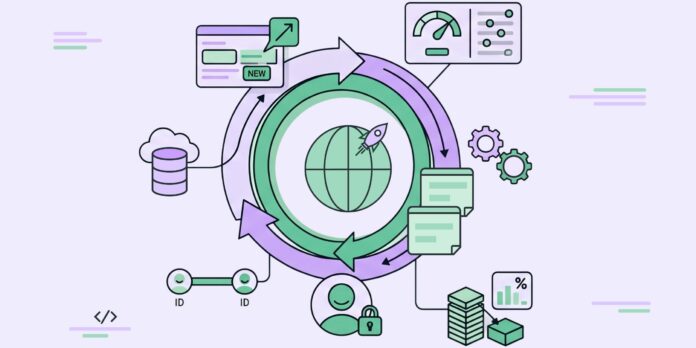
Crowdin's multilingual re-translation animated workflow

For decades, the localization industry operated on a linear model. A file was extracted, sent to a translator, reviewed, approved, and pushed to production. Once published, that string was considered done. Unless the source text changed, the translation remained untouched – frozen in time as a permanent asset in a translation memory.

This “publish and forget” mindset was perfectly rational in a human-centric workflow where changing existing translations cost too much time and money. In the era of AI localization, however, this approach is outdated. Treating AI-generated translations as static assets limits the quality of content.

Today, we can say that there is no such thing as a finished translation.

Why Yesterday’s AI Translation is Today’s Legacy Content

If you deployed an automated AI translation pipeline a year ago to localize fast-changing content (such as documentation, release notes, support articles), that content is already underperforming.

The original output might have been completely fine at the time. However, AI translation quality is dynamic, and the gap between yesterday’s baseline and today’s potential is widening rapidly.

This evolution goes far beyond simply upgrading to a newer large language model (LLM) generation. The true differentiator in localization quality is that your own localization workflows have evolved. Over the past year, you have likely updated your system parameters, refined your rules, and added better context.

Today, localization managers do more than manage text – they configure the entire translation environment. Quality improves continuously as these system parameters evolve:

  • Terminology databases and glossaries are constantly updated, expanded, and corrected.
  • Brand voice requirements change, requiring new systemic enforcements.
  • Workflows are becoming more sophisticated, incorporating automated quality checks, context-retrieval steps, and multi-model coherence validation.

When any of these variables change, the output changes. A pipeline configured today with an updated glossary and sharper rules will give you much better AI translations than the exact same model running on last year’s setup. Leaving older AI content unrefreshed means giving your audience an outdated experience.

Technical Challenges of Content Refreshes

We all know previous AI translations could be better, but updating them manually is incredibly slow and complex. Attempting to build an in-house continuous-refresh mechanism using standard APIs or basic translation scripts usually creates unexpected technical issues.

Without a proper localization platform, teams face major technical issues such as:

  • Broken IDs and missing context: In most development ecosystems, string keys change, files get refactored, and content blocks are shifted. If you try to run an automated script to re-translate older strings, matching the exact original source string to its active production counterpart is incredibly unreliable. Without proper context tracking, scripts can pull text out of context, leading to broken variables, malformed placeholders, or completely broken UI text.
  • Overwriting human edits: Localization is rarely 100% automated. High-priority pages often get manual polishes from professional linguists. A basic automation script running a bulk update can easily wipe out those pristine human edits. Building custom code to track the exact origin of every single string is a big task for engineering teams.
  • Calculating the delta: Pushing entire files back into production just to update 15% of your strings triggers unnecessary CI/CD builds and strains APIs. Instead of refreshing everything, teams struggle to find the “delta” – identifying exactly which strings need an update, tracking when they were last translated, and deploying only those specific segments.

How Crowdin Solves the Refresh Loop

To unlock the true ROI of artificial intelligence, localization platforms must treat translations as a living, continuous loop rather than a final destination.

This requires a system that maintains a persistent connection to your content source — whether it is a code repository, a CMS, or a marketing automation platform. Because Crowdin natively tracks your project state, it eliminates the administrative and development work of content iteration.

Introducing the Re-Translation Feature in Crowdin

This paradigm shift is why we introduced Re-Translation. It fundamentally changes how enterprises maintain multilingual content and allows teams to safely refresh previously translated AI content, preventing the classic pitfalls of automated updates:

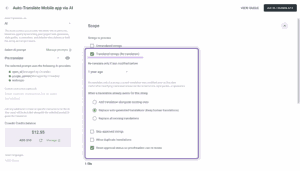
Auto Translate Mobile app demonstration

  • Crowdin tracks the exact metadata of every string. In the updated workspace UI, you can target text dynamically by its operational “age” (for example, Re-translate only if last modified before 1 year ago).
  • To protect human workflows, Crowdin includes built-in translation logic filters. You can explicitly instruct the system to Replace auto-generated translations (Keep human translations). The platform safely isolates machine-generated data and protects your human-curated edits from being touched.
  • Because Crowdin maintains a persistent mapping layer between your content repo and your localization workspace, it doesn’t need to re-import files or recreate tasks. The system calculates the precise delta, runs the current, optimized AI pipeline against the selected scope, and pushes the updated assets directly back to your connected repository or CMS without breaking deployment pipelines.

The Future of the Localization Role

Because AI translations are never truly finished and are continually improving, the role of the localization professional undergoes a profound transformation and the focus shifts away from micro-managing individual strings. Instead, tomorrow’s localization managers will act as localization architects. They will manage quality at scale by continuously refining system guardrails, optimizing context-retrieval mechanisms, and adjusting pipeline steps.

When the localization stack becomes automated, continuous, and architecturally secure, multilingual content is never truly finished – it is simply continuously optimized.

Re-Translation capabilities are now fully live and available across both Crowdin and Crowdin Enterprise platforms.

Terra Promotes Belén Agulló García to Chief Innovation Officer

0
Belén Agulló García

Terra has announced the promotion of Belén Agulló García to Chief Innovation Officer, effective June 8, 2026. The newly created role recognizes her instrumental contribution to the company’s ongoing evolution from a traditional language service provider into a global content solutions partner.

Over the past year and a half, Agulló García has led innovation initiatives across teams as Executive Consultant of Innovation, helping Terra adapt to a rapidly changing industry shaped by AI, automation, and increasingly complex global content ecosystems. Her work has focused not only on implementing technology, but on ensuring those solutions meaningfully improve workflows, scalability, and the experience of the people behind the process.

As Terra expands its consultancy-driven approach, the company has been working closely with clients in industries such as healthcare and video games to streamline multilingual content operations, improve data governance, and build more scalable workflows. Agulló García has also collaborated closely with Terra’s Business Intelligence team to research emerging technologies and develop strategic tools for clients, including the company’s ROI Calculator initiative for video game clients.

“Belén has played an invaluable role in helping Terra rethink what innovation should look like in our industry,” said Marina Ilari, CEO of Terra. “She brings a rare combination of strategic vision, operational understanding, and human-centered thinking. Her leadership has helped us build solutions that address the real challenges our clients face today.” 

“Innovation only matters when it serves the people using the process,” said Agulló García. “Technology should create clarity and efficiency, not burnout. Our goal is to help clients build smarter, more sustainable content ecosystems that can scale with confidence.”

About Terra

Terra is a global language services provider with teams across the US, Spain, and Brazil. The company delivers translation, localization, and culturally aligned content through a diverse, multilingual staff, emphasizing quality, collaboration, and personalized service for clients across industries.

Phrase Expands Language Intelligence for Humans and AI Agents

0
Phrase building a platform for humans and agents sign

Phrase, one of the world’s leading Language Intelligence Platform, has announced a new set of platform enhancements designed to help organizations extend language intelligence across human and agent-based workflows.

As AI agents become active participants in content workflows, organizations face a new challenge. The systems generating content often operate without access to the language assets, brand standards, and governance frameworks required to produce consistent customer experiences across international markets.

The enhancements reflect a broader shift toward global content operations where humans and AI agents increasingly work side by side. Phrase is addressing that directly, by making context, quality controls, and language assets accessible across workflows, enterprise applications, and the agents operating within them. The result is consistency, governance, and quality that scales as content creation increases.

“Our customers have spent years building language context; their terminology, translation memory, quality standards, and brand voice. With Style Guides now generally available, together with Quality Profiles, and the new APIs (also MCP) we’ve opened up, that context can power every agent, workflow, and system across the enterprise. That’s what makes the difference between AI that just produces output and AI that produces content that actually works in-market.”

A platform built for humans and agents alike

Organizations increasingly want the freedom to use their own models, build their own agents, and integrate language intelligence into the systems and agentic tools they already use. To support that, Phrase is expanding its API portfolio and significantly extending its Model Context Protocol (MCP) capabilities.

New APIs for style guides, quality profiles, and language assets give agents, workflows, and enterprise applications access to the same brand context, terminology, translation memory, and quality evaluation that power Phrase’s own AI capabilities.

Expanded MCP support includes capabilities such as Translation Memory and Term Base management, quality evaluation, analysis and quoting capabilities. It also allows users to manage files from any MCP-compatible AI tool or agent, such as Claude Desktop, and a Google Drive connector. Together, these enhancements make Phrase more open, flexible, and accessible across enterprise applications, custom AI solutions, and agent-based workflows.

Governance built for automated content operations

The update also marks the general availability of Style Guides.

First introduced earlier this year, Style Guides give both AI and linguists the context behind the content, the brand voice, tone, audience guidelines, and market-specific requirements that determine not just what gets translated, but how. They apply consistently across the entire localization process, from initial translation generation through post-editing to quality evaluation, so every stage works from the same contextual foundation.

With API access now open, that same foundation is accessible to any agent, workflow, or external system across the enterprise. This ensures the context that defines how a brand communicates in every market is no longer confined to the platform, but available wherever content is being created or adapted.

Quality Profiles, available through API access, allow organizations to assess content against the same standards used to create it. Together, they go beyond traditional “quality” measures (such as MQM) to establish a shared source of truth for translation, evaluation, and adaptation, helping organizations improve quality, maintain consistency, and scale content operations globally with confidence.

Zero-touch localization for instant translations of every release

Phrase is introducing Zero-Touch Localization, a new automation that eliminates the manual work that typically sits between a code change and a translated release. Once configured, the pipeline runs automatically alongside the existing development workflow. It detects new content, triggers translation, and returns completed strings to the codebase without any action required from developers or localization teams. This reduces engineering overhead and accelerates release cycles. Business and Enterprise customers on GitHub can request early access today.

Additional platform enhancements:

  • Phrase Studio: The latest release expands Phrase Studio, bringing the same translation memories, style guides, and quality standards used across global content operations into video localization workflows. New capabilities include support for files up to 20GB, automated subtitle timing suggestions, undo and redo functionality, and enhanced dubbing workflows.
  • Design-led localization: Enhancements to the Phrase Figma plugin improve performance and automation for design teams managing multilingual experiences, with support for large-scale design systems, improved content synchronization, and branch-aware automation.
  • Expanded ecosystem connectivity: Through its partnership with Blackbird, Phrase now connects to more than 200 enterprise applications, adding 150 new integrations including Notion, ServiceNow, Airtable, Asana, and Bynder, helping organizations integrate language intelligence across their existing technology stack.

A foundation for the future of global content

As organizations increasingly rely on AI to create, adapt, and distribute content across markets, the need for governance, context, and consistency continues to grow.

Phrase believes the future lies in a shared intelligence layer that connects people, systems, and agents through a common understanding of language. These updates extend that vision, helping organizations bring context, quality, and governance to the workflows where humans and AI increasingly work side by side.

“The question we hear most from customers right now is whether they can build with their own agents, their own models, their own workflows, without sacrificing the quality and consistency that defines their brand across markets,” said Ell. “Winning in global markets has never been about producing the most content. It is about producing content that is trusted, consistent, and on-brand in every language. Our Language Intelligence Platform is designed to make that possible at scale and get measurably better the more you use it.”

About Phrase

Phrase is one of the world’s leading language intelligence platforms, helping global organizations move faster, reach more markets, and deliver content that feels local, relevant, and authentic. The Phrase Platform combines AI, agentic orchestration, and a headless, API-first architecture in one unified system. It applies the context that makes content perform in every market, including brand voice, quality standards, glossaries, prior translations, and cultural nuance. This means every team, in every region, can ship content that’s on-brand, on-point, and ready for any audience. 

DigitalTolk Makes Second Acquisition in Less Than a Year With Hieronymus Ltd

0
Digitaltolk

DigitalTolk, a leading European language and technology company, has announced the acquisition of Hieronymus Ltd, Switzerland’s premier legal translation firm. The acquisition is DigitalTolk’s second acquisition in less than a year, following the purchase of German-Swiss translation company 24translate in July 2025, further strengthening the group’s position as a premium provider of language services across the DACH region and Europe.

Hieronymus, founded in 2007 and headquartered in Zurich, has built a distinguished reputation as a go-to translation partner for Switzerland’s most established legal and financial clients. The company is unique in the translation industry: projects are overseen by a Senior Lawyer-Linguist who is licensed to practice law in Switzerland. Its client base includes leading Swiss law firms, banks, insurance companies, and corporate legal departments.

“Hieronymus stands out for one reason above all: the unmatched quality of its lawyer-reviewed translations. That level of precision is critical for serving highly regulated sectors across Europe. By bringing Hieronymus together with 24translate and DigitalTolk’s technology platform, we now cover the full spectrum — from AI-assisted translation to the highest standard of certified legal work,” said Virpal Singh, CEO, DigitalTolk.

Hieronymus will continue to operate under its own brand. Its team, including all lawyer-linguists and project managers, will remain in place. Existing clients will experience no change in service quality or delivery, the same people, the same Swiss precision.

“Hieronymus was built on a clear premise: that legal translation requires the same level of rigour and accountability as legal advice itself. I am proud of how consistently these standards have been upheld over the years. Seeing the company continue to evolve and extend its reach internationally is a strong testament to the exceptional team that drives it today,” said Paula Reichenberg, Founder, Hieronymus Ltd.

A full-spectrum language services group

The acquisition brings together three complementary capabilities that, combined, cover the full spectrum of professional language needs including:

  • Hieronymus continues to do what it has always done: deliver premium legal translation for Switzerland’s most demanding clients, with every project overseen by a Senior Lawyer-Linguist licensed to practice law in Switzerland. That standard is unchanged.
  • 24translate handles professional translation for financial services, insurance, and regulated industries across Germany and Switzerland — drawing on a network of over 7,000 translators and AI-assisted workflows that enable faster turnaround on high-volume work.
  • DigitalTolk provides AI-powered interpretation and translation technology across 210+ languages, including PretPal, a real-time AI interpretation tool for live multilingual conversations, and Secure Translations, an enterprise suite built for organisations with sensitive multilingual content needs.

For clients who need certified legal precision, Hieronymus remains the answer. For everything else across the language spectrum, the group now offers a seamless path to the right solution.

“Hieronymus is exactly the kind of acquisition we look for: a market leader with an irreplaceable reputation, operating in a segment where quality is non-negotiable. We are systematically building a group that combines the speed of AI with the rigour of human expertise — and Hieronymus sits at the most demanding end of that spectrum,” said Anshul Tyagi, Head of Corporate Development, DigitalTolk.

Together, the group offers what few language service providers can: the speed and scalability of AI-powered translation where appropriate, and the precision of human expertise — including lawyer-reviewed certified translation — where the stakes demand it.

Data sovereignty by design

The acquisition further reinforces the group’s commitment to European data sovereignty. Hieronymus has always operated with strict confidentiality standards aligned with Swiss data protection legislation and adhering to the same professional confidentiality that lawyers are bound by. DigitalTolk processes data exclusively within Switzerland and the EU, with no exposure to US jurisdiction or the CLOUD Act. All data centres hosting information relating to Swiss clients are located in Switzerland, ensuring that data is processed, transferred, and handled exclusively within the country. For clients in banking, insurance, legal, and government sectors, this is not a technical detail — it is a requirement.

Continued growth across europe

DigitalTolk was founded in Stockholm in 2015 and has grown into one of Europe’s leading language technology companies, combining proprietary AI with a network of over 6,000 professional interpreters and — through 24translate and now Hieronymus — more than 7,000 professional translators. The company serves public sector agencies, healthcare providers, courts, banks, insurance companies, and corporations across Scandinavia, the DACH region, and the UK.

The transaction was financed with DigitalTolk’s own funds.

About DigitalTolk

DigitalTolk is a leading Swedish language service provider offering interpreting, translation, and messaging across 210+ languages. Its award‑winning booking system delivers rapid matching, emergency access in under 15 seconds, and transparent feedback loops. Trusted by 1,000+ clients, DigitalTolk combines technology and human expertise to streamline multilingual communication.