Sara’s winning pitch, “Intelligent triage with XTM Go: Document translation that begins with content, not configuration,” tackled one of enterprise localization’s most consequential blind spots: the daily flood of translation that happens outside governed systems. Her pitch centered on a deceptively simple idea that translation should start by reading the content, not by asking the user to configure a workflow.
The innovation she presented, XTM Go, is a risk-aware translation gateway built for the invisible translation demand. It weighs each request by risk, intent, and complexity before deciding how to handle it and self-optimizes based on past outcomes. Routine content returns in minutes through AI, while anything sensitive escalates automatically to human-assisted workflows.
What further sets it apart is that approved translations are reused first for consistency, and complex files come back with the structure intact. With no friction to work around, it draws everyday translation through a governed front door.
“Sara’s win tells you exactly what kind of company we are,” said Lorcan Malone, CEO of XTM. “We’ve taken one of the hardest problems in enterprise localization and made a room full of experts rethink it. That instinct, to challenge how things have always been done and picture something better, is the culture we care about most at XTM. I couldn’t be prouder of the XTM team, or of what this recognition says about the thinking that drives us.”
The PIC is one of the localization industry’s most rigorous peer-judged forums, held at LocWorld conferences before audiences of 300+ industry professionals. XTM’s win, out of 28 submissions and against five other finalists, is a signal that the market is ready for a governed alternative to the AI challenge enterprises can no longer ignore.
About XTM International
XTM International is an AI globalization platform that transforms language from a barrier into an opportunity. It brings translation management, business management, software localisation, and video creation together into a composable system, giving enterprises the flexibility to adopt the solutions they need, when they need them. Trusted by over 1,300 global companies, supporting more than 880 languages and over 80 ready-to-go integrations, XTM enables teams to scale global content with accuracy, speed, and absolute trust.
Inside classrooms and dorms across the United States, immigrant teens are quietly carrying two languages, and two worlds, inside them. They translate for their parents, for their teachers, and sometimes for themselves. But when it comes to emotions, words don’t always make the journey. Anxiety, loneliness, and exhaustion can feel untranslatable. For many, silence becomes a survival strategy.
This silence reflects a deeper gap in the country’s mental health landscape. Immigrant teens experience numerous mental health challenges, but they oftentimes do not seek help they need. Language is one barrier. Culture is another. In many families, emotional struggle is dismissed as weakness or something to “sleep through.” Mental health care can feel foreign, inaccessible, or even shameful. For young people navigating this space between cultures, support is often lost in translation.
Across the nation, schools and community organizations are working to fill this gap. Yet even the best-intentioned programs often assume English fluency and Western attitudes toward therapy. Digital mental health tools like apps, chatbots, and text lines have made care more accessible, but they rarely speak in the emotional language of immigrant families. A literal translation of words cannot convey tone, slang, or the cultural subtext that gives language its character. When help doesn’t sound like home, many teens choose silence instead.
A student’s insight sparks a collaborative solution
That was the challenge brought forward by a high-school student named Kunqi Wang, founder of the nonprofit MindBridge, who had lived this experience firsthand. Kunqi immigrated from Shanghai to Seattle as an infant. Although he personally felt safe and supported at home, he saw a very different reality among many of his immigrant friends. In families where academic expectations ran high, where scores of 95 and above were considered the baseline, conversations about stress or insecurity were rarely welcomed.
Kunqi Wang, Founder of MindBridge
Kunqi would later recall how one of his close friends, the child of Chinese American parents, tried to open up about feeling overwhelmed in school. His parents responded by reminding him of the exacting standards they had faced growing up in China, insisting that his struggles were minor in comparison. Their words were meant to toughen him, but they had the opposite effect. His friend, in tears, vowed that he would never raise the topic again with his parents.
For teens from less affluent immigrant families, the situation was even harder. Wealthier classmates could conceivably seek private support, but many immigrant families simply didn’t have access to those resources. Financial constraints, cultural stigma, and language barriers combined leave too many young people without an outlet.
As Kunqi watched these moments accumulate around him, he began to see a pattern: silence was usually a lack of understanding. From that insight emerged a question that would guide his work: what if technology could listen with cultural sensitivity, in the language teens trust most? This question became the starting point for LUCIA, a multilingual, culturally adaptive AI companion for youth mental wellness. Developed through a collaboration between MindBridge and Centific, LUCIA was designed to do something deceptively simple: help teens find their voice in their own language, and in their own cultural context.
Centific provided the AI engineering foundation for LUCIA, integrating localization-aware large language models into a safety-first conversational framework. LUCIA combines adaptive prompting with cultural style guidance to deliver emotionally attuned responses across languages. It uses domain classification to filter out unsafe or off-topic queries, and a multilingual crisis-detection module to flag distress signals and connect users with verified hotlines.
Honorifics, tone shifts, and cultural expressions, such as collectivist phrasing in Spanish or indirectness in Korean, are built in using Centific’s language and cultural packs, which are refined in partnership with native speakers and mental health advisors. The platform is web-based, privacy-preserving, and modular by design, allowing schools, nonprofits, and healthcare organizations to localize the experience for the communities they serve.
Designing for safety, not just fluency
From the outset, the Centific and MindBridge teams approached LUCIA with a clear understanding: general-purpose language models are not built for safe, culturally attuned mental health conversations, especially with adolescents. Although large language models (LLMs) can mimic empathy, they often fall short when faced with nuanced expressions of distress. In fact, AI can produce responses that are vague, inappropriate, or even harmful.
For immigrant teens, the stakes are even higher. Cultural phrasing, indirect communication, and context-specific descriptions of emotion often go unrecognized by AI chat assistants. That blind spot increases the risk of misunderstanding or false reassurance, which can delay access to real support.
That’s why LUCIA was never designed to rely on general-purpose AI. Instead, LUCIA is built from the ground up with localization-first architecture, multi-layered safety controls, and culturally specific tuning. Its crisis-detection engine is trained to recognize distress signals in multiple languages and dialects. Its responses are bound by design. It does not attempt clinical interpretation or advice, and its language and cultural packs are co-developed with native speakers and mental health experts to help ensure emotional fidelity, not just translation accuracy.
Localization as a foundation for empathy
LUCIA’s foundation lies in localization-first design: the belief that empathy requires understanding, not just translation. Its natural language model was trained using a hybrid process that combines machine learning with human cultural insight. Native speakers, mental health advisors, and community partners review and annotate language data to capture subtleties that algorithms often miss: humor, slang, politeness, and the emotional weight carried by certain phrases. Each refinement makes LUCIA sound less like a machine and more like someone who understands where you’re coming from.
LUCIA was built to live within communities. MindBridge and Centific intend to work with local schools, nonprofits, and medical students to identify untranslated or culturally specific resources, which are then localized and integrated into the platform. When a person asks about stress, burnout, or depression, LUCIA can respond in context and connect them with appropriate local resources in their native language. This partnership model ensures that AI acts as a bridge between technology and trusted community support.
Ethics at the center of design
Ethics is central to that design. Every dataset undergoes human review to minimize bias or misinterpretation. Multi-layered safety filters detect harmful or distressing content and respond with appropriate next steps, including verified hotlines and professional resources. LUCIA clearly communicates that it is not a therapist; it is a first step toward help, not a replacement for it.
In pilot surveys, 94% of immigrant users said LUCIA successfully captured the nuances of their language. Twenty-six percent said it felt like speaking to someone raised in their culture. Those numbers matter less as performance metrics than as indicators of something deeper: a sense of belonging. When a young person says, “It feels like talking to someone who understands me,” technology has fulfilled its highest purpose.
A bridge to belonging and support
The potential of this collaboration lies in reach. Because LUCIA is modular, new languages and cultural frameworks can be added quickly through community co-training. That flexibility allows it to grow through partnerships with schools, hospitals, and nonprofits, which already serve multilingual families but oftentimes lack the tools to engage them fully. The goal is not to expand users, but to expand trust networks.
This approach offers a quiet but important lesson about how AI can evolve to understand human context. As technology advances, the measure of progress should include how well we honor the diversity of lived experience; how we teach machines to listen with respect. And the localization community is responding favorably. Kunqi was recently invited to present the LUCIA project at the LocWorld conference. The presentation from the then-15-year-old student received strong interest and encouraging feedback from leaders in the localization community — an early sign that this work is resonating far beyond the classroom.
The collaboration behind LUCIA reminds us that empathy can be designed, but it must also be earned. It takes the perspective of those who have lived through the problem and the discipline of those who build responsibly. It requires both data and conscience, precision, and care.
For Centific, this work affirms a broader belief: effective localization is the result of a collaboration between people and technology. A leading provider of AI services, Centific has deep experience with multilingual AI, and has been cited as a leader in the field by organizations such as Nimdzi. Centific has long advocated for combining AI with human oversight. When we localize empathy by teaching technology to hear emotion in another language, we move closer to a world where help is never lost in translation. For every teen who finds comfort in a familiar word, or courage in being understood, the silence begins to break, and that is where healing starts.
Asta Rusakeviėčienė reflects on the impact of her early years as a translator for orphanages and speaks about her current role as owner and CEO of Diskusija, a boutique translation and localization company.
Have you ever read Multilingual Magazine? If yes, which is your favorite part?
Yes, I have — and I even contributed to the magazine quite some time ago with an article about the peculiarities of localization into the Baltic languages. It would be interesting to read it again now and see how much the entire landscape, technology, and our understanding of localization have changed since then.
When I read Multilingual, I especially enjoy the articles where professionals share their personal stories — how they arrived where they are, the choices they made, and how they see their role and the industry. On the other hand, I also appreciate pieces that feature languages and regions I’m less familiar with. They broaden my perspective and remind me how diverse and fascinating our industry truly is.
How did you get involved in the translation business?
My path to the translation industry was quite natural. I studied French philology at Vilnius University, planning to become a translator or interpreter. The demand for language services was very high at that time, so many of us — including me — started working as translators in the early years of our university studies. However, I soon realized that interpreting wasn’t for me. Even though I was good at it, I preferred to lead the conversation rather than simply support it — my entrepreneurial spirit was stronger.
Together with friends from my studies, we started Diskusija in 1993, when we were in our third year at university. Over time, my friends pursued different careers, while I continued developing the company. What began as a small initiative quickly became my professional calling. I discovered that language services are not just about words but about connecting cultures and helping businesses communicate effectively.
Since you entered the translation industry, how has the business landscape changed?
It sometimes feels like it all happened in a previous life. I still remember dreaming during my university years about electronic dictionaries while carrying around heavy Petit Robert and Larousse volumes — or going to the library to look up domain-specific terms. I even remember some translators using typewriters. Wasn’t that another era?
Over the years, I’ve witnessed the full transformation of our industry: from typewriters to computers, from servers to the cloud, and now to AI. I’ve seen the shift from a time of “knowledge vacuum,” when information was scarce and we relied on associations like Eulogia, GALA, and ELIA to share expertise, to today’s reality of information overload — where it can be difficult to stand out and stay focused.
Technology has made processes faster and more integrated, but at the same time, the human side — creativity, expertise, and meaningful relationships — has become more important than ever.
Could you share your experience working with your first client or on your first project?
My very first client was a French company newly established in Lithuania — just a few years after Lithuania regained its independence. This company hired me as a part-time employee when I was only in my second year at university. Although I was paid for the work, it felt like a second university for me — I was learning the language, gaining my first translation skills, and getting my first insights into business management, putting theory into practice and testing everything I had been studying.
Every interpreting project I took on later during my studies helped lay the foundation for my entrepreneurial life. Interpreting at complex negotiations taught me about communication and decision-making, while working on projects with orphanages and adoption cases showed me how every single word in a document can have a deep impact.
It was not an easy time, but in a way, we were fortunate to start our careers then — when language professionals were in high demand and we were trusted with real responsibility very early on. That early start allowed us to grow and develop quickly. Looking back, those experiences shaped my values — professionalism, precision, and respect for communication — principles that still guide me today.
Do you believe it’s a good time to enter the translation business?
It depends on what kind of “entry” we are talking about. For translators, there is still space — but adaptability is key. You need to be open to technology, flexible in your mindset, and ready to embrace constant change. Being “technology agnostic” and curious about new tools and workflows is essential. The tasks may evolve from pure translation to a broader range of linguistic and content-related activities, but the same skills and mindset will remain valuable.
For those thinking of starting a new translation company, however, it may not be the right time in the traditional sense. The market has matured, and the concept of “translation” alone is no longer enough. It’s rather about multilingual communication, content strategy, and value-added services that go far beyond simple translation. The future belongs to those who can see this broader picture.
Where do you see yourself professionally in the next ten years?
Ten years feels like a very long time in such an unpredictable industry. I believe that, at some point, we will gain more clarity about where the language industry is heading — and then each of us will be able to see whether we still fit within it.
If you had asked me this question three years ago, I would have said that I see myself continuing to contribute to the industry, perhaps more in the areas of strategy, mentoring, or innovation. Today, however, “innovation” feels like a very broad and fast-moving concept — it’s not easy to keep up with everything that’s happening.
So, I see myself in this industry for as long as I truly enjoy being part of it. And for now, I definitely do. I keep finding ways to reinvent my company — and myself — to stay curious, relevant, and inspired.
What predictions do you have for the future of the translation business?
I believe we are still far from exhausting the possibilities of artificial intelligence (AI) in the language industry. Development in this area is progressing rapidly, and the quality of AI-generated output keeps improving. Many linguistic tasks once performed by humans are now being handled by AI — and often with a speed, consistency, and availability that humans simply cannot match.
As someone who is not a technical expert, I wouldn’t dare to predict how quickly or how far AI will continue to evolve. For now, we still rely on experts in the loop to enhance and refine AI output. What the human role will look like in ten years is hard to say — especially how many people the industry will still need and what new roles they will take on.
However, translation is, at its core, the transformation of meaning — whether in text, audio, or video — from one language into another. This means that the technologies enabling this process are still part of the translation industry. The players may change, and the industry might even be called something different, but it will certainly continue to exist.
Concordia, along with McGill University and Bishop’s University, has signed an agreement with Quebec’s Ministry for Higher Education to support French-language learning among new international and out-of-province students enrolled in an undergraduate degree program.
“Concordia is committed to promoting and advancing the French language as part of an inclusive and enriching student experience,” says Concordia President Graham Carr. “This agreement supports our ongoing efforts to help students develop linguistic skills that enhance their studies and create additional opportunities to engage more fully with the cultural, professional and community life of Quebec, all while opening doors to the rest of the world.”
Under the terms of the agreement, Concordia will receive funding to enhance existing programming and to develop initiatives to promote French-language proficiency. The goal is to ensure that 60 per cent of international and out-of-province students demonstrate a Level 4 on the Quebec Scale of French Proficiency Levels by the time they graduate.
There is no impact on admissions or graduation requirements for the students. Participation in courses, activities and assessments will be entirely voluntary.
In response to the agreement, Concordia will launch Oui Can Help, an initiative that will highlight and promote courses, activities and support services available to the students targeted by the measure. The Oui Can Help website will serve as a coordinated entry point to existing and expanded learning opportunities across the university, including access to standardized testing, courses, and peer-to-peer conversation groups.
Support and advising services will also be enhanced to guide students on their French-learning journey.
Concordia’s commitment to the promotion of French
Concordia’s long-standing commitment to French-language learning is reflected in the programs and opportunities it has developed to help students thrive and prepare to live and work in the province.
These include flexible French credit courses designed to integrate language learning into academic pathways, a French-language and artistic immersion experience in Baie-Saint-Paul, a specialized French program supporting researchers in Quebec’s electrification sector, and a regional career fair connecting students with employment opportunities outside Montreal as part of broader regionalization and workforce integration efforts.
“Students choose Concordia for an exceptional academic experience designed to prepare them for the real world, and developing French-language skills alongside their studies can become an important complement to the degree they earn here,” says Effrosyni (Faye) Diamantoudi, Provost and Vice-President, Academic. “By making French learning accessible, flexible and connected to student life, we hope to help students build confidence in French, and graduate with an additional asset that can support their future careers.”
Oui Can Help is expected to launch ahead of the fall 2026 academic year. More information will be made available soon.
From June 9–11, the global localization community gathered in Dublin for LocWorld55 — a milestone edition that marked both continuity and renewal. Just weeks after Nimdzi Insights acquired Localization World, Ltd. from longtime founders Donna Parrish and Ulrich Henes, this year’s conference became the first to take place under new stewardship. The result was an event that honored two decades of legacy while signaling a confident next chapter for one of the industry’s most trusted meeting places.
Across three days, LocWorld55 delivered a three-day conference shaped by the accelerating influence of artificial intelligence on global communication. Day one of the conference’s AI‑focused keynotes explored the evolving relationship between human expertise and machine intelligence. Parallel tracks in global business, localization management, content technology, and user insights likewise examined how organizations are adapting workflows, governance models, and quality frameworks for an AI‑mature era. Day two continued this momentum with sessions on enterprise‑scale implementation, data governance, and the future of multilingual content operations.
This year’s conference was supported by multiple industry-leading sponsors, underscoring the strategic importance of LocWorld as a cross‑functional gathering place for buyers, vendors, technologists, and researchers. For many attendees, the event also served as a rare opportunity to reconnect with industry colleagues, creating space for candid conversations about shared challenges, shifting market dynamics, and emerging opportunities.
One highlight was the launch of AI in Translation: How Experts Are Rethinking Language and Quality, a new eBook produced by MultiLingual Media in partnership with LanguageLine and XTM. Featuring diverse perspectives from leaders across technology, healthcare, entertainment, and enterprise localization, the publication reflects the same questions that animated the conference: how AI is reshaping quality, risk, language access, and the future role of linguists.
As LocWorld transitions into its new era under Nimdzi’s stewardship, LocWorld55 Dublin demonstrated that the conference’s core values of practical knowledge‑sharing, inclusive networking, and a deep respect for the professionals who make global communication possible remain firmly intact. The conversations sparked in Dublin will continue shaping the industry long after the final session concluded.
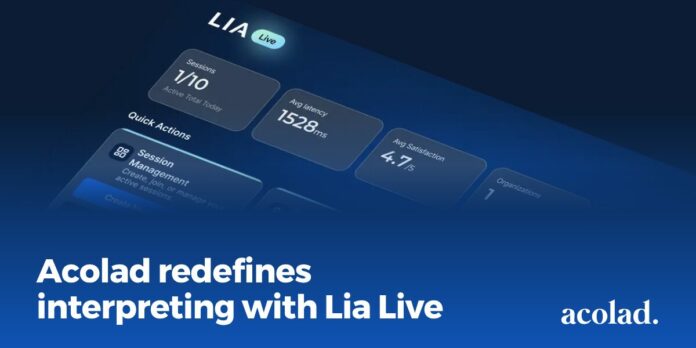
Acolad, a global leader in language and content solutions, has announced the launch of Lia Live, the first omnichannel interpreting platform that combines real-time AI-augmented interpreting with professional interpreters in a single, secure solution.
Part of the Lia ecosystem, Lia Live helps organizations meet constant, around-the-clock demand for multilingual communication, at a moment when AI deployment is rapidly progressing, but human oversight remains essential in sensitive settings. For enterprises and public sector organizations, choosing between speed and trust is no longer an option. They need both AI and human, orchestrated together in one hybrid model.
“Lia Live gives organizations the flexibility to design and manage multilingual communication in the way that best suits their needs – whether AI-first, human-led, or through a blend of both,” said Giulia Silvestrini, Head of Global Interpreting at Acolad. “Combined with advanced analytics, terminology management, and continuous quality monitoring, the platform helps organizations communicate consistently and confidently across every interaction, channel and scale.”
Designed for speed, usability, compliance and intelligent automation
AI is making interpreting faster, more scalable, and more accessible. But when complexity, risk, or sensitivity increase, human judgment and accountability remain irreplaceable.
Lia Live runs real-time AI interpreting in 50+ languages, with live captions and AI voices, and professional interpreters step in when the stakes rise.
With one login, one SLA, and one reporting view, organizations gain full visibility and control across every interpreting need, through a single accountable partner.
Built for governance and compliance
As AI adoption accelerates, organizations face increasing regulatory and governance requirements. Frameworks such as the EU AI Act are raising expectations around transparency, accountability, and human oversight.
Lia Live is designed to meet these requirements, with compliance and control mechanisms embedded directly into the platform – rather than being add-ons. Backed by Acolad’s ISO 27001 and SOC 2 Type II certifications, with GDPR compliance and governance measures aligned with the EU AI Act, the platform provides built-in auditability, encryption, access controls, and activity logging to support data protection in regulated environments.
The platform also integrates easily into existing systems. It is accessible via web, mobile, telephony, and APIs, so language access lives directly inside existing workflows.
Part of the growing Lia ecosystem
Lia Live is the latest addition to Acolad’s expanding portfolio of AI-powered language solutions and an important milestone in the evolution of the Lia ecosystem. Together, the solutions within Lia help organizations manage an increasingly broad range of language needs through a connected, AI-enabled experience.
The launch reflects Acolad’s broader vision for the future of language services:
“AI plays an increasingly important role in multilingual communication, but technology alone is not enough,” added Stéphane Cinguino, Chief AI & Technology Officer at Acolad. “The future belongs to solutions that combine innovation with human expertise, giving organizations the flexibility to scale while maintaining trust. Lia Live is a reflection of that vision.”
With Lia Live, Acolad continues to redefine multilingual communication – combining technology and human expertise to help organizations communicate more effectively across languages, channels, and markets.
About Acolad
Acolad is the global leader in content and language solutions. Its mission is to support companies in every industry to scale across markets and enable growth through cutting-edge technology and localization expertise. Established in 1995, the group is present in 22 countries across Europe, North America, and Asia, with over 1,400 employees supported by a network of +10.000 linguists around the world. www.acolad.com
Into23, a multilingual AI‑operations company, has officially announced its new AI Language Operations portfolio, introducing three dedicated service lines: Into23 Verify+, Into23 Data+, and Into23 Voice+.
The announcement marks a significant evolution for Into23, building on its localization and language-services heritage to help enterprises manage multilingual content, AI data, and voice production at a global scale.
As organizations adopt AI across customer experience, training, content creation, and product development, the challenges of quality, cultural accuracy, and governance have become more complex. Into23’s new portfolio is designed to address those challenges by combining AI-enabled workflows with expert human oversight.
“When we founded Into23, our mission was to help organizations communicate across languages and cultures. That mission hasn’t changed. What has changed is the technology. Today, enterprises need partners who can combine AI-driven scale with human expertise, quality assurance, and governance. Verify+, Data+, and Voice+ are the next evolution of that vision,” said Richard Delanty, Founder and CEO, Into23.
The new portfolio includes:
Into23 Verify+: AI translation with human verification, helping organizations accelerate multilingual content production while maintaining quality, consistency, and accountability.
Into23 Data+: Multilingual data services for AI training, evaluation, safety, and model improvement, including transcription, annotation, human feedback, and evaluation workflows.
Into23 Voice+: Multilingual voiceover and eLearning production services, combining AI-powered workflows with native-speaker quality review for global audiences.
The announcement builds on Into23’s established experience supporting enterprise clients across Asia-Pacific and global markets. The company combines localization expertise, AI-enabled operations, and ISO-governed delivery processes to support organizations operating across multiple languages and regions.
The launch also introduces Into23’s new positioning: “The Bridge Between AI Speed and Human Accuracy.”
For nearly a decade, Into23 has helped organizations communicate across languages and cultures. Today, the company is expanding that mission to help enterprises navigate the growing intersection of language, AI, and human expertise.
With operations across the APAC region and support for over 100 languages, Into23 serves organizations across various sectors, including technology, healthcare, legal, life sciences, e-commerce, training, media, and AI.
About Into23
Into23 is a global language services company with offices across Southeast Asia, specializing in translation, localization, multilingual content, AI data, and voice solutions across more than 100 languages. Combining AI-enabled workflows with expert human oversight and ISO-governed delivery, Into23 helps enterprises scale multilingual communication and AI initiatives across diverse markets.
Globibo, a Singapore-based provider of language services and event technology solutions, has announced a new capability within its Events.Studio AGM platform that integrates live polling, multilingual captions, and real-time voting results directly into Microsoft PowerPoint presentations. The solution has already been successfully deployed across multiple events over the last six months.
The new functionality is designed to address one of the most common challenges in meetings, Annual General Meetings (AGMs), town halls, and hybrid events: keeping audiences informed, engaged, and aligned while critical decisions are being made.
Traditionally, live polls and voting results are displayed in separate applications, on event platforms, or via video mixing systems. This often creates a fragmented experience for presenters and participants alike. Switching between slides, polling systems, and external displays can interrupt meeting flow, increase AV complexity, and create confusion among attendees.
Events.Studio eliminates this challenge by allowing presenters to display secured, personalized, and weighted voting results directly within Microsoft PowerPoint slides. Poll outcomes can appear instantly as charts, graphs, or text-based results without requiring presenters to leave their presentation environment. The result is a smoother, more engaging experience in which audiences can view live responses and decisions as they happen.
“Meetings should focus on communication and decision-making, not on managing multiple technology platforms,” said V Vignesh, Director of Business Development at Globibo. “By integrating live polling directly into Microsoft PowerPoint, we simplify the presenter experience while making audience participation more immediate and transparent.“
Beyond displaying poll results, Events.Studio introduces another important innovation: multilingual captions and poll questions embedded directly into PowerPoint presentations.
In many international meetings and AGMs, participants are expected to vote on important matters that may only be presented in a single language. While interpretation services help bridge language gaps, attendees can still struggle to follow complex poll questions, resolutions, or voting instructions in real time. Events.Studio addresses this challenge by displaying live captions and poll content simultaneously in multiple languages within the presentation itself.
The integrated solution offers several practical advantages for organizers, presenters, and participants.
For presenters and organizers:
Simplifies event production and AV workflows
Reduces reliance on external display systems and video mixers
Displays live polling results without interrupting presentations
Improves audience engagement throughout sessions
Enables real-time feedback collection and decision-making
For attendees:
Clear understanding of poll questions in their preferred language
Live captions that provide context before and during voting
Equal participation opportunities for multilingual audiences
Better alignment between remote and in-room attendees
Increased confidence in voting and decision-making processes
As presenters advance through their slides, audiences can view translated captions and poll questions directly within the slide footer, ensuring participants understand the context behind every decision, vote, and discussion point. This creates a more inclusive experience for multilingual audiences and helps ensure that voting outcomes are based on genuine understanding rather than assumptions.
“Voting should reflect informed decisions,” explained Mr. Zain Ali Shah from Globibo’s product development team. “By bringing multilingual captions and polling directly into PowerPoint, we help attendees follow discussions, understand questions, and participate confidently in their preferred language. This becomes particularly valuable in AGMs, shareholder meetings, and global corporate events where accuracy and transparency are essential.“
Organizations conducting shareholder votes, board approvals, policy discussions, and strategic decision-making sessions often face the challenge of ensuring that every participant fully understands the information being presented. By combining live captions, multilingual support, and integrated polling within a familiar presentation environment, Events.Studio helps reduce ambiguity and improve the quality of participation.
As organizations continue to embrace global collaboration and hybrid participation models, the need for clear, inclusive, and trustworthy decision-making tools grows. With the introduction of live multilingual polling and captions within Microsoft PowerPoint, Events.Studio takes another step toward making meetings more accessible, interactive, and efficient.
By combining audience engagement, multilingual communication, and real-time decision support within a single presentation workflow, Globibo Events.Studio transforms traditional slide decks into dynamic, participatory experiences where every attendee can understand, engage, and contribute with confidence.
About Globibo
Globibo delivers fast, cost‑efficient language services, conference interpretation, and translation supported by event technology and corporate training. Its platforms — Events.Studio, Link.Studio, and Localize.Studio — help organizations engage audiences, enhance communication, and maximize the potential of people, content, and events across global markets.
The Supreme Court of Canada has ruled that New Brunswick’s lieutenant-governor must be able to perform the duties of the office in both English and French, concluding that appointing a monolingual representative of the Crown violates the province’s constitutional language guarantees.
In a 6–3 decision released Friday June 12, the Court found that section 16(2) of the Charter requires the lieutenant-governor to understand and communicate in both official languages when carrying out their functions. The majority held that the office is “a unipersonal and highly symbolic institution” whose occupant cannot be separated from the institution itself, and that appointing a monolingual person undermines the equality of status guaranteed to English and French in New Brunswick’s public institutions. The Court’s Case in Brief is available here.
The case stemmed from the 2019 appointment of Brenda Murphy, who did not speak French at the time. The Société de l’Acadie du Nouveau-Brunswick challenged the appointment, arguing that it breached the Charter’s language protections. While the Court agreed that the Charter imposes a requirement of personal bilingualism, it declined to invalidate Murphy’s appointment, issuing instead a declaration clarifying the constitutional obligations for future appointments.
Chief Justice Richard Wagner, writing for the majority, emphasized New Brunswick’s unique constitutional framework as Canada’s only officially bilingual province. The ruling states that equality of status has both functional and symbolic dimensions, and that the lieutenant-governor’s role requires embodying that equality in person.
Three justices dissented. Justice Malcolm Rowe wrote that the Charter establishes institutional bilingualism, not personal language requirements for office holders. He warned that the majority’s reasoning could extend similar obligations to other public officials, including premiers, cabinet ministers, or federal representatives, a result he said would amount to constitutional amendment through interpretation.
New Brunswick Premier Susan Holt welcomed the decision, saying it aligns with her government’s position that both the office and its holder should be bilingual. Murphy, who worked to improve her French during her tenure, was succeeded in 2025 by Louise Imbeault, who is bilingual.
This website uses cookies to improve your experience. We'll assume you're ok with this, but you can opt-out if you wish. Cookie settingsACCEPT
Privacy & Cookies Policy
Privacy Overview
This website uses cookies to improve your experience while you navigate through the website. Out of these cookies, the cookies that are categorized as necessary are stored on your browser as they are essential for the working of basic functionalities of the website. We also use third-party cookies that help us analyze and understand how you use this website. These cookies will be stored in your browser only with your consent. You also have the option to opt-out of these cookies. But opting out of some of these cookies may have an effect on your browsing experience.
Necessary cookies are absolutely essential for the website to function properly. This category only includes cookies that ensures basic functionalities and security features of the website. These cookies do not store any personal information.
Any cookies that may not be particularly necessary for the website to function and is used specifically to collect user personal data via analytics, ads, other embedded contents are termed as non-necessary cookies. It is mandatory to procure user consent prior to running these cookies on your website.