Iyuno Deploys SDVI Rally Platform to Accelerate and Scale Its Global Media Services and Localization Workflows

0
SDVI and Iyuno partnership

SDVI, a leading platform provider for cloud-native media supply chains, has announced that the company’s Rally platform has been deployed by Iyuno Media Group to accelerate and scale its industry-leading media services and localization operations.

Iyuno is leveraging the Rally media supply chain management platform to standardize workflows and to drive more efficient ingest, processing, and distribution of content, vastly enhancing its capacity to take on complex, high-volume media processing and migration projects, as well as its speed in handling end-to-end localization workflows across 45 studios in 29 countries. Iyuno’s shift from a siloed approach to a cloud-native pipeline has also narrowed security vulnerabilities, reinforcing the company’s status as a content security leader.

“Iyuno operates at a scale and speed that make consistency and coordination critical,” said Chase Logan, vice president of global media operations at Iyuno Media Group.

“Enabling us to standardize workflows and centralize processing in the cloud, Rally has significantly improved the efficiency of our localization services. Because the platform orchestrates and automates routine processes, our teams working worldwide can immediately focus on creative tasks and turn around content more quickly. For migration and other large-scale processing projects, Rally has allowed us to increase throughput and handle projects that previously would have been impossible to execute.”

Uniting supply chain orchestration, resource management, and a robust array of application services, Rally dynamically provisions infrastructure and aligns resources to active workloads. The platform’s extensive ecosystem of integrated tools and application services enables media organizations such as Iyuno to build workflows without the overhead of redundant on-premises infrastructure across distributed locations.

For Iyuno’s media services, Rally supports high-volume content processing and migration projects, where assets are ingested from client systems, validated, normalized, and delivered back in the required formats. These cloud-enabled workflows allow Iyuno to handle projects involving tens of thousands of titles and delivery rates of roughly 2,500 assets per week in a consistent, repeatable way. For localization services, Rally automates the preparation and movement of content — including proxy generation, subtitle workflows, watermarking, and distribution to studios worldwide — so that creative teams can begin work quickly and operate against a shared, standardized pipeline.

“While helping us to streamline operations across our localization and media services, Rally also allows us to integrate much more directly into our customers’ operations,” said Iyuno CTO Allan Dembry.

“Rather than work at arm’s length, we connect into their systems, build workflows around their requirements, and move content through the process with far greater visibility and control. That level of integration changes how we collaborate with customers and how quickly we can respond to new demands.”

About SDVI 

SDVI is a media‑technology company specializing in cloud‑based media supply chain optimization. It helps broadcasters and content owners streamline operations, reduce costs, and accelerate delivery through agile, data‑driven workflows. With deep industry expertise and award‑winning innovation, SDVI enables modern media organizations to adapt quickly and operate with greater efficiency, transparency, and sustainability. 

About Iyuno

Iyuno is a leading provider of localization services for the media and entertainment industry. Trusted by top entertainment brands and creators worldwide, Iyuno offers comprehensive end-to-end localization services from 45 offices across 29 countries. Backed by a team of exceptional creative and technical talent, state-of-the-art facilities, and cutting-edge technologies, Iyuno proudly boasts the largest global footprint amplifying its dubbing, subtitling and media services offerings. 
Why We Throw Away Our Best Localization Data (And How to Fix That)

0
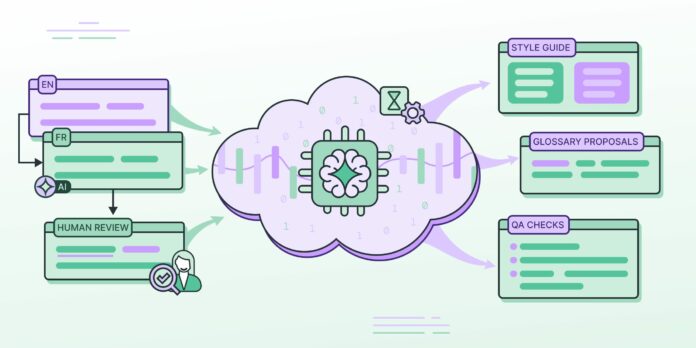
Crodwin Dreams animated flow chart

Every night, while you sleep, your brain performs a critical function: it filters the day’s data. It replays hours of raw information, stripping away noise to identify key “signals”. This process, known as memory consolidation, is how your brain converts chaotic experiences into patterns and rules.

In the localization industry, we are currently doing the opposite. We are caught in a loop of repetitive effort, effectively refusing to learn from our own successes.

Missing Feedback Loop

In the AI-driven translation workflow, a familiar ritual takes place:

  1. Source text is fed to the LLM.
  2. AI output is generated.
  3. A human reviewer makes a decision – correcting a term, shifting a tone, or fixing a placeholder.

This third step is the most valuable data point in the entire chain. It is a goldmine for AI. Yet, in almost every standard workflow, this information is used once and then discarded. The editor fixes the string, the file is exported, and the insight vanishes. When the next string arrives, the AI makes the same mistake again.

Technically, you could prevent this by updating your AI prompt after every edit, but doing that manually is impossible. Most linguists don’t even have access to the prompts, and relaying every minor correction to a manager to “tweak the settings” creates a mountain of extra work.

At Crowdin, we started asking: What if the system just did that work for you?

Introducing Crowdin Dreams: Memory Consolidation for Content

We have begun experimenting with a background process we call Crowdin Dreams. Much like the human brain during REM sleep, “Dreams” watches human edits as they happen in real-time. It doesn’t just store them, but it tries to surface the patterns your team already knows but has never had the time to write down.

Instead of a static database, Dreams acts as an analytical layer that proposes:

  • Organic glossaries: Bilingual term candidates identified by consistent human usage.
  • Inferred style guides: Tone and register shifts detected across hundreds of edits.
  • AI Pipeline improvements: Suggestions to modify AI prompts or add logic steps to the translation chain.
  • QA checks: Custom rules for punctuation and formatting based on target-language conventions.

Practical Case in a Gaming Project

To test this, we looked at one of the hardest puzzles in the industry: game localization. Games are notorious for short, fragmented strings and a complete lack of visual context.

We ran an experiment using a small sample – just 150 strings (roughly 7% of the total project), consisting of AI translations and subsequent human post-editing. The results suggest that “data dreaming” can transform a project’s trajectory almost immediately.

Insight Category Problem Crowdin Dreams Solution
Structural Logic `”Meet Frank at the [location]”` – placeholders like [location] failed in locative-case languages. Identified a linguist’s trick of re-ordering strings (e.g., “[location]: Meet Frank”) and proposed it as a new style guide rule.
Punctuation AI mimicked source trailing periods that felt “wrong” in the target culture. Detected consistent deletions by editors and proposed to add a new QA check.
Terminology Inconsistent naming of in-game items. Extracted dozens of high-confidence glossary candidates from editorial choices.


Even with a tiny data set, the system began to understand what “acceptable” looked like for that specific project.

The Future of “Active” Localization

We aren’t publishing a release date or hard metrics just yet. Crowdin Dreams is currently an internal experimental technology, and it raises fascinating philosophical questions. For instance, if the system learns a better way to translate halfway through a project, should we go back and “correct” the unreviewed strings automatically?

We believe the best way to answer these questions is through real-world application. We are currently looking for early adopters – teams using the Crowdin AI Pipeline whose policies allow for this type of research. If you are ready to experiment, contact us!

We are moving toward a future where human review doesn’t just fix a single sentence, but teaches the entire ecosystem how to be smarter. It’s time we stop throwing away our data and start dreaming.

Interpreters Unlimited Debuts AI Assistants to Enhance Customer and Linguist Experience

0
Interpreters Unlimited Group and IU branded companies

Interpreters Unlimited (IU), a leading national provider of language services, has announced the launch of a new suite of AI powered assistants designed to streamline communication, simplify workflows, and enhance the overall experience for both customers and linguists.

The newly introduced IU AI Assistants bring intelligent, real-time support directly into the hands of users through a simple, conversational interface, making it easier than ever to access critical information, manage appointments, and navigate the platform without friction. At the heart of the launch are two primary tools, the Client AI Assistant, built for customers, and the Linguist AI Assistant, designed specifically for interpreters and translators.

For organizations and individuals relying on language services, time and clarity are critical. The Client AI Assistant allows users to instantly retrieve important appointment details, ask platform related questions, and get guided support 24/7 without having to search through multiple pages or wait for assistance.

Using natural language, customers can ask questions such as, “Show my upcoming events”, “Give me upcoming events in California”, or “How do I reset my password” etc. The assistant then delivers clear, relevant answers in real time, pulling directly from system data and trusted knowledge sources.

For interpreters and translators, the Linguist AI Assistant introduces a faster, more intuitive way to manage daily workflows. From viewing and accepting assignments to submitting timesheets and accessing event details, linguists can now handle essential tasks through a single conversational interface. Key capabilities include viewing upcoming, ongoing, and past assignments, accessing detailed event information (date, time, location, language), accepting assignments directly through the assistant, completing and submitting timesheets, payment related questions etc.

Both the Client and Linguist AI Assistants operate through two intuitive modes. Appointment Mode, which provides real-time access to event and scheduling information, and General Mode, which answers common questions and provides platform guidance. This dual-mode approach ensures users can quickly get the information they need, whether it’s related to a specific assignment or general support.

Users can access the AI Assistants in the main navigation menu of interpreters.com and create a secure account with an email and password, ensuring a personalized and protected experience.

“The goal was simple,” said Interpreters Unlimited CEO Shamus Sayed. “We wanted to remove friction, so whether you’re a customer needing quick answers or a linguist managing your schedule, everything is easier, faster, and more intuitive.”

In addition to customer and linguist tools, IU has also developed an internal AI Assistant for staff, designed to enhance day-to-day operations for the IU team, improving response times, and increasing overall efficiency across the organization.

With the launch of these AI Assistants, Interpreters Unlimited continues to expand its investment in technology, combining human expertise with intelligent tools to better serve a diverse and multilingual world. As demand for fast, accessible communication grows across industries, IU’s latest innovation reflects a broader shift toward smarter, more responsive language solutions. Try the IU AI Assistants today at interpreters.com.

About Interpreters Unlimited, Inc.

The IU Group of companies include: Interpreters Unlimited, Accessible Communication for the Deaf, Albors & Alnet, Arkansas Spanish Interpreters and Translators, and IU GlobeLink, LLC, and are headquartered in San Diego, California as a minority-owned company.  IU Group is committed to providing equal opportunity in the work environment with its diverse team to aid in supplying linguistic and cultural interpretation services to clients. A combined 70 years in the industry has demonstrated a surplus of leadership and best practices, which has helped establish its respected role in the language services community. Its services include interpretation, document translation and non-emergency medical transportation.

2026 Nimdzi 100 Report Published and Free to Access

0
Nimdzi 2026 100 ranking report cover

Nimdzi Insights has announced the official publication of the Nimdzi 100 2026. This flagship report provides the industry’s most comprehensive ranking of the world’s largest language industry providers and a deep-dive analysis of market trends, size, and future projections.

As the language industry faces a transformative era defined by rapid AI integration and shifting global economic pressures, the 2026 Nimdzi 100 serves as a critical compass for stakeholders and a benchmarking tool for providers. The report goes beyond simple revenue rankings, offering an autopsy of the previous year’s performance while forecasting the trajectory of the $72.6 billion market.

“It’s extremely satisfying to build a report on extensive data, interviews, and a deep understanding of our industry,” said Marjolein Groot Nibbelink, Nimdzi 100 Program Lead. “Comparing the results to the general sentiments shared online sometimes match, and sometimes contradict. Finding the truth and sharing it is not only rewarding, but it feels important in today’s business environment.”

The report, which has a 14,000 word count, covers key trends, M&A, an extensive market analysis, 35 charts and graphs, industry size and growth projections, technology shifts, and an atlas of growth, market share, and where the clients are. The report is best known for its ranking of the 100 largest providers, which includes language service providers (LSPs), language technology providers (LTPs), and interpreting companies. Print copies can be requested at Nimdzi-100@nimdzi.com.

About Nimdzi Insights

Nimdzi Insights is a market research and consulting firm focused on the language services industry, localization programs, and language technology. Nimdzi helps clients worldwide make informed decisions about their international growth strategies through data-driven insights and expert analysis.

3Play Media Launches AI Dubbing Solution for YouTube Creators Ready to Go Global

0
3PlayMedia logo

3Play Media, a leader in video accessibility and localization, has announced an AI Dubbing solution purpose-built for YouTube creators. The company, whose accessibility and localization work spans major broadcasters and streaming platforms, is now bringing that enterprise-grade expertise directly to the creator community.

The solution combines AI-enabled, human-reviewed dubbing workflows with a built-in analytics layer that helps creators understand which content to localize, in what languages, and why — turning international growth from a guessing game into a data-informed strategy.

“We’ve spent over 15 years building human-in-the-loop workflows at scale. Now we’re bringing that same rigor to creators so they can see exactly where their audience is, dub the right content, and know whether it’s working,” said Josh Miller, Co-founder and Co-CEO of 3Play Media.

Creators have the potential for more global reach than ever. YouTube reports that over 40% of watch time on dubbed videos comes from viewers who don’t speak the original language. However, local language translation only adds value if the dub is good enough to earn and hold international viewers’ attention, not just reach them.

For most creators, capturing new local-language audiences has been frustratingly out of reach. Pure AI dubbing services, including platform-native tools like YouTube’s auto-dubbing feature, can produce outputs that sound robotic with the potential to damage brand perception. Traditional localization vendors deliver quality at price points and timelines designed for studios, not creator teams. And nearly every option on the market delivers a file with no insight into whether it actually helped grow their channel.

The result? most creators who’ve tried dubbing have stopped, and most who haven’t are afraid to start — not because global audiences aren’t there, but because no one has given them the data, the strategy, or accountability for whether the investment actually works.

3Play Media’s creator solution is designed to close that gap. The service acts as a localization manager for creator teams, offering channel analytics, language prioritization, voice casting, cultural adaptation, and delivery directly to YouTube. Multiple service tiers let creators match the right level of production to the right content — whether they’re testing a new language market or investing in their highest-performing videos.

Every dubbed video goes through a process that includes human-verified scripting, culturally adapted dialogue, and voice production ranging from AI-generated voice clones of the creator’s own voice to a curated library of native-language synthetic voices. The depth of human involvement scales with the tier, but the human-in-the-loop core stays the same.

“The creator economy doesn’t need another AI tool that produces a file and disappears,” said Chris Antunes, Co-founder and Co-CEO of 3Play Media. “What creators and their teams actually need is a partner who combines the speed of AI with the judgment of real people and then shows them the data on what’s working. That’s what we’ve built. The AI makes the workflow fast and scalable. The humans make the output something a creator would actually put their name on.”

The solution connects directly to a creator’s YouTube channel data, analyzing views, watch time, and revenue by geography to identify where international audiences exist and what content is worth localizing next. Early pilots with established YouTube creators are showing promising results in new geographic markets, with creators using the analytics to make smarter dubbing decisions.

“The biggest challenge for creators going global isn’t finding a dubbing vendor, it’s finding a partner who actually understands what it takes to make localization perform on YouTube,” said Luke Hale, Head of Media at CrunchLabs. “Most solutions hand you a dubbed file and call it done. What creators need is someone who knows the data, knows the platform, and can tell them not just how to dub, but what to dub and why. And ultimately, someone who understands that the dub itself has to be genuinely delightful — something audiences actually enjoy, not just tolerate. That’s the gap 3Play is filling.”

Creator teams and channel managers interested in exploring how AI dubbing can support their international growth strategy can learn more at www.3playmedia.com/solutions/youtube-dubbing. 3Play Media will also be demonstrating its dubbing solutions at the NAB Show in Las Vegas this April.

About 3Play Media

3Play Media, headquartered in Boston, is an accessibility‑driven video technology and services company that provides captioning, transcription, audio description, and localization services powered by human expertise and intelligent automation. The company helps organizations create accessible, searchable, and compliant video content at scale, supporting education, enterprise, and media teams with reliable workflows and rigorous quality standards.

CoSET SAFE AI Task Force Proposes a Risk Framework for Automated Interpreting at SLxAI Summit

0
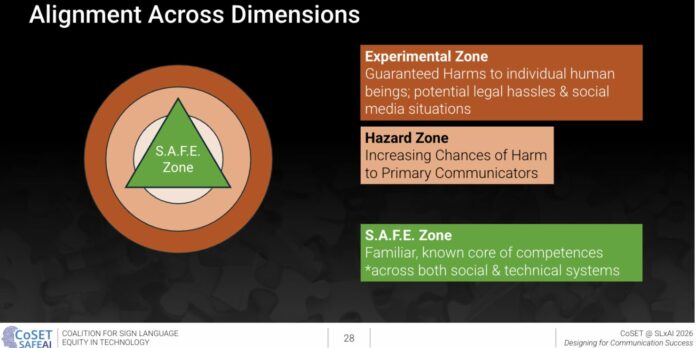
CoSET's SAFE zone diagram explain

The Coalition for Sign Language Equity in Technology (CoSET) is an independent advocacy group dedicated to ensuring that Deaf perspectives are central to the development and implementation of artificial intelligence (AI). Formed to bridge the gap between rapidly evolving tech and the actual needs of signing communities, CoSET focuses on sign language equity as the leading edge case for AI-driven interpreting and translation tools.

A cornerstone of its recent work is the AI Interpreting Solutions Evaluation Toolkit Part A: Organization, Implementation, and Management, developed in collaboration with Stakeholders Advocating for Fairness and Ethics in Interpreting, known as the SAFE AI Task Force. This set of checklists provides a standardized way for organizations to assess the quality, safety, and ethical implications of automated interpreting tools. To assess the hype of new AI releases, Part A of the Toolkit helps buyers and vendors evaluate whether a service can truly provide high-quality, accountable communication — prioritizing the “Deaf-Safe” principle where technology expands access without creating harmful or dangerous miscommunications.

The framework will be presented at the SLxAI Summit 2026 in April.

CCI Group Selected for Sourcewell’s Inaugural Language Services Contract Category

0
CCI Group logo
CCI Group, an Orlando-based language services company, has been awarded a Sourcewell cooperative purchasing contract, becoming one of only 10 providers selected nationwide for this newly created category.
Sourcewell, one of North America’s largest cooperative purchasing organizations, created its first language services contract category, Accurate Language Services, in response to growing demand for language access in government services – from emergency response and public health to education and social services. The competitive selection process drew over 60 applicants from across the United States and Canada.
“Language access is no longer optional infrastructure for government entities; it’s essential,” said Indy Vega, President and CEO of CCI Group. “This is very exciting for all of us in the industry, not just for us. Sourcewell’s decision to create this category shows that language access has earned its place alongside essential services like IT, security, and emergency response.”
The contract enables more than 50,000 government agencies, educational institutions, and nonprofits across the United States and Canada to access CCI Group’s services in over 350 languages without conducting individual competitive bidding processes. This streamlines procurement cycles from months to weeks while ensuring compliance with Title VI of the Civil Rights Act and other language access requirements.
Founded in 2012, CCI Group has grown from court interpretation services into a full-service language solutions provider serving federal agencies, including FEMA, USAID, and USDA. The company holds SBA 8(a), Woman-Owned Small Business (WOSB), and Economically Disadvantaged Woman-Owned Small Business (EDWOSB) certifications, along with a GSA Schedule contract.
“Our work responding to Hurricanes Irma and Ian with FEMA exposed critical gaps in how government entities access language services during emergencies,” Vega explained. “Cooperative purchasing addresses this challenge by pre-qualifying providers so agencies can mobilize language support immediately when communities need it most.”
Indy Vega, CCI Group’s President and CEO was named a 2024 MultiLingual Industry Influencer and received the 2022 SBA Small Business Person of the Year Award for Florida. Vega, a Colombian-American entrepreneur, founded the company after working as a practicing court interpreter and forensic linguist. 
The Sourcewell contract has a five-year term with opportunities for renewal. Participating entities can access the contract immediately without additional procurement processes.

About CCI Group

CCI Group (Indy Interpreting Services Inc.) is an Orlando-based language services company providing interpretation, translation, and language solutions in over 350 languages. Serving federal agencies, education, healthcare, and government clients, CCI Group maintains SBA 8(a), WOSB, EDWOSB certifications, a GSA Schedule, and Sourcewell contract #081225-IDY. The company operates a network of over 10,000 linguists across North America through its U.S. headquarters and Colombian subsidiary, Globika.

The Week in Review: Language Industry News April 7-13 

0
Week in Review April 7-13

This week’s stories highlight a common thread: widening access, deepening equity, and modernizing the infrastructure of multilingual communication. From federal recognition efforts and K–12 funding to Indigenous language revitalization, enterprise rebranding, and real‑time AI subtitles, the field is expanding in both scope and ambition.

Product Expansion

South Korean startup Elnino has launched Knoc, a real‑time AI subtitle service designed as a low‑cost alternative to traditional simultaneous interpretation for universities, conferences, and mid‑sized organizations. The platform uses a 30‑second contextual memory window to produce stable, non‑flickering subtitles, supports 101 languages with domain‑specific models, and adapts to classrooms, large events, and online meetings under a “Data Zero Retention” policy. Early pilots in Korean academic settings reported strong user approval, and Knoc is now available via pay‑as‑you‑go pricing, institutional plans, and a free trial.

Welocalize has launched Welo Global as the new parent brand overseeing specialized client‑focused brands — Welocalize, Adapt, Park IP, Welo Data, and the newly introduced Welo Life Sciences. The move represents a strategic shift toward segment‑specific expertise rather than a single localization‑centered identity. According to the company, the reorganization is in response to enterprise demand for partners with deep capabilities across different domains, allowing each brand to maintain its own positioning, technology, and go‑to‑market strategy. 

Community and Awards

The Department of Defense Education Activity has opened applications for FY26 World Language Advancement and Readiness Program (WLARP) grants, offering $500,000 to $2 million for up to five years for qualifying school districts. The grants aim to expand K-12 world language programs, particularly in federally designated “strategic languages,” through early‑learning initiatives, immersion models, technology‑enabled instruction, and cross‑curricular integration. Framed as a national‑security investment, the program encourages eligible districts to apply by April 24 with resources and sample submissions available online.

Kū‑A‑Kanaka’s EA Ecoversity has secured a three‑year federal grant to develop LEO, a mobile‑friendly Hawaiian language program designed to help Native Hawaiian learners build real‑world conversational fluency through interactive, culturally grounded experiences. A response to decades of community requests for accessible, non‑grammatical approaches to reconnecting with ʻōlelo Hawaiʻi, the program includes roughly 125 hours of engagement through avatars, videos, and game-like activities. The project aims to expand access, support revitalization efforts, and offer micro‑credentials for learners who complete the program.

Sydnee Cooper examines how April became a long‑standing focal point for language‑access advocacy well before Congress introduced a 2026 resolution proposing it as National Language Access Month. Multiple states, along with advocacy groups and industry organizations, helped establish April as a de facto awareness month through years of campaigns and policy work. Framing language access as a civil‑rights issue with direct consequences for health, safety, and civic participation, the piece argues that the federal resolution represents a late but meaningful acknowledgment of a movement built from the ground up.

____________________________________________________________________________________________________________________________________________

Across this week’s stories, the industry’s momentum is unmistakable: language access is expanding, multilingual infrastructure is diversifying, and AI‑driven tools are reshaping what “real‑time communication” can mean. Whether through federal recognition, Indigenous revitalization or enterprise restructuring, the field continues to push toward broader inclusion and more adaptive multilingual systems.

For more stories like these, visit our News section.

Language Testing International Awarded Sourcewell Cooperative Contract Expanding Opportunities in Government Procurement

0
LTI's Sourcewell contract award label

Language Testing International® (LTI), the exclusive licensee of ACTFL® assessments and a global leader in language proficiency testing, has announced it has been awarded a Sourcewell cooperative purchasing contract within the Language Services category. This milestone enables LTI to expand access of ACTFL language assessment solutions to public agencies across United States and Canada.

Sourcewell, a self-funded governmental organization established in 1978, facilitates a cooperative purchasing program that harnesses the collective purchasing power of more than 50,000 participating agencies. By streamlining procurement with competitively solicited contracts, Sourcewell empowers government, education, and non-profit organizations to secure efficient and cost-effective solutions that support compliant purchasing.

LTI secured the Sourcewell contract through a rigorous competitive process, demonstrating full compliance with public procurement standards while delivering exceptional value, service, and technical expertise. Through this partnership, public agencies can now access LTI’s comprehensive portfolio of ACTFL language assessments via a ready-to-use, Sourcewell-vetted contract, streamlining the lengthy traditional bid processes and accelerating implementation.

ACTFL assessments are the gold standard for assessing language proficiency and performance and are used worldwide by academic institutions, government agencies, and private corporations for purposes such as academic placement, student assessment, program evaluation, professional certification, hiring, and promotional qualification.

“We are honored to be awarded a Sourcewell contract and to expand our ability to serve public agencies and academic institutions with greater efficiency,” said Kim Sallee, Chief Executive Officer at Language Testing International. “This partnership removes procurement barriers, making it easier for organizations to access the gold standard in language testing with ACTFL assessments.”

Through this contract, government agencies and academic institutions can seamlessly integrate ACTFL assessments, delivered by LTI, into curriculum development, Seal of Biliteracy attainment, academic placement, certification, hiring, and workforce development initiatives, ensuring that language proficiency is measured accurately, consistently, and in alignment with real-world communication demands.

For more information, including how to utilize LTI’s Sourcewell contract, please visit: Language Testing International – Sourcewell Contract Page

About Language Testing International (LTI)

Since 1992, Language Testing International (LTI) has been a leader in language proficiency testing for more than 120 languages in over 60 countries, delivering over a million tests annually. LTI is the exclusive licensee of ACTFL, a leader in development of proficiency-based teaching and testing solutions. ACTFL assessments, delivered by LTI, are widely recognized and accepted by major corporations, academic institutions, and government agencies. The tests administered by LTI come in all formats and include speaking, reading, writing, and listening. Each test is designed to properly determine the specific proficiency level of an individual and to ultimately provide a valid and industry-recognized language credential.