

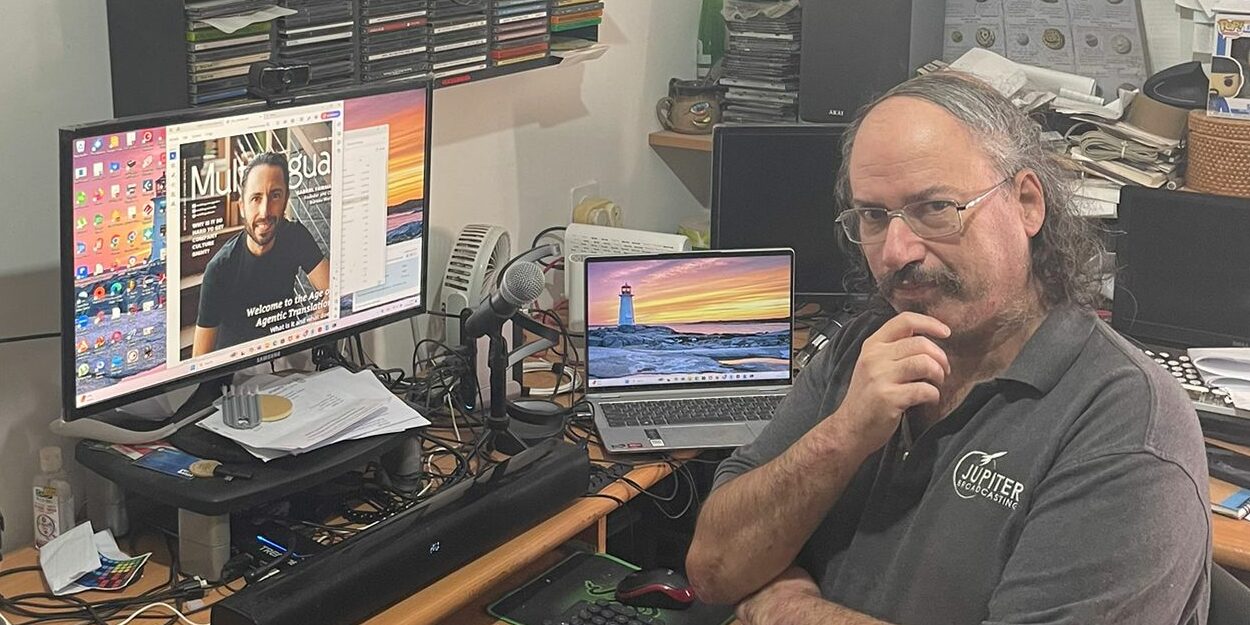
An expert in both Hebrew ↔ English translation and software development, Uri Bruck believes in continually growing his skills and taking on new challenges — whether that means embracing emerging technology or getting involved in professional associations and events.
Why do you enjoy reading MultiLingual magazine?
It informs me about things that happen in the translation industry, and tells me niches and aspects of the industry that I’m not necessarily familiar with.
How did you get involved in the translation business?
I started translating as a student, for students. I discovered that I enjoyed it, and I got favorable feedback not just from the students, but also from their professors. My grandfather was a translator and wrote a lot about language. I have a few more translator relatives. That also encouraged me to take it more seriously. And then a translator from my neighborhood saw a translation I did for family, of a text about my mother’s art exhibition, and suggested I might enjoy studying translation. I enrolled, and I did enjoy it. For me, translation studies helped transform me from someone who translates into a translator.
Since you entered the translation industry, how has the business landscape changed?
As a freelancer, I probably glimpse only parts of the business landscape. In recent years, quite a few small agencies I used to work with have become part of larger companies.
Marketing myself has changed. One of the most brilliant marketing directors I ever worked with told me once, “There is no such thing as marketing — it’s all communications.” Thus, I should really say that communication has changed. You need to be more creative about communicating who you are and what you do to get noticed.
Could you share your experience working with your first client or on your first project?
I can’t remember the very first project, but some of my early translations were text by and about artists who were second-generation Holocaust survivors. I could relate to many of the issues and themes, because they had a lot in common with my own family history.
One thing about art texts in general, and specifically those, was that I had to resist the translator’s instinct to add notes and explanations. Artists already expose themselves through their art. They chose how much to expose. What they write about themselves and their art, or what a curator or another writer writes about them, is all within the sphere of what they chose to put out there. Those translations require the translator to be sensitive and not over-expose what the artists chose not to. What’s implied should stay implied. What’s between the lines should stay between the lines.
Do you believe it’s a good time to enter the translation business?
I think it’s a very exciting time to enter the translation business. I’ve been translating since the previous century (that sounds so much more impressive than “since the 1990s” or “for almost 30 years”), and that was an exciting time to start because many people were just getting on the commercial internet, and mailing lists, including professional ones, were a huge thing. The web was becoming a resource. Suddenly you could consult with people everywhere. I think computer-assisted translation (CAT) tools like translation memory (TM) also started gaining a foothold about that time, and they’ve come a long way since. Now, there is a new wave of language-related technology, which we haven’t quite figured out what do with. We’re exploring ways to integrate it into our craft and into our process, and eventually they will become part of our tool box. Maybe we should start calling ourselves language scientists or language engineers.
Where do you see yourself professionally in the next 10 years?
In recent years, I have been involved with not only translation (and my high-tech hobbies I do on the side), but also the Israel Translators Association by organizing events — before, during, and after the COVID pandemic. In 10 years, I see myself still translating, but also more involved with speaking and writing about translation, perhaps involved with the further development of new tools for translators, in some capacity.
What predictions do you have for the future of the translation industry?
On the technology side, artificial intelligence (AI) will certainly be integrated into CAT tools, but it’s not the only technology that can enhance our work. Different types of translation require different processes, and the time is ripe for CAT tools to evolve and become more specialized for specific translation niches. For me, a word processor is too generic to be a translator’s tool. Generic tools are optimized for nobody; CAT tools are translator tools. In a way, advocating for CAT tools to be more specialized goes even further.
On a different note, the industry will need to develop awareness of what sort of texts can tolerate more automation, and what sort of texts need to have more human in the translation. Ideally, I would like the translator at the center and have technology enhance the translator, rather than marginalize them. In the real world, we should strive to have each do what they do best. We have differences, and together we can become greater than the sum of both of us. Often, this is said of people. It can also be said of how we work with present and future technology.


