Heirs Insurance Leads Africa’s Insurance Revolution With Nigeria’s First Multi-Language GenAI Assistant

0
Heirs Insurance Group logo

Heirs Insurance Group, one of Nigeria’s fastest-growing insurance groups, has announced the launch of its multi-language generative AI assistant, Prince AI, marking a major milestone in its digital transformation journey and reinforcing its commitment to making insurance simple, accessible, and inclusive.

The launch comes as the Group approaches its fifth anniversary, highlighting five years of redefining insurance through innovation, customer-centricity, and technology-driven solutions.

With Prince AI, Heirs Insurance becomes the first insurer in Nigeria to deploy a multi-language generative AI assistant, setting a new benchmark for customer engagement in the industry. The AI-powered assistant delivers instant, intelligent responses not only to customer requests about Heirs Insurance products, but also to broader insurance enquiries, helping users understand coverage options, assess their needs, and identify the right policies for their unique situations.

Built with accessibility at its core from Figo AI Labs, Prince communicates fluently in multiple local and international languages, including English, Yoruba, Igbo, Hausa, French, German, Spanish, Portuguese, Chinese, and many more, breaking down language barriers and enabling more customers to engage confidently with insurance in the language they understand best.

Beyond handling enquiries, the AI assistant enables customers to purchase and renew policies, initiate and track claims. The chatbot is available across WhatsApp, the SimpleLife Mobile App, and the Heirs Insurance website, delivering seamless, always-on service experience across multiple digital touchpoints.

Speaking on the launch, Peace Okhianmhense-Philips, Chief Digital Officer, Heirs Insurance Group, said: “Prince AI represents the next phase of our digital evolution. By embedding generative AI into our customer experience, we are not only improving speed and efficiency but also humanizing insurance. This innovation allows us to connect more meaningfully with our customers, anticipate their needs, and deliver support that is instant, intelligent, and accessible.”

Built on adaptive intelligence, the AI Assistant continuously refines its capabilities through every interaction, ensuring customers receive increasingly accurate and relevant guidance. Where personalized counsel is required, Heirs Insurance’s seasoned representatives stand ready to provide expert advice and clarity, ensuring a hybrid experience that blends the speed of automation with the empathy of human support.

About Heirs Insurance Group

Heirs Insurance Group is the insurance arm of Heirs Holdings, a leading pan‑African investment company with investments across 24 countries and four continents. A digital‑first Nigerian insurer headquartered at Heirs Towers in Victoria Island, Lagos, the Group comprises Heirs General Insurance Limited, Heirs Life Assurance Limited, and Heirs Insurance Brokers. Heirs Insurance Group provides life, general, and advisory insurance solutions to individuals and businesses nationwide. The Group emphasizes fast claims, personalized products, nationwide branches, and seamless digital access through its app, USSD, and online platforms — serving both corporate and individual customers across Nigeria.

Implementing Multi-Stage AI Pipelines for Predictable Localization

0
Crowdin Multi-Stage AI Pipelines for Predictable Localization visual

In the rush to integrate Large Language Models (LLMs) into localization workflows, the industry has hit a common ceiling: unpredictability. Standard prompts often ignore glossaries, hallucinate technical tags, or lose the established brand voice.

Moving away from raw LLM outputs

Relying on a single, massive prompt for translation is a high-risk strategy. Even when an LLM produces a linguistically “correct” translation, it often fails at the technical level – breaking critical {user_name} placeholders or ignoring the specific formal register that localization teams have spent years establishing through manual translation. The black box approach lacks the guardrails needed for production-ready code.

From monolithic prompts to modular workflows

To solve this, Crowdin has moved away from the idea of a single translation prompt. Instead, the process is broken down into a series of specific, logical steps. This is the core philosophy behind the AI Pipeline app by Crowdin. By using specialized agents for context, adherence, and safety, the platform catches and fixes technical issues before they reach the final string.

Rather than forcing every piece of text through the same rigid process, Crowdin bundles these modular steps into distinct presets tailored for different content types and business goals.

1. Minimal preset

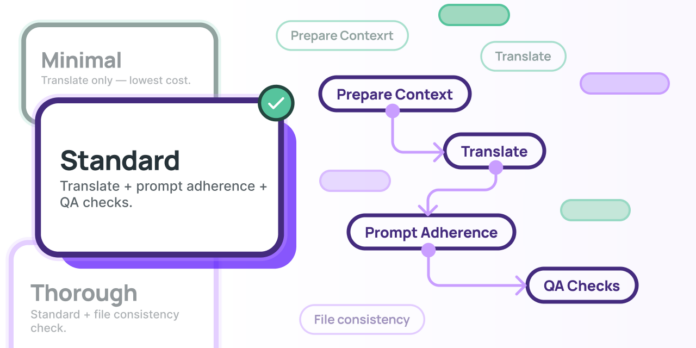
The most common cause of AI failure is contextual blindness, where an LLM translates a string without understanding its environment. Even in a cost-optimized, minimal workflow, direct translation is a risk. The approach begins with a Context Preparation phase that analyzes project metadata before the first word is translated. This prevents the AI from making fundamental errors that occur when AI is forced to guess.

For example, even when using a Minimal AI Pipeline preset, AI can identify whether the word open refers to a file menu or an electrical circuit, grounding the translation in reality before it even begins.
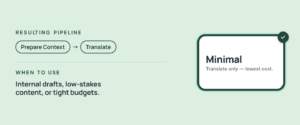
AI Pipeline Step 1 - Minimal visual


2. Standard preset

For customer-facing UI, accuracy is only the baseline. The real challenge is prompt adherence. The Standard preset moves beyond simple translation generation by introducing a Self-Correction Layer. Most AI errors happen because the model ‘forgets’ the rules mid-sentence. By adding a dedicated step, the system compares the output against the specific glossary and technical constraints provided. If the AI detects a mismatch (such as a broken HTML tag or a tone that is too formal), it triggers an immediate self-correction, ensuring the final string is both linguistically natural and technically functional.
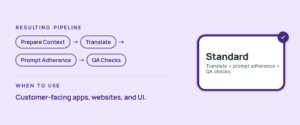
Crowdin - AI Pieline Standard Preset visual

3. Thorough preset

In technical documentation or long articles, consistency within a single file is critical. The thorough preset adds a File Consistency check. This step analyzes the document currently being translated to ensure new updates match the terminology and style of the existing content.

  • Previously: AI translated the new strings in isolation. This often led to shifts in terminology or tone within the same document, making it obvious which parts were updated later.
  • Now: The File Consistency step analyzes the entire file you are currently translating. It uses the existing sentences as a reference to ensure the new 10% matches the terminology and style of the other 90%.

When to use it? This is a specialized tool for long-form content like documentation, help articles, or legal specs. For simple resource files (like a list of random app buttons), you can skip it, but for narrative or technical flow, it’s a must.
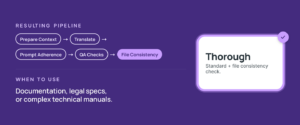
Crowdin - AI Pipeline Thorough Preset visual

Solving the ambiguity in AI translations

The biggest risk in AI translation is when the system is forced to guess. When an LLM encounters a word with multiple meanings (and no clear context), it doesn’t stop to ask for help. AI is forced to make a statistical guess. In many UI/UX scenarios, a 50/50 guess can break the user experience.

Consider the word User. In English, it is neutral. In languages like French or Spanish, you must choose: is the user male or female?

  • Previously: The AI usually defaults to the masculine form. If your application context requires a female or neutral address, your entire UI suddenly feels “off” or grammatically incorrect.
  • Now: Ambiguity Filter identifies these gender-sensitive or multi-meaning words. Instead of guessing, the system recognizes it lacks context and flags the string for review.

The Filter out step can be added to any pipeline, from the simplest to the most complex. This ensures that even your fastest workflows have an option to prevent hallucinations when context is missing.

How to solve those flagged strings at scale

You might worry that filtering hundreds of strings will create a mountain of manual work. However, try using the AI Pipeline alongside the Crowdin Copilot for such tasks. It can save your time with:

  • Smart Grouping: Copilot doesn’t make you solve 100 individual issues. It groups similar ambiguities together. If the word User appears in 50 places with the same missing context, you resolve it once, and Copilot applies the fix to all 50.
  • Rapid Context: You give the AI a tiny hint, and it handles the complex grammatical issues across all related strings.

Choose your trade-off: quality, time, or costs

Let’s be honest: there is no such thing as a perfect and instant translation. Adding specialized layers like Context Preparation, Prompt Adherence, and Ambiguity Filtering makes the translation process slower. Because the AI is actually “thinking” (auditing its work and scanning your history), it consumes more tokens and takes more time to complete. However, in today’s localization, the real cost isn’t in the tokens; it’s in the cleanup. Users have a choice:

  • Fast results that work well for low-stakes content. However, these often require more human proofreader time afterward to manually fix glossary mismatches, broken tags, or gender context errors.

    or

  • A slightly slower, more expensive AI pipeline that translates perfectly the first time. By spending a few more minutes in the AI phase, you can reduce the manual cleanup needed later.

It is a simple equation of where your team wants to spend more time. Organizations can either have a fast AI and a slow human review, or a thorough AI that delivers results ready for immediate use.

Customized AI Pipeline

While these presets (Minimal, Standard, and Thorough) cover the vast majority of localization needs, we know that enterprise workflows aren’t always standard. Custom pipelines remain available for teams that need to build their own logic from scratch. Whether you have a unique multi-step approval process or a highly specific AI prompt, you aren’t forced into a preset. You can take the best parts of this tiered approach and modify them to fit your exact internal requirements.

Customization goes beyond just the order of steps. For those who want to optimize their budget or performance, the AI Pipeline app lets you select a specific AI model for each step of the process.

Real control over the AI trade-off

The goal of these tiered pipelines isn’t to replace human judgment, but to provide the controls localization managers have traditionally lacked. AI localization is no longer a “take what you get” situation. It is now a strategic choice based on your project’s needs.

With Crowdin AI Pipeline, teams now have the flexibility to decide exactly how to spend their time and budget:

  • Minimal: For when speed is your only priority, and the risks are low.
  • Standard: For when your code and brand terms are non-negotiable.
  • Thorough: For when document-wide consistency is the only way to maintain your professional voice.

By providing these presets, Crowdin is moving away from the black box of AI. Users no longer have to settle for a single, unpredictable result. Instead, teams can align Al pipelines with their goals.

Welo Data Launches Proprietary Platform for Frontier AI Data Production

0
Welo Data

Welo Data, a Welo Global brand, has announced the launch of Inkky, its proprietary data production platform built for the operational demands of frontier AI development.

Frontier AI programs, including large language models, multimodal systems, agentic workflows, and emerging AI applications, require data work that is fundamentally different from traditional annotation. Tasks involve complex evaluation, multi-stage judgment, and instruction sets that evolve continuously as model requirements change.

Inkky is Welo Data’s answer to that requirement. It consolidates the full data production lifecycle into a single configurable system: project setup, contributor assignment, quality controls, multi-stage review, and delivery. Built for dynamic AI pipelines, Inkky gives operations teams real-time control over workflow performance, quality enforcement, and production prioritization.

“AI programs depend on more than scale alone. Inkky gives teams greater visibility into data quality, workflow performance, and operational consistency across the model lifecycle,” said Siobhan Hanna, GM of Welo Data.

The platform is designed around the realities of how frontier AI development actually works. Programs do not run in a straight line. Guidelines change mid-cycle, edge cases surface that nobody anticipated, and evaluation frameworks evolve as the model does. Inkky gives the teams running those programs the visibility and control to adapt in real time, rather than waiting on engineering queues or manual reconciliation across disconnected tools.

Key capabilities include:

  • Configurable multi-stage pipelines managed directly by operation teams, with enforced quality transitions and no engineering dependency for setup or modification.
  • Benchmark gates and linters that run natively on every project, verifying contributor readiness and enforcing output standards before anything reaches export.
  • Real-time production visibility across every active program, including batch status, task queue depth, contributor performance, and export readiness.
  • Multi-modal data production supporting text, image, audio, and video workflows within a single unified system.
  • Full IP ownership and no third-party platform dependencies, ensuring client training data remains within infrastructure that Welo Data controls.

Inkky is integrated with Welo Works, Welo Data’s managed contributor community, which provides the verified, specialized human judgment these programs require. The platform and the workforce are designed to operate as a single system, not as separate services layered on top of each other. It combines platform technology with operational expertise, supporting AI initiatives where quality outcomes depend on both scalable systems and human oversight.

The launch reflects Welo Data’s broader approach to AI development, centered on building the systems, controls, and workflows required to generate high-quality data for advanced model training and evaluation.

About Welo Data

Welo Data, a Welo Global brand, is the data production and evaluation partner for foundation model builders and enterprises deploying AI at scale. Through a global network of 500,000+ vetted experts across 300+ languages and locales, Welo Data delivers the human judgment, structured evaluation, and data infrastructure that AI programs require to perform reliably across languages, cultures, and real-world contexts. Programs span large language models, voice and speech systems, agentic workflows, and robotics. Welo Data’s proprietary identity and fraud-prevention framework, NIMO, maintains data integrity and workforce accountability across every engagement.

Awin Global Accelerates Multilingual Content Translation With Acclaro and Lokalise Integration

0
Awin Global

Acclaro and Lokalise have announced they are accelerating global expansion for Awin Global, one of the world’s largest affiliate marketing networks. Awin is now able to adapt content for multilingual audiences 57% faster — speeding time-to-localization from four weeks to under 12 days.

The all-in-one platform for smarter partner marketing, Awin has a robust on-the-ground presence in 17 countries across 4 continents. Its powerful technology combined with its award-winning expert support, enables advertisers to scale confidently online and access new levels of growth. A diverse global network of 1 million partners, from influencers to emerging tech companies, helps brands discover, engage, and reward the right partners to achieve their marketing goals.

Awin’s internal localization ecosystem involved six disparate teams generating content in eight languages — resulting in 1.5 million source words and approximately 12 million localized words annually. This fragmentation introduced variances, and slowed product and marketing releases, while also obscuring visibility into the localization progress itself.

Today with Acclaro, a leading provider of technology-driven language services, and Lokalise, a leading AI language platform, Awin’s localization effort consists of one centralized process that combines the power of workflow automation and AI orchestration with the added human-in-the-loop domain expertise of trained linguists.

The integrated solution has introduced a unified workflow across product, UX, marketing, and engineering teams — replacing siloed approaches with one central workflow hub and a shared, scalable pipeline, for improved process visibility and governance. AI-powered localization is coupled with expert post-editing, retaining consistency in brand voice while boosting cycle times. Shared linguistic assets ensure consistent messaging across languages and reduced redundant work. Smart automation and system integration align localization tasks with existing development processes, cutting internal review demands by up to 80%.

“Acclaro adapted to our niche requirements from the start — a must for a business with unique terminology and cross-functional dependencies,” said Rosario Messina, Senior Product Operations Manager at Awin Global. “By consolidating tools and workflows into a standardized, technology-enabled process, we have been able to reduce localization turnaround times by more than half while clearing our existing localization backlog. We are now enabling faster market releases without any budget increase and have been able to reallocate the efforts of three to five full-time employees to more value-added tasks.”

“Disparate localization processes become bottlenecks at scale,” said Devin Lynch, Chief Growth Officer for Acclaro. “By unifying workflows, leveraging automation, and embedding a central language platform, we helped Awin unlock faster releases with greater consistency — without increasing spend. The benefits go well beyond operational efficiency; Awin now has scalable localization infrastructure to accelerate expansion, product iteration, and competitive differentiation with high-quality multilingual content that resonates locally and performs globally.”

About Acclaro

Acclaro is a technology-driven localization provider specializing in helping high-growth technology, media, and e-commerce companies expand into global markets. With a focus on AI-enhanced translation services, scalable automation, and expert language solutions, Acclaro partners with innovative brands to deliver multilingual experiences that drive international success.

About Lokalise

Lokalise is an AI‑driven localization platform that unifies product, marketing, and engineering workflows. It automates translation, maintains linguistic consistency, integrates with existing tech stacks, and enables continuous, scalable multilingual content delivery so global brands can launch faster, stay consistent, and resonate across markets.

GLOBO Named to Modern Healthcare’s 2026 Best Places to Work in Healthcare List for Second Consecutive Year

0
GLOBO named to Modern Healthcare's 2026 Best Places to Work in Healthcare

GLOBO Language Solutions, a leading B2B provider of interpreting, translation and language access technology services, has been selected by Modern Healthcare as one of the 2026 Best Places to Work in Healthcare. This honor marks GLOBO’s second consecutive year on the prestigious list, recognizing the company’s continued commitment to building a workplace culture that values diversity, equity, and inclusion.

The complete alphabetical list of 2026 winners is available at ModernHealthcare.com/bestplaceslist. Modern Healthcare will publish a special supplement featuring the ranked list of all winners in its October magazine issue.

“GLOBO’s repeat recognition of Modern Healthcare’s Best Places to Work is a meaningful reflection of the people behind our mission,” said Dipak Patel, CEO of GLOBO Language Solutions. “Our team is united by a shared purpose: building a world without language barriers and helping organizations communicate with every person they serve with accuracy, compassion, and cultural sensitivity and understanding.”

“Language access is not an add-on. It is critical to achieving trust, safety, equity, and the overall patient experience,” Patel continued. “As GLOBO continues to grow, we remain focused on pairing expert human linguists with thoughtfully tested AI technology to deliver language access solutions that are scalable, reliable, and cost effective. This recognition belongs to our entire team, whose dedication makes GLOBO a trusted partner to providers committed to improving patient communication and care for limited English proficient, Deaf, and hard-of-hearing communities.”

“Healthcare is changing rapidly as new technologies are adopted on both the clinical and administrative sides,” said Mary Ellen Podmolik, editor-in-chief of Modern Healthcare. “Still, the most forward-looking companies understand that employees are the heart of their organizations. Creating the right culture, with the appropriate mix of financial rewards, training and career advancement opportunities — as embodied by our honorees of the Best Places to Work in Healthcare — will be imperative for long-term employee and employer success.”

The Best Places to Work in Healthcare program identifies and recognizes outstanding employers in the healthcare industry nationwide. Modern Healthcare partners with Workforce Research Group on the assessment process, which includes an extensive employee survey.

GLOBO will learn its ranking on the Best Places list and be celebrated at the 2026 Best Places to Work in Healthcare Awards Gala on Sept. 16 in Houston, Texas. Information about the gala is available at ModernHealthcare.com/BestPlacesGala.

About Modern Healthcare

Modern Healthcare is one of the most trusted business news and information brands in the healthcare industry. Modern Healthcare empowers healthcare leaders and influencers to make timely and informed business decisions. Its mission it to provide real‑time coverage of U.S. healthcare news, including hospital leadership changes, health‑tech adoption, regulatory shifts, insurance market trends, mergers and acquisitions, layoffs, and industry awards.

About GLOBO

GLOBO Language Solutions (GLOBO”), headquartered in Philadelphia, Pa., is a leading healthcare language access company that helps healthcare providers communicate more effectively and equitably with patients by delivering on-demand interpreting and translation services through its technology platforms GLOBO HQ and GLOBO Connect, featuring AI-powered language access innovations GLOBO KAI and GLOBO Live Quality. The company manages an independent global network of 10,000+ linguists who speak over 430 languages and dialects. GLOBO supports diverse industries with 24/7 audio, video, on-site, and sign language interpreting and translation — all informed by actionable insights. 

The Translation People Makes Fifth Acquisition in Three Years With Purchase of German LSI Kocarek

0
The Translation People successfully acquire German LSI Kocarek

Manchester-based language solutions integrator The Translation People has added another European business to its growing portfolio, completing the acquisition of Kocarek GmbH at the end of April 2026. The deal builds on last year’s purchase of Transladiem, marking the company’s fifth acquisition in three years and its first in Germany.

Kocarek will continue to trade under its own name and retain its full translation team. The acquisition broadens The Translation People’s reach into the engineering, manufacturing and consumer goods sectors, where Kocarek has built a strong domestic and international client base. Kocarek‘s expertise in developing multilingual chatbots was also a draw.

The deal is backed by Mobeus, the UK-based private equity firm that has supported The Translation People’s buy-and-build strategy since the company received investment in 2022. Further acquisitions are planned across both the UK and Europe as The Translation People seeks to deepen its international client relationships and expand its access to best-in-class localisation capabilities.

Jasmin Schneider, Managing Director of The Translation People, said: “Kocarek has had a fantastic year, and it’s easy to see why. They have built a loyal client base, a talented team and real technical depth in areas such as multilingual chatbot development. This acquisition deepens our footprint in Germany and brings complementary expertise into the group. We’re genuinely excited to have the Kocarek team on board and committed to giving them the platform and resources to go further than they could independently. Their clients will quickly start to see the benefits that come with being part of a larger, well-resourced organisation.”

Werner Lierz, Managing Director at Kocarek, said: “The Translation People stood out to us not just because of their scale and technology, but because of the way they operate. From the outset, it was clear we share the same values around quality and putting clients first. Joining the group opens up new capabilities and infrastructure for our clients whilst creating genuine career development opportunities for our people. Our clients can count on the same high standard of service, and a great deal more besides.”

About The Translation People

The Translation People is a B2B provider of business-critical localisation services, combining award-winning customer service with best-of-breed technology and deep human expertise. Backed by Mobeus, the business is pursuing a strategy of organic growth and targeted acquisitions to extend its international reach and service capabilities. The Translation People is ranked in the CSA and Slator top 100 LSIs and is a member of the ATC and EUCAD. The company is headquartered in Manchester, with offices across the UK, Germany, France and Spain.

The Week in Review: Language Industry News May 5-11

0
Week in Review May 5-11

This week’s diverse stories point to a decisive shift where multilingual access is no longer optional, nor an add‑on. It’s becoming embedded core infrastructure for brand protection, financial inclusion, public education, telehealth equity, and cultural preservation. From major acquisitions to community‑driven digital resources, the industry is building systems that increasingly treat language as a strategic asset.

Expansion

RWS has acquired Obviously Group Limited, integrating its AI‑driven IP and brand‑protection platform with RWS’s patent and localization capabilities. The acquisition creates a single system for enterprises to manage, localize, monitor, and enforce brand and IP assets worldwide and enhances RWS’ end‑to‑end “Global Brand Guardianship,” — a first‑of‑its‑kind consolidation of the full brand lifecycle. Obviously’s technology and client base will join RWS’s Protect segment, expanding the company’s reach across different industries while accelerating its shift toward a technology-first enterprise AI strategy. 

Metro Credit Union has become the first credit union in Massachusetts to deploy Traduality’s Fire Lingo Multicultural Member Experience Platform across all branches, enabling real‑time, one‑on‑one communication with members in their preferred languages. The partnership equips teams with Fire Lingo Face‑to‑Face tablets and Fire Lingo Cloud, supporting both in‑person interpretation and multilingual content creation. Positioned as a financial‑inclusion initiative, the collaboration highlights Metro’s Juntos Avanzamos designation and advances its strategy to provide equitable, culturally relevant service to non‑English‑preferring members across Massachusetts and southern New Hampshire. 

GLOBO Language Solutions has integrated its on‑demand interpreting services into Enghouse VidyoHealth’s virtual care platform. A partnership enabling clinicians to invite interpreters into telehealth sessions without leaving existing workflows, it supports equitable care for LEP and Deaf or hard‑of‑hearing patients compliant with the newly enacted SPEAK Act, which calls for stronger language‑access standards in telemedicine and EHR systems. By simplifying interpreter connectivity for both providers and linguists, the integration aims to reduce workflow friction and improve communication quality across increasingly digital healthcare environments. 

Community

The New Jersey Department of Education has recognized five school districts for outstanding second‑language programs, selected through a rigorous review process that included statewide educator evaluations and on‑site visits. The honored districts — spanning both dual language immersion and world language models — will serve as demonstration sites where educators can observe effective multilingual instruction and exchange best practices. State leaders have positioned these programs as models for how language education can support both academic achievement and community cohesion.

Creole Solutions has launched HaitianHeritage.com, a free bilingual digital platform offering a five‑week cultural and linguistic experience featuring Haitian language and culture. Built with AI as a co‑builder but fully reviewed by native experts, the site emphasizes cultural accuracy and authentic pronunciation. The project extends Creole Solutions’ longstanding work in Haitian Creole localization and cultural consulting, providing a permanent, community‑centered resource designed to support visibility, education, and linguistic pride during Haitian Heritage Month and beyond.

_____________________________________________________________________________________________________________________________________________

Together, this week’s stories show a language industry investing in durable, systemic multilingual access — not just as tools, but critical infrastructure. Whether safeguarding global brands, expanding financial inclusion, strengthening public education, improving telehealth equity, or preserving cultural identity, the week underscores a shared direction: language is becoming a foundational layer of how institutions operate, serve, and connect.

For more stories like these, visit our News section.

Women in Localization and TAUS Partner to Shape the Future of AI in Localization

0
Women in Localization

Women in Localization (W.L.), a leading professional organization for women in the localization industry, has announced a strategic alliance with TAUS, a global leader in translation quality and language technology. At a pivotal moment for AI in language services, this partnership connects global community leadership with deep AI expertise to ensure innovation is not only practical, but inclusive and shaped by the professionals it impacts.

The collaboration unites W.L.’s community of more than 33,000 localization professionals and TAUS’s two decades of expertise in language data, quality estimation, and translation technology. The two organizations will focus on building structured opportunities for dialogue, knowledge exchange, and hands-on engagement with AI, while actively shaping the industry’s perspective on how AI should be applied in localization.

Through WeShape AI, W.L.’s global AI initiative launched in 2025, the two organizations will deliver structured training, shared insights, and initiatives designed to empower industry professionals to actively translate emerging AI technologies into real-world understanding and application.

WeShape AI by Women in Localization is a global initiative created to empower women in localization to lead at the intersection of AI and globalization. Through its focus areas — Learning, Ideas, Labs, and Awards — WeShape AI helps members build AI literacy, exchange ideas, move from inspiration to implementation, and gain visibility for women-led innovation. The initiative supports Women in Localization’s broader mission to advance women and the localization industry by giving members the platform, resources, and visibility to help shape the future of AI.

“Our members understand how language actually works across markets, cultures, and industries. That expertise has real value in how AI tools are being built right now, and this partnership turns that knowledge into action, helping ensure greater representation and inclusivity in how AI is being developed. WeShape AI empowers our members to navigate this change, while TAUS brings the technical depth necessary to scale the impact,” said Jill Goldsberry, Women in Localization’s board member overseeing Global Partnerships & Events.

“Building AI that truly understands culture and context is both an art and a science — one that TAUS has pioneered for two decades. Our team of NLP experts are actively working on an actual ‘cultural intelligence layer’ that allows AI to speak a company’s unique language. By partnering with Women in Localization, we are connecting our work and research with the very professionals who will lead this new era of AI orchestration. It’s a collaboration that ensures the industry doesn’t just survive the shift to Intelligence-as-a-Utility, but masters it,” said Anne-Maj van der Meer, Head of Growth, TAUS.

The partnership will debut at the TAUS Massively Multilingual AI Conference in Rome, June 3-6, 2026, where Women in Localization will host an all-women panel on Enterprise Globalization. In celebration of this partnership, W.L. members will receive a 20% discount on conference registration. Following the Rome event, the organizations plan to extend their collaboration to the next TAUS Conference, scheduled for 14-16 October 2026 in Vancouver, Canada. 

About Women in Localization

Women in Localization (W.L.) is a leading non-profit organization for women in the localization industry with a community of over 37,5000 professionals globally. Recognized as the premier platform for mentoring, upskilling, and reskilling programs, its vision is to be the leading voice in technology and innovation in localization. Its mission is to foster a global, diverse and inclusive community for the advancement of women and the localization industry through initiatives such as WeShape AI.

About TAUS

Founded in 2004, TAUS began as a global think tank dedicated to accelerating innovation in the translation industry. Today, TAUS has evolved into an AI-driven SaaS provider that combines twenty years of industry authority with a purposefully curated repository of high-quality language data. Through its flagship API, EPIC, TAUS delivers advanced Quality Estimation and Automatic Post-Editing solutions. Developed by expert NLP engineers, EPIC enables enterprises and LSPs to streamline workflows, reduce costs, and ensure communication is both accurate and culturally resonant.

Wordly AI Translation Saves Taxpayers $30M as Government and Education Adoption Surges 5x

0
Wordly

Wordly, a pioneer in real-time AI translation and captioning, has announced that public sector organizations using its platform have saved taxpayers more than $30 million in interpretation costs, as adoption across state, local government, and education has increased 5x over the past 24 months.

The savings come as public agencies face continued pressure from rising operational costs across nearly every category – including staffing, services, and compliance-driven requirements – forcing governments to find more efficient ways to deliver multilingual communication without reducing access to public services.

“Public sector agencies are under pressure to expand language access while being responsible stewards of taxpayer dollars,” said Lakshman Rathnam, Founder & CEO of Wordly. “That’s driving a clear shift in procurement priorities toward solutions that reduce costs, expand access, and deliver measurable outcomes. Our 5x growth in the public sector reflects that shift.”

Procurement shifts toward measurable ROI

A key driver of adoption is the ability to quantify cost savings before deployment. Using Wordly’s ROI Calculator, agencies can model translation costs based on actual usage, comparing traditional interpretation line items directly against AI-driven alternatives. This enables procurement teams to justify investments, ensuring that language access programs are both compliant and fiscally responsible in a broader high-cost environment.

Public sector adoption accelerates

Adoption has been particularly strong among state and local governments and educational institutions, where rising costs and accessibility requirements intersect most directly. Across these sectors, Wordly supports use cases ranging from public meetings and hearings to classrooms, staff training, and community engagement.

To learn more about the Wordly ROI Calculator or to see your city’s potential savings, go to: https://wordly.ai/roi-calculator

About Wordly

Wordly is a pioneer and leader in AI translation, providing real-time translation, live captions, transcripts, and AI-generated summaries for meetings and events. A 2025 Inc. 5000 company, Wordly is trusted by thousands of organizations across corporate, nonprofit, government, education, and association sectors. It helps make global communication more inclusive, accessible, and actionable.