Piedmont Global Launches New Brand Identity as the World’s Leading Strategic Globalization Organization

0
Piedmont Global

Rebrand reflects expanded capabilities, vertical integration, and a renewed commitment to making cross-cultural operations easier, smarter, and more human.

Formerly known as PGLS, Piedmont Global today announced a new brand identity and positioning as the world’s first Strategic Globalization Organization (SGO), marking its evolution from a leading language solutions provider into an embedded partner that integrates strategy, culture, and technology across the enterprise.

Inspired by its namesake — “Piedmont,” the foothill that signals the climb — the new identity reflects the company’s role in preparing organizations for pivotal moments and helping leaders scale with confidence. The rebrand also honors the language industry’s enduring relevance in a rapidly changing world, while extending its impact into broader global operations.

Piedmont Global’s SGO model combines cultural fluency, strategic insight, custom solutions, and embedded partnership to help clients seamlessly navigate cross-cultural operations across populations, systems, and markets. Whether expanding globally or serving diverse communities at home, the approach equips leaders to operate with clarity, agility, and confidence.

This is more than a new logo or look. It’s a new model for operating across borders and communities,” said Mohamed Hussein, Founder and CEO of Piedmont Global. “For too long, our industry has been seen as the last mile. Piedmont Global flips that script. We embed earlier in the value chain, aligning the people, capabilities, and strategies to unlock growth and impact. This isn’t about words or workflows anymore; it’s about transforming how organizations connect, decide, and deliver in a complex world.

With vertically integrated solutions that span advisory services, federal alignment, workforce and learning solutions, tech-enabled platforms, and market intelligence, alongside its long-standing leadership in language and cultural expertise, Piedmont Global provides end-to-end solutions that reduce risk, accelerate readiness, and strengthen connections across cultures and systems.

These capabilities represent a natural evolution of the work the company has delivered for years; the rebrand makes that expanded role official, giving enterprise and public sector organizations a trusted partner across the full spectrum of Strategic Globalization.   

Key elements of the rebrand include:

  • Transition from PGLS to Piedmont Global, reflecting expanded scope and capabilities.
  • A new visual identity expressing growth, connectivity, and limitless opportunity.
  • Service pillars uniting strategy, culture, and technology for integrated solutions.
  • Refined messaging anchored in the company’s core purpose: to make cross-cultural operations easier, smarter, and more human.
  • An updated website featuring new solutions, client success, and thought leadership on Strategic Globalization.

The new brand launches today with a phased rollout to clients and partners in the coming weeks.

About Piedmont Global

Piedmont Global is a Strategic Globalization partner for enterprises and public sector organizations, dedicated to making cross-cultural operations easier, smarter, and more human. The company offers advisory services, language and cultural expertise, workforce and learning solutions, and tech-enabled platforms—delivered as custom solutions—to help clients reduce risk, accelerate readiness, and expand their reach with confidence. Learn more at www.piedmontglobal.com
Hyperfusion and CAMB.AI Launch a Sovereign, Multilingual Voice AI & Agent Platform for the MENA Region

0
Hyperfusion and CAMB.AI

Real-time conversational speech infrastructure – voice agents, text-to-speech, speech-to-speech, and live translation – now hosted locally on UAE GPUs with 100+ languages, including Arabic

Hyperfusion, the GCC’s leading sovereign AI cloud, and CAMB.AI, a global company that enables seamless multilingual communication, today announced a landmark partnership to deliver sovereign, real-time voice AI and agent infrastructure across the Middle East and North Africa (MENA) region.
At the core is CAMB.AI’s MARS7 text-to-speech technology –will now be deployed in-region on Hyperfusion’s low-latency GPU cloud. Combined with CAMB.AI’s speech-to-speech, alignment, and live translation capabilities, the platform lets organizations build production-grade conversational voice agents, assistants, and real-time media experiences with sub-second responsiveness, all while keeping compute and data inside the UAE.

Why this matters now:

  • Sovereign by design: Workloads run on UAE-based GPUs, with private networking options, encryption, access controls, and auditability to meet regional regulatory expectations.
  • Agent-first: A purpose-built runtime for voice agents and copilots – barge-in, interruptions, stateful context, tool use/function calling, and multilingual turn-taking – so enterprises can ship real applications (not just demos).
  • Multilingual at its core: High-fidelity voices and translations across 100+ languages (including English, French, Hindi, Turkish, German, and more). Arabic gets first-class treatment through dialect packs (Gulf, Levantine, Egyptian, MSA) and continuous improvements driven by local talent and data partnerships.
  • Conversation and Broadcast-grade latency & scale: Designed to handle contact-center spikes, match kickoffs, breaking news, and national events with elastic GPU orchestration.
  • Globally validated, locally specialized: MARS7 has global distribution via major clouds; the Hyperfusion deployment brings that caliber of tech home to MENA with sovereignty, regional performance, and Arabic expertise.

What you can build today:

  • Voice Agents & Copilots: Customer care, telco copilots, banking, insurance, travel assistants, e-gov service agents–responsive, interruptible, and Arabic-capable by default.
  • Conversational enterprise workflows: Sales enablement, training, HR onboarding, field-ops checklists–multilingual and compliant.
  • Media creation & streaming pipelines: Live commentary, newsroom dubbing, pressers, live broadcasting, trailers, and VOD with studio-grade alignment and voice design.
  • Developer-led products: SaaS tools, vertical copilots, embedded voice experiences–LLM-agnostic and easy to extend.

Day-one product surface

  • Streaming APIs (WebSocket/gRPC/HTTP) for TTS, STT, speech-to-speech, and real-time translation.
  • Agent runtime: barge-in, turn management, function/tool use, memory hooks, and session recording.
  • Voice controls: SSML, lexicons, style/tempo/prosody, multilingual prompts, and safe cloning (with explicit consent workflows).
  • Enterprise deployment modes: single-tenant VPC, private interconnect, IP allowlists, KMS-backed key management, audit logs; optional on-prem edge or co-lo.
  • Observability: latency/quality metrics, usage dashboards, and per-locale analytics.

Executive Comments:

Quentin Reyes, CEO, Hyperfusion “Enterprises in the GCC don’t just want AI–they want trusted, sovereign AI that can power real products. With CAMB.AI, we’re giving builders in the region a voice and agent layer that is multilingual, low-latency, and compliant–so they can launch at scale, here.”
Akshat Prakash, Co-Founder & CTO, CAMB.AI “Our mission is to remove language as a barrier–live and at production scale. By combining our speech stack and MARS voices with Hyperfusion’s sovereign cloud, developers, startups, and large enterprises in MENA can build Arabic-capable voice agents and multilingual applications with the performance and trust they need.”
Availability:
  • Available now for pilots and production workloads on Hyperfusion’s UAE regions.
  • Solution packs for contact centers, telco self-service, BFSI assistants, travel/hospitality concierges, e-gov portals, healthcare triage, and media localization.
  • Co-selling across MENA + APAC; reference architectures and sandbox access for qualified builders.

About CAMB.AI

CAMB.AI is building a global content localization infrastructure driven by AI-powered multilingual translation. With the world’s most advanced speech and translation AI capabilities, CAMB.AI enables seamless multilingual communication via video, audio and text, and across 150+ languages – including one spoken by less than 650 indigenous people in Costa Rica – preserving cultures, retaining authenticity, and making stories accessible to new audiences. Its philosophy: “the Internet was made for English-speakers. It’s time to re-design it for the world.”
The company works with the world’s biggest brands, including the Australian Open, Comcast/NBCUniversal, Dentsu, Eurovision Sport, IMAX, MLS, and NASCAR.  Other milestones include the first AI-driven multilingual live sports commentary (in the world, in Europe, in motorsports, and in a press conference); the biggest real-world deployment of AI; and the first Arabic movie to be dubbed using AI. CAMB.AI has raised $18.5 million to date and is supported by investors including Comcast NBCUniversal Sports Tech, TRTL Ventures, Oraseya Capital, Courtside Ventures, Ikemori Ventures, 5Point Venture Partners, and Dubai Future District Fund. It has operations in the U.S., Canada, APAC, Europe, the Middle East, and India. For more information, visit www.CAMB.AI.

About Hyperfusion

Hyperfusion is the GCC’s sovereign AI neo-cloud, providing at-scale, low-latency GPU infrastructure and outcome-driven AI services for enterprises, media companies, and public sector organizations across the Middle East and Europe.

The Overlooked Orchestrator: Reinventing the Role of the Localization Project Manager

0
Man sitting at desk

In localization, the spotlight usually shines on translators — or more recently, artificial intelligence (AI). These are the people and tools directly shaping content in new languages and formats. But another role, often overlooked, makes the entire ecosystem work: the project manager (PM).

PMs are the conductors of the localization orchestra. They connect linguists, technologies, clients, and deadlines. Yet too often their role has been weighed down by administrative tasks and a lack of the one thing they need most: actionable, real-time data.

The hidden pressure

Ask a localization PM what their day looks like, and you’ll hear about spreadsheets, email chains, and constant status updates. Global demand has soared — content is expected in dozens of languages, in multimedia formats, under tight deadlines. Add cost pressures, and many PMs feel they are firefighting instead of steering.

Meanwhile, access to data has evolved unevenly. Translators use AI-assisted tools. Executives rely on dashboards with topline metrics. Project managers — the ones coordinating everything — are often left piecing together reports manually, lagging behind what’s really happening. Decisions get delayed, risks go unnoticed, and clients receive vague updates instead of data-backed clarity.  

Why data matters

Project management is fundamentally about decision-making. Every day, PMs decide how to allocate resources, shift timelines or escalate risks. Without immediate, contextual information, those choices become reactive rather than proactive. Instead of anticipating issues, PMs scramble to contain them.

The contrast is stark: In one scenario, a PM spends hours building a tracker for a client call, only to find the situation has already changed by the time the call begins. In the other, they have a live dashboard showing project health in real time — ready to share with stakeholders at a click. The first scenario breeds stress and doubt; the second builds confidence and trust.

From coordinator to advisor

When PMs gain real-time insights, their role changes. They stop being task coordinators and start becoming strategic advisors. With clear visibility, they can spot risks early, reallocate resources quickly, and give clients updates that are both specific and credible.

Just as importantly, they can surface trends across projects — advising leadership on capacity planning, technology adoption and global content priorities. In effect, they become translators of a different kind: turning operational detail into business intelligence that leaders can act on.

An evolving role

Consider this shift an evolution. Traditional translation platforms have long offered reports, but they often required time to configure and interpret. Now AI is accelerating access, making it possible to surface insights faster and more intuitively. Dashboards that refresh automatically and flag risks early are helping PMs spend less time chasing updates and more time guiding strategy.

Clarity as a competitive edge

Localization has never been more critical to business growth. Accuracy, speed, trust, and scalability are the big challenges — and they cannot be solved by translators or technology alone. They need orchestration. They need empowered PMs.

When PMs have access to the right data at the right time, the benefits ripple outward: smoother workflows for linguists, greater transparency for clients, clearer ROI for executives, and more sustainable practices for the industry.

The next wave of localization innovation is about translating information into insight — and putting that power in the hands of the conductors who keep it all moving.

Learn more about how PMs can make faster, smarter decisions with Trados Smart Insights.

Welocalize’s Patented AIQE Named Finalist in the 2025 A.I. Awards

0
Welocalize

Welocalize, a global leader in AI-enabled translation and multilingual content solutions, today announced that its patented AIQE (AI Quality Estimation) has been named a finalist in the Best Use of AI in Natural Language Processing (NLP) & Translation category at the 2025 A.I. Awards. Operated by The Cloud Awards, the international program recognizes groundbreaking applications of artificial intelligence across industries.

AIQE is Welocalize’s patented solution for segment-level translation quality estimation, which enables enterprises to determine when machine-generated content meets quality thresholds without requiring full human review. Integrated with the additional components of the OPAL Platform (MT and LLMs for automated post-editing), the system dramatically reduces review time while increasing speed.

In addition to AIQE’s finalist placement, Welocalize also earned shortlist recognition in two further categories:

  • Best Use of AI in Cyber Security – NIMO (Network Identity Management and Operations) by Welo Data, a risk-management platform for AI training data pipelines. NIMO verifies workforce identity, monitors production in real time, and prevents fraud, bots, and policy violations—ensuring data integrity at scale across 500,000+ experts in 250+ languages.
  • Best Use of AI in Legal Tech – Legal Studio, a platform that streamlines multilingual legal and IP filings by combining AI workflow automation with expert human review. It helps global legal teams reduce turnaround times and maintain compliance.

“AIQE being named a finalist is a powerful validation of our patented innovation and its impact on multilingual workflows,” said Paul Carr, CEO of Welocalize. “It shows how we’re redefining translation quality by combining automation with human expertise at scale. The recognition of NIMO in Cyber Security and Legal Studio in Legal Tech further underscores our commitment to combining AI, software, and human expertise to solve very specific use cases.”

The winners of the 2025 A.I. Awards will be announced on October 13, 2025. For the full list of finalists, visit https://www.cloud-awards.com/2025-ai-awards-finalists.

About Welocalize, Inc.

Welocalize is a leading language service provider. It bridges language and AI to power global success in complex and regulated environments. Welocalize’s expertise in translation, localization, and AI training data ensures precise, scalable, and compliant solutions for businesses worldwide. Whether high-quality multilingual content for regulated industries or structured datasets to train AI models, Welocalize helps clients communicate, innovate, and accelerate their businesses globally in over 300 languages.  Welocalize’s investment in AI innovation has produced patented, award-winning products that deliver multilingual content with unmatched efficiency, speed, scale, and accuracy. These solutions are delivered within a framework of data security, compliance, and safety, underpinned by 7 ISO certifications. Welocalize is headquartered in New York with offices all over the globe. welocalize.com

About Welo Data

Welo Data, a division of Welocalize, stands at the forefront of the AI training data industry, delivering exceptional data quality and security. Supported by a global network of over 500,000 AI training professionals and domain experts, along with cutting-edge technological infrastructure, Welo Data fulfills the growing demand for dependable training data across diverse AI applications. Its service offerings span a variety of critical areas, including data annotation and labeling, large language model (LLM) enhancement, data collection and generation, and relevance and intent assessment. Welo Data’s technical expertise ensures that datasets are not only accurate but also culturally aligned, tackling significant AI development challenges like minimizing model bias and improving inclusivity. Its NIMO (Network Identity Management and Operations) framework guarantees the highest level of accuracy and quality in AI training data by leveraging advanced workforce assurance methods. welodata.ai

Google Pixel Named Tech of the Week for Machine Interpreting Capabilities

0
Google Pixel Named Tech of the Week

Google Pixel has been recognized as Tech of the Week by an independent industry research company Nimdzi Insights. Google Pixel’s latest machine interpreting feature blends context awareness and fluid multilingual speech recognition.

Google Pixel’s Live Translate and Voice Translate features support a variety of languages, with the exact number depending on the specific function. For real-time call translation (Voice Translate), the Pixel 10 and later models support 11 languages. The Pixel’s solution distinguishes itself by leveraging multimodal AI that processes not only speech but also cultural nuances, tone, and intent. More importantly, the Pixel’s interpreting mode is integrated directly into the device, requiring no additional app or subscription. This makes it accessible to global users in travel, business, healthcare, and education.

Renato Beninatto, Co-founder of Nimdzi Insights and long-time language industry leader, teamed up with Claudio Fantinuoli, PhD, a leading innovator in language and speech technology, to put Google’s Live Translate feature on Pixel phones to the test. Renato spoke Italian, which was instantly translated into English for Claudio to hear, and Claudio responded in English, which was instantly translated into Italian. While they both understand English and Italian, this trial simulated a real-time conversation between two people who don’t share a common language.

Google Pixel’s approach takes machine interpreting to a new level, delivering experiences that feel almost seamless, and are instantly useful in everyday situations.” — Renato Beninatto.

With this “tech of the week” nomination, Nimdzi Insights continues their initiative of recognizing developments in the language technology field.

About Nimdzi Insights

Nimdzi Insights is an international market research and consulting company. Nimdzi advises on international trade & development, language services, language technology, and localization programs. Nimdzi guides companies through investment and M&A activities. Nimdzi consultants are committed to providing opportunities for continuous professional development and resources for business professionals worldwide.

New AI-Powered Translation Agent Makes Online Meetings Instantly Multilingual

0
Interprefy Agent

Interprefy, the multilingual solutions and meeting technology provider used by the likes of JP Morgan, SAP and GSK, has launched the first multilingual translation agent that joins online meetings like any other attendee, but delivers real-time audio translation in up to 25 languages.

Interprefy Agent can deliver live translation in over 80 languages, with automatic switching for up to 10 source languages and manual switching for up to 25 source languages.

Unlike other online meeting translation agents, Interprefy Agent instantly streams crystal-clear audio without the need for complex audio connections or virtual cables. Making it the first multilingual audio translation agent available to join online meetings outside of basic native applications.

By adding the Interprefy Agent to an online meeting via a dedicated email, all attendees can access high-quality, live AI speech translation and/or captions from the meeting in the language of their choice.  

This latest release is designed for friction-free audio capture, allowing users to easily add real-time translation to their online meetings. See how it works for yourself.

Commenting on this latest innovation, Oddmund Braaten, CEO at Interprefy, said, “This is a real first, and one that we are immensely proud of. By simply adding an email address to an online meeting, the Interprefy Agent acts as a smart, automated participant that captures the meeting’s audio and securely streams it to the Interprefy platform. 

From here, the audio is translated and delivered to the meeting attendees in the language of their choice, in real time.” 

Interprefy Agent is the first solution to combine live AI-powered speech translation with real-time captions across any major meeting platform. 

Unlike built-in tools that require premium licenses, limit language options, or lock users into one ecosystem, Interprefy Agent offers scalable, automated, and simple multilingual access for everyday meetings and events. 

Braaten continues, “In a business world dominated by online meetings, many of which include attendees that speak multiple languages as businesses tap into a global workforce, Interprefy Agent breaks down communication barriers and allows all attendees to participate in their preferred language”. 

Hearing information in your own language builds confidence to contribute to a meeting, while the combination of live, AI-powered text-based captioning ensures equal opportunities for employees who might be hard of hearing or neurodiverse. With the right combination of audio and visual aids, meeting engagement and understanding is increased dramatically.” 

Worried about security or sensitive information being discussed on a call? Don’t be. Interprefy Agent does not record or store any information discussed during a meeting. 

With Interprefy Agent, providing real-time AI speech translation and captions becomes effortless. Interprefy’s technology and expertise help businesses to deliver inclusive, accessible meetings – whether they are complex global events or day-to-day video calls.

More information on Interprefy Agent is available on the Interprefy knowledge base.

“GenAI in Localization” Announces Call for Papers for December 2025 Online Conference

0
GenAI in Localization

Industry leaders invited to share expertise on AI adoption, multilingual workflows, and the future of language technologies

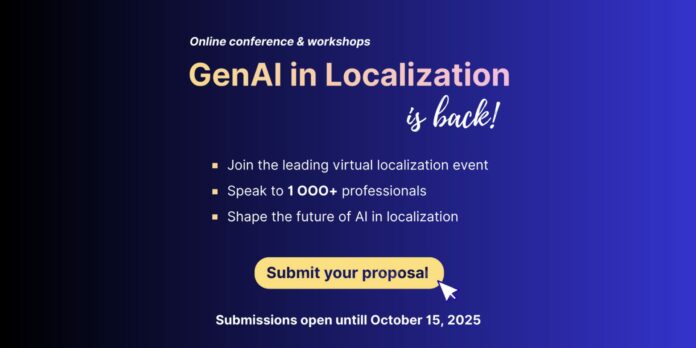
Following its highly successful May 2025 edition, which drew more than 900 participants and over 50,000 on-demand views, GenAI in Localization today announced its Call for Papers for the upcoming December 2025 conference and workshop series.

GenAI in Localization is a global online event series designed for language and localization professionals, managers, and machine learning scientists eager to understand AI adoption, build technical skills, and lead transformation within their organizations. Known for its hands-on, engineering-focused approach, the series has become a go-to destination for pragmatic, independent, and critical perspectives on AI in the language industry.

Conference Focus

The December edition of GenAI in Localization, will dive into the next phase of AI integration in localization and multilingual product development. Proposed talks may cover, but are not limited to, the following tracks:

  • Implementing AI — operationalization strategies, change management, workflow reliability.
  • Multilingual Models — datasets, metrics, synthetic data, fine-tuning, evaluation.
  • TMS of Tomorrow — adapting translation software for AI, post-editing, quality estimation, terminology management.
  • Next-Gen Language Teams — narratives, organizational transformation, leadership in localization.
  • Multilingual Product Design — designing products with multilingual features and market adaptability.

Session Formats

Speakers can contribute through:

  • Keynotes (30 min) — visionary talks that set the stage.
  • Panels (60 min) — expert discussions with Q&A.
  • Interactive Workshops (90 min) — hands-on technical training.
  • Case Studies (30–45 min) — practical lessons from implementation.

Why Contribute?

  • Share your expertise with an audience of 1,000+ industry professionals.
  • Gain visibility as a thought leader in the rapidly evolving AI-localization space.
  • Connect with pioneering practitioners and technology innovators.

How to Participate

Researchers, practitioners, and industry leaders are invited to submit their proposals now for consideration.

👉 Submit your proposal here: https://forms.gle/ep4hyHuuc5jNjZdr9

About GenAI in Localization

Since 2023, GenAI in Localization (previously named ChatGPT in Localization) has been tracking AI adoption trends and providing high-value, accessible learning to the global localization community. Its sessions cover the entire AI-driven content pipeline — from pre- and post-editing, content generation, and translation to quality estimation and fine-tuning. 

With open Day 1 broadcasts on LinkedIn and YouTube and interactive closed workshops on Days 2 and 3, the event delivers cutting-edge knowledge and practical training to a worldwide audience.

Conference Board

This edition’s program is shaped by a diverse board of industry leaders, including:

  • Konstantin Dranch (Custom MT)
  • Jourik Ciesielski (ELAN Languages)
  • Gema Ramirez-Sanchez (Promptsit Language Engineering)
  • Olga Beregovaya (Smartling)
  • Alessandra Binazzi (Global Sights)
  • Dave Ruane (Lion People)

The Week in Review: Language Industry News September 22–28

0
Language Industry

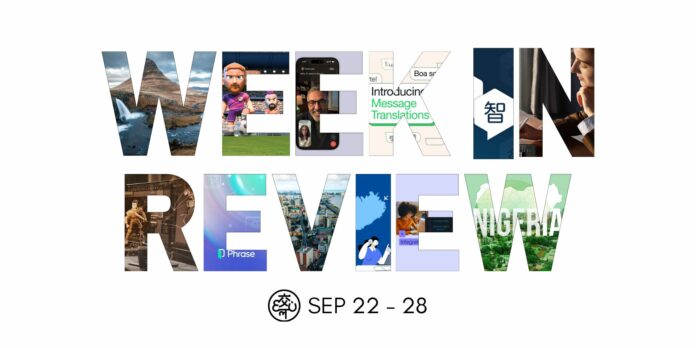
Every week, the language industry delivers stories that connect technology, culture, and access. Between September 22–28, updates ranged from open-source AI launches in Africa to real-time translation tools from the world’s biggest tech companies. Here’s what stood out.

AI Tools and Marketplaces

Lionbridge Games introduced Lionbridge Samurai™, a new AI-powered solution for game localization that blends cultural nuance, customization, and human oversight.

DeepL unveiled DeepL Marketplace, a platform offering ready-made apps and integrations for its translation and writing APIs, designed to simplify adoption for enterprise clients.

Phrase rolled out an AI Translation Agent that delivers instant, high-quality translation by combining translation and optimization in a single step, advanced AI in Phrase Studio with real-time collaboration, and smarter workflows for faster results.

Real-Time Translation for Global Audiences

Meta began rolling out real-time translation on WhatsApp. The feature supports six languages on Android and nineteen on iOS, with translations processed on-device to protect user privacy.

Apple also introduced updates to its live translation features, enabling users to hold cross-language conversations more seamlessly—a step forward for travelers and global communication.

Meanwhile, CAMB.AI partnered with World League Live! to bring AI-powered sports translation in more than 150 languages, aiming to strengthen athlete-fan connections worldwide.

And in Iceland, Youpret launched instant interpreting services, allowing clients to connect with professional interpreters on-site or remotely within seconds.

Open-Source and Global Voices

Nigeria unveiled N-ATLAS V1, a multilingual open-source large language model, during the UN General Assembly. Designed with inclusivity in mind, the model aims to reflect Africa’s unique linguistic contexts while contributing to global AI development.


This week showed how the race toward real-time, AI-powered translation is intensifying—whether through messaging platforms, gaming, or global open-source projects. As companies and countries push innovation, multilingual access is becoming both more immediate and more inclusive.

For more stories like these, visit our News section.

Inside NTIF 2025: Shaping the Nordic Language Industry

0
Inside NTIF 2025

Imagine tuning into a conversation that feels part travelogue, part strategy session. That’s the energy in the September 23, 2025 episode of Localization Today, where host Eddie Arrieta talks with Anne Marie Colliander—co-founder and organizer of the Nordic Translation and Interpretation Forum (NTIF). Since 2011, NTIF has given the Nordic and Baltic language industry a place to share knowledge, deepen relationships, and tackle the region’s distinct challenges. This year, it returns to Helsinki, Finland (November 23–25) with a theme that couldn’t be timelier: SISU—the Finnish spirit of determination, resilience, and courage.

👉 Don’t just read about it—listen to Inside NTIF 2025: Shaping the Nordic Language Industry right here.


A regional forum with global relevance

NTIF is proudly regional—and that’s the point. As Anne Marie explains, the Nordics and Baltics share plenty with the rest of the world, but they also face unique realities: five official languages in a compact geography, minority languages that shape policy and product decisions, and limited language corpora that complicate AI training (a challenge echoing other regions like Africa). The event draws a 60/40 mix of local and international attendees, creating space for deals that often start with a handshake—and, yes, sometimes in a sauna, where candid conversations and cross-border partnerships tend to heat up.

Post-pandemic, the verdict is clear: online is efficient, but in-person builds trust. NTIF leans into that with intimate scale (~150 attendees), deliberate networking, and a program tailored to the region rather than a one-size-fits-all global agenda.

SISU as strategy

With markets shifting and AI redefining roles, SISU frames the 2025 program: a call to push through uncertainty with focus and grit. The lineup reflects that tone. Julia Salorenko opens with a keynote on navigating change—bridging startup energy, AI fluency, and Nordic perspective. Johan Lawrence, an enterprise-turned-vendor leader, shares where vendor–client communications go wrong (and how to fix them). Day two brings Joel Williams—author, podcaster, and the mind behind Very Finnish Problems—for a witty, culture-savvy take on doing business the Finnish way, from sauna etiquette to everyday SISU.

Beyond headliners, NTIF’s sessions probe AI readiness for low-resource languages, speaker and agenda diversity, and a critical reminder for global brands: English isn’t enough in the Nordics. High English proficiency can mask the need for true localization—and, in immigrant-friendly countries like Sweden, that can mean additional languages (think Arabic) to reach real communities.

Want more stories like this? Discover other episodes of Localization Today on Spotify, Apple Podcasts, or directly at Localization Today online.